Laminitis after a cold snap? Learn about vasoconstriction, insulin regulation, and why pre-existing damage often triggers "winter laminitis".
Snow, Ice, and Mud: How to Keep Your Horse Safe Through the Winter
© Adobe Stock / Kseniya Abramova
This article was translated using AI.
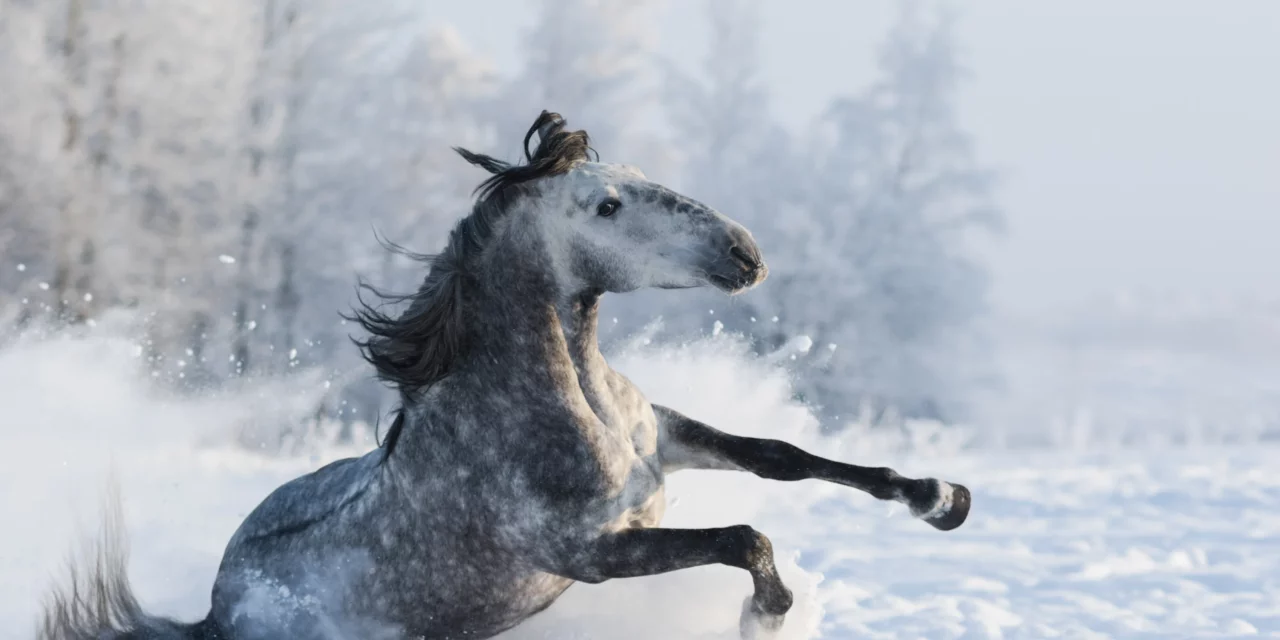
Can my horse go outside to romp in the snow? Generally, yes – horses love bucking through the snow, and as long as the ground is not deeply softened or newly frozen, the turf will not be damaged. Things get trickier with ice: a sheet of ice hidden beneath snow can end badly for a heavy horse, which is why trail rides in icy conditions are not a good idea. And the waterer needs to be kept ice-free during severe frost.
Let's start with the pleasant part: the snow. Fresh snow on frozen or well-dried ground is a real treat for most horses – they roll, buck, and gallop, and that is precisely the free movement they often miss in winter. Nothing brings a broader smile to horse owners' faces than watching horses being turned out onto a snow-covered pasture to romp around exuberantly. It only becomes problematic if the ground underneath is thoroughly soaked and soft: hooves then destroy the turf and turn the area into a muddy wasteland that recovers only with great difficulty in spring. Caution is also advised on newly frozen ground, as frozen blades of grass break easily. As a rule of thumb: on hard-frozen ground or under a thick layer of snow, there is nothing wrong with playtime in the pasture; on wet ground, it is best to spare the surface so that you still have a pasture and not a ploughed field next summer.
The topic of ice is far more serious. A horse is large and heavy, and a slip on an icy patch can lead to anything from a strained tendon to a broken leg – especially treacherous when a sheet of ice is hidden beneath a thin layer of snow and no one sees it coming. That is why horses do not belong on the trail in icy conditions, no matter how tempting the snowy winter landscape may be.
It gets especially tricky when not just a path, but the entire turnout freezes into a sheet of glare ice – which was precisely the case for weeks in some regions over recent winters, when wet conditions combined with severe, prolonged frost, turning mud into an ice rink overnight. Many horses are then suddenly confined to their stalls for days or restricted to a tiny safe patch, because slipping on the ice would be too dangerous. For animals built to move, this is a real strain, both physically and mentally. To cushion this, a whole bundle of small measures helps: gritting or sanding the slipperiest spots and main walkways, offering controlled exercise in hand or in the indoor arena, or turnout in the indoor arena or a frost-proof round pen, providing enrichment (additional hay nets in different locations, branches to chew on, hiding feed), and, above all, ensuring social contact. A horse standing alone in a stall while herd mates are elsewhere suffers twice as much – wherever possible, a small, well-gritted turnout area with company is better than a stall without friends.
When it comes to improving traction, anything that provides grip goes: sand and gravel are the classics, but things readily available around any yard can also do the job. In particularly harsh winters, many yards simply spread horse manure over icy surfaces – it roughens the surface and slows down ice formation. It isn't pretty and creates a lot of work once the thaw sets in, but it gets horses safely across the yard and paddock. What should be avoided, however, is road salt: it irritates hooves and skin and is harmful to both the horse and the environment. For shod horses, you can also discuss studs or removable cleats with your farrier, though not in group turnout settings, as the risk of injury is too high.
The most underestimated winter issue, however, is drinking. Horses naturally drink less in cold weather, especially if the water is ice-cold and they have a sensitive stomach. Too little fluid is one of the most common causes of impaction colic in winter. A frozen or partially iced-over waterer exacerbates the problem even further. Keeping the water source ice-free is therefore not a matter of luxury, but genuine colic prevention: using heated or insulated troughs, regularly breaking the ice, and, where possible, offering lukewarm water or herbal tea, which experience shows ulcer-prone horses drink much more readily and in greater quantities. Snow, by the way, is no substitute: a horse would have to eat enormous amounts to meet its water requirements, chilling its core in the process and disrupting its mineral balance.
If you are spared severe frost, you are faced with mud in winter instead, accumulating in all the inevitable areas – at the gate, around the waterer, around the feeder, and in front of the shelter. Constant moisture softens the skin in the pastern hollow and paves the way for mud fever, and mud is also no friend to hooves prone to thrush. Dry, reinforced surfaces where mud typically forms, as well as stabilized walkways – using mud grids or a layer of crushed stone at high-traffic spots – are the best prevention. Major construction, however, is a task for autumn; right now it is about holding the line and ensuring your horse has at least enough dry space to stand, eat, and sleep.
A note on our content. Sanoanimal’s content (articles, podcasts, videos, webinars, etc.) is based partly on scientific studies and partly on more than 20 years of practical experience within the Sanoanimal therapist network. For many relationships, methods and feeding practices involving horses, independent scientific studies do not exist or are not yet available; the corresponding statements reflect knowledge gained through experience. Our aim is to combine current scientific knowledge with the practical experience of our network. Our content makes no promises of healing or effectiveness; it does not replace examination, diagnosis or treatment by a veterinarian or trained therapist. Please do not put any of it into practice without professional guidance. Learn more: Editorial principles and disclaimer