This article was translated using AI.
Understanding Causes, Recognizing Symptoms, and Reducing Risk Factors
Typical Racehorse?
For a long time, gastric ulcers were considered a "racehorse disease." It was well known that 80–100% of examined racehorses suffered from gastric ulcers. A genetic defect was suspected as the cause of the high disease rate. Today, we know better.
A few years ago, studies were conducted on clinically healthy sport horses, and it was found that about 80–90% of them also had gastric ulcers.
Meanwhile, these studies have also been carried out on leisure horses; every second horse—symptomatically inconspicuous, mind you!—suffers from lesions of the gastric mucosa. These studies led researchers to deal more closely with the horse's stomach and the possible causes of gastritis (inflammation of the stomach lining) and ulcers.

How Does the Horse's Stomach Work?
Horses have a single-chambered stomach; their food enters from the esophagus, travels through it over the course of usually about two hours, and is then transported further into the small intestine.
Front Stomach Region
The stomach is divided into different zones that the food passes through sequentially. In the front area, there is a gastric mucosa with a very thin protective mucus layer and largely without embedded glands. This is where lactic acid bacteria reside in horses, helping to "pre-digest" the starch in the food bolus; they produce lactic acid for this purpose, which acidifies the food bolus to a pH value of about 5–6. Furthermore, this process produces small amounts of so-called "volatile fatty acids." These include, in particular, propionic acid, acetic acid, and butyric acid. Further along, in the fundus of the stomach, special glands are embedded in the gastric mucosa, which primarily add a digestive enzyme called pepsinogen to the food bolus. Upon contact with the acids, this is activated into pepsin in the further course and begins to "pre-digest" proteins in the posterior part of the stomach.
Rear Stomach Region
In the rear stomach area, it gets really acidic. Here, glands in the gastric mucosa release hydrochloric acid, which further acidifies the food bolus to a pH value of approximately 3. The gastric mucosa is protected from the acids by a thick protective mucus layer. The pH values are stabilized throughout the stomach by buffering substances contained in the saliva. Thus, despite all the acids produced, the stomach usually does not become too acidic. The pH values around 3 in the rear stomach area are necessary to activate the pepsin and also represent a "germ barrier" so that not too many unwanted microorganisms can enter the intestine.
Horses are Continuous Feeders
In its natural state, a horse's stomach is never empty. Nature designed the horse as a continuous feeder of lean roughage, so that food is constantly ingested and enters the stomach. If horses are offered roughage for constant free access, it is found that the feeding breaks chosen by the horses themselves rarely last longer than two to three hours. Even at night, horses eat most of the time and only sleep in short sequences. Through constant chewing, horses permanently produce saliva, which buffers the stomach acids. Food is continuously transported through the stomach—from the high pH value at the stomach entrance to the low pH value at the stomach exit.
What Promotes Gastric Ulcers?
Long Feeding Breaks
It is quite different when a horse is fed in "meals," as is often common in stables today. There, long roughage breaks occur, especially at night but also during the day in the paddock. Feeding breaks of significantly more than four hours are not uncommon. After about this time, however, the last of the food is transported from the stomach into the small intestine, and the horse's stomach runs largely "empty." It is not adapted to this condition. The glands continue to produce hydrochloric acid, which further acidifies the environment—down to pH values around 1.3. When a horse does not eat, there is also no saliva available to buffer the resulting stomach acid. And no food bolus follows to soak up and thus bind the acids. Instead, the acids can "slosh around" freely in the stomach and thus also reach the front stomach area. This process is not intended by nature, and accordingly, the mucosa there is etched by the stomach acid, causing inflammatory reactions ("gastritis") and, in the long term, gastric ulcers.
Too Little Hay
About 80% of gastric ulcers are located in the front stomach area. They are practically always feed-related and arise from excessively long roughage breaks, especially combined with an overall insufficient amount of roughage. The less roughage is eaten, the less saliva is produced. Horses eat significantly more hastily when fed in meals rather than continuously, and they then chew too little overall; this causes problems not only for the stomach but also further down in the large intestine. Hay feeding cannot be replaced by feeding straw; the grasses in hay contain additional substances to buffer the stomach that are missing in straw. Although the horse chews and can fill its stomach, if it eats as much straw overnight as it would ingest hay to buffer its stomach, there is a high risk of impaction colic ("straw colic").
Stress
In addition to the problems caused by improper feeding, there is the factor of stress: studies have shown that stress plays a significant role in the development and, above all, the maintenance of gastric ulcers. Stress-related gastric ulcers are mainly found in the rear stomach area, even though it should actually be well protected from acids. The reason for this is that the gastric mucosa is significantly less well supplied with blood during stress than in normal cases. With short-term stress, this does not cause problems, but it does with permanent stress. Often, husbandry conditions cause permanent stress for many horses (and unfortunately, this is not always obvious from looking at them). If the gastric mucosa is poorly supplied with blood for a long period, it produces too little protective mucus. The acids can then infiltrate this thinned protective layer and etch the gastric mucosa. Once a spot is inflamed, even less mucus is formed there, so that the process—once started—reinforces itself. Gastric ulcers are very painful. Pain creates more stress; this creates a vicious cycle from which a horse often cannot escape without help. Especially when both factors come together—excessively long roughage breaks combined with permanent stress, possibly combined with generous portions of concentrate feed—gastric ulcers are inevitable. Concentrate feed ensures a strong fermentation process in the front part of the stomach, which produces more volatile fatty acids. These very aggressive acids can further damage an already compromised gastric mucosa.
Horses need and enjoy contact with conspecifics. Sometimes, however, conflicts arise that can cause (permanent) stress.
Illus: © Adobe Stock / Наталья Дьячкова
What to Do About Gastric Ulcers?
If gastric ulcers are suspected, the husbandry and feeding conditions should first be closely examined, even if they appear good, professional, and knowledgeable to you.
Identifying Causes
It is highly recommended to step back from your own perspective for a moment and judge the environment in which your horse is housed according to sober and objective criteria. Sometimes, in this way, you notice things that you haven't seen or evaluated before because they were very normal and familiar to you, but which can nevertheless cause the development of gastric ulcers. If distancing yourself is difficult or you cannot discover any deficiencies yourself, it can help to take a close person with you (as unbiased as possible, not from the same stable and not necessarily an equine expert) and have them judge "neutrally" according to agreed objective criteria:
• Does the horse have constant access to sufficient hay?
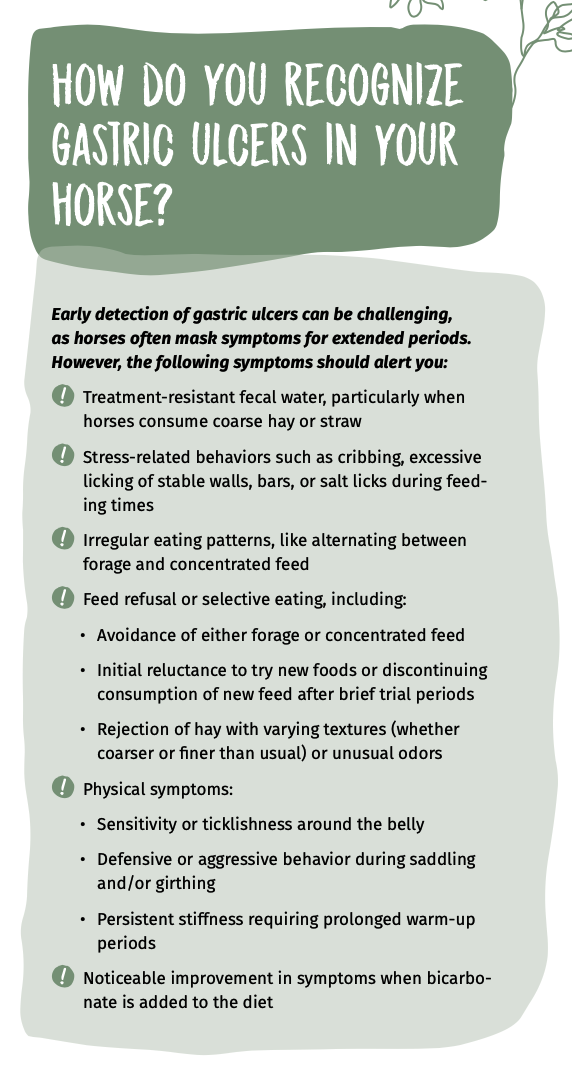
• Does it show one or more of the abnormalities mentioned above?
• Does the horse seem content and balanced and enjoy being in its group?
Reviewing the Daily Routine
Are there situations in which excitement, restlessness, or hectic activity prevails (both among the animals and with people, i.e., fellow boarders, staff, trainers, which occur in the daily routine); does the horse appear particularly excited, stressed, fidgety, incomprehensibly (!) "moody" and tense in certain situations?
Eliminating Stress Factors
There are many different circumstances that can cause permanent stress. Contact us, we will be happy to help you find possible stress factors. They must be eliminated if a horse is to be helped sustainably.
Changing the Diet
If gastric ulcers are suspected, hay as roughage must be provided permanently, if necessary in small-mesh hay nets—this also applies at night! Concentrate feed and any kind of starch- or sugar-containing feed should initially be removed from the menu. The change in diet (if a lot of concentrate and little hay was fed previously) must take place slowly over about four weeks to prevent further health problems. Once the possible causes have been eliminated, it is urgently recommended in most cases to support the horse therapeutically. For gastric ulcers, OKAPI GasterCare is suitable, as well as the administration of OKAPI Licorice Extract over a limited period or, alternatively to the licorice extract, Lapacho tea if, for example, insulin resistance or Cushing's is suspected. Which therapy is suitable for your horse depends on the severity of the symptoms, their concomitant diseases, and how long the gastric ulcers have already existed (as a horse owner, of course, you can often only estimate this).
If gastric ulcers are suspected, we recommend care by a competent therapist, e.g., via our Therapist Network.
More on this topic: Online Seminar Gastric Ulcers or 13 Symptoms Indicating Gastric Ulcers