How does chamomile work in horses? Discover everything about its use for stomach issues, fecal water & stress, as well as correct dosage and application.
Herbal Advice: Chamomile
© Adobe Stock / Christian Palent
This article was translated using AI.
Herb Profile:
|
Common name |
Chamomile (German chamomile, wild chamomile, scented mayweed) |
|
Latin name |
Matricaria chamomilla (syn. Matricaria recutita, Chamomilla recutita) |
|
Traditional use |
One of the oldest known medicinal plants, prized as early as ancient Egypt and antiquity. Traditionally used for gastrointestinal complaints, flatulence, cramps, and inflammation of the mucous membranes; externally for compresses, rinses, and baths for wounds and skin inflammation; as a steam inhalation for colds. In folk medicine, it is also used for restlessness, sleep disorders, and women's ailments. In horses, chamomile is traditionally fed for sensitive stomachs, gas, fecal water syndrome, and nervousness; externally as a wash for skin irritations, mud fever, and minor wounds. |
|
Scientifically proven effect(s) |
Essential oil (0.4–1.5%) with α-bisabolol, bisabolol oxides, matricin (converted to blue chamazulene during distillation), and en-yn dicycloethers; flavonoids (especially apigenin and apigenin-7-glucoside, luteolin, quercetin), coumarins (herniarin, umbelliferone), mucilages, phenolic carboxylic acids, tannins |
|
Contraindications |
Do not use in case of known allergy to plants of the daisy family (Asteraceae). Do not apply to the eyes, as chamomile flowers can introduce allergens and suspended particles. Risk of confusion with stinking chamomile (dog chamomile), whose constituent anthecotulide can trigger severe contact allergies. Traditionally, do not feed in large quantities to pregnant mares. |
|
When is it collected? |
The flower heads from May to August, about three to five days after blooming, on dry, sunny days around midday when the essential oil content is at its highest. |
|
Which plant parts are used? |
The flower heads; the herb plays only a subordinate role. |
|
How is it prepared? |
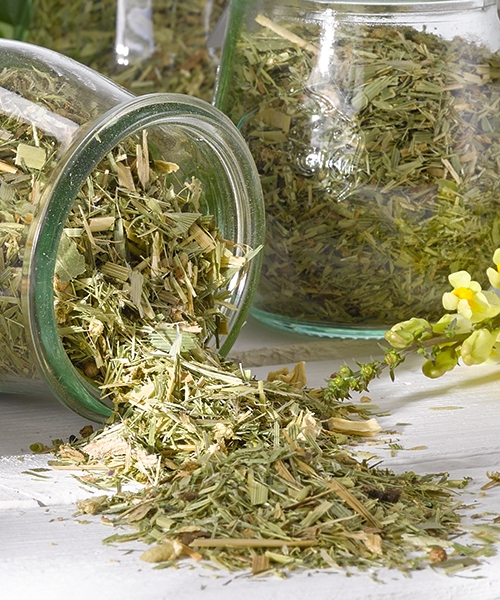
Mix dried flowers directly into the feed or brew as a tea: pour boiling water over flowers, cover and steep for 10 minutes to prevent the essential oil from evaporating, strain and offer lukewarm or pour over the feed or a grain-free mash. Externally as a cooled tea for washes. |
|
Trivia |
In 1987, chamomile was crowned the very first “Medicinal Plant of the Year”. |
Herbal Tip:
For many, chamomile is the medicinal herb par excellence, and in equine nutrition it is also among the most proven herbs for horses. Chamomile is mild, exceptionally well tolerated, and readily eaten by most horses. Its strengths lie primarily where the stomach and gut need support, which is why it should not be missing from any stable first-aid kit.
It owes its efficacy primarily to the essential oil containing α-bisabolol and chamazulene, as well as flavonoids, foremost among them apigenin. Bisabolol and chamazulene have anti-inflammatory effects and promote the healing of irritated mucous membranes. At the same time, these active constituents relax the smooth muscles of the digestive tract, acting as an antispasmodic and carminative, allowing trapped gas to pass. In the brain, apigenin binds to the same receptors as certain sedatives, explaining the gently balancing effect for which chamomile tea has always been valued.
Chamomile is particularly valuable for the equine stomach. Because horses produce stomach acid around the clock, the gastric mucosa is sensitive to long feeding pauses, stress, and grain-heavy rations; gastric ulcers are correspondingly widespread. In animal studies, bisabolol protected the gastric mucosa against ulcers induced by stress, alcohol, or anti-inflammatory painkillers, and shortened the healing time of existing lesions. In a study conducted on horses with gastric ulcers, a herbal blend containing chamomile alongside licorice, marshmallow, and peppermint achieved healing results comparable to the drug omeprazole after four weeks. However, anyone who notices symptoms of gastric ulcers in their horse should always consult a veterinarian. Chamomile is no substitute for species-appropriate, stomach-friendly feeding with sufficient forage, but it can provide valuable support during feed transitions.
The downstream digestive tract benefits from chamomile as well. In cases of flatulence, mild spasmodic abdominal pain, a tendency toward free fecal water, mild colic, or after feed changes, it can soothe the intestines and contribute to the gut health of the horse. It has proven particularly helpful for nervous horses whose stress affects their belly directly, for instance in the form of stress-related fecal water. Important: At any signs of colic, chamomile is no substitute for a veterinarian.
When is chamomile used in horses? Typical situations include stressful phases such as transport, competitions, changing stables, or clinic stays, the spring turnout period and other feed transitions, the administration of painkillers that irritate the stomach, as well as horses that generally tend to have stomach issues, gas, or fecal water. Externally, cooled chamomile tea is suitable for washes in cases of skin irritations, mud fever, and minor wounds. How colic risks can be preventively reduced through feeding is an important topic of its own.
Feeding chamomile is straightforward. For an adult horse weighing around 500 kg, 10 to 20 g of dried chamomile flowers daily has proven effective, which corresponds to roughly one to two generous handfuls. Ponies receive approximately half this amount. The flowers are simply mixed into the feed. During acute phases, chamomile can be given as a course for two to four weeks, or over longer periods in sensitive horses.
Many horses also accept chamomile tea readily. To prepare chamomile tea for a horse, pour one liter of boiling water over two to three tablespoons of flowers, cover, let steep for 10 minutes, and strain. The tea can be offered lukewarm in a separate feed bowl. Alternatively, the tea can be poured over the feed or used to soak a grain-free mash.
Caution: Chamomile tea should not be applied to the eyes.
Side effects are rare with chamomile; it is one of the best-tolerated medicinal herbs for horses. However, horses with an allergy to plants of the daisy family should not receive chamomile. Caution is advised when foraging wild chamomile, as the similar stinking chamomile contains anthecotulide, a compound that can trigger severe contact allergies. For pregnant mares, chamomile is traditionally fed only in standard amounts. If in doubt, your veterinarian or a Sanoanimal therapist will be able to help.
Chamomile can be combined exceptionally well with other herbs. Combined with fennel and caraway, it forms a classic blend for digestion; together with marshmallow and licorice, it creates a mucosal-protective combination for the stomach. For nervous horses, chamomile pairs well with calming herbs such as lemon balm.
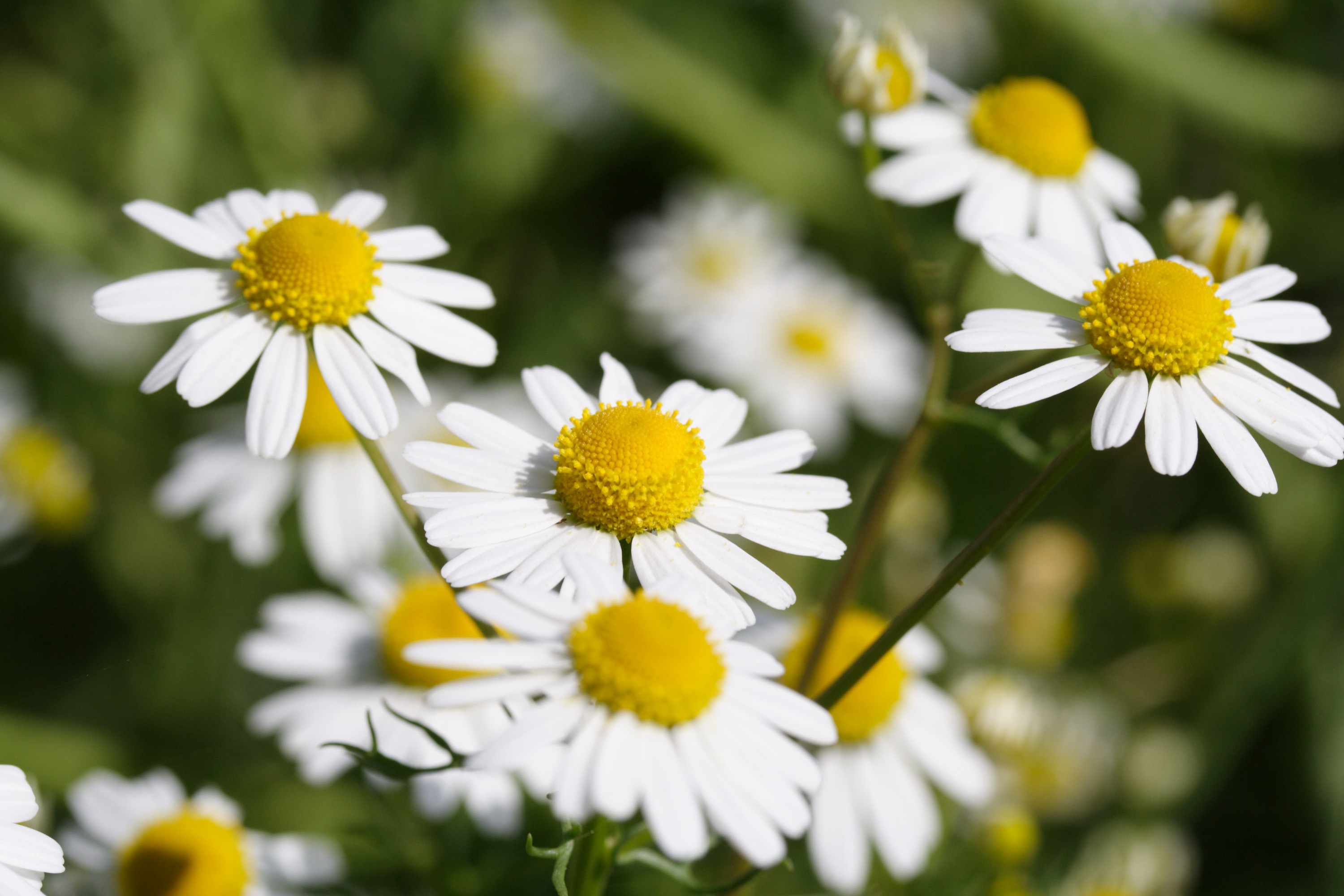
A practical tip: Anyone wishing to forage chamomile should look for the hollow flower receptacle, which reliably distinguishes German chamomile. Gently dry the flowers in the shade or in a dehydrator and subsequently store them in an airtight, dry, and dark container. Because the essential oil dissipates over time, the supply should be refreshed after one year at the latest.
References:
-
Fritz C: Kräuter, die Pferde fit machen. Sanoanimal Verlag 2024
-
Kulcsár, M., et al. “Phytotherapy compared to omeprazol therapy in equine gastric ulcers.” Acta Veterinaria Brno 91.4 (2022): 309-315. https://actavet.vfu.cz/media/pdf/actavet_2022091040309.pdf
-
Szelényi, I., O. Isaac, and K. Thiemer. “Pharmakologische Untersuchungen von Kamillen-Inhaltsstoffen. III. Tierexperimentelle Untersuchungen über die ulkusprotektive Wirkung der Kamille.” Planta Medica 35.3 (1979): 218-227. https://www.thieme-connect.de/products/ejournals/abstract/10.1055/s-0028-1097208
-
Achterrath-Tuckermann, U., et al. “Pharmakologische Untersuchungen von Kamillen-Inhaltsstoffen. V. Untersuchungen über die spasmolytische Wirkung von Kamillen-Inhaltsstoffen und von Kamillosan am isolierten Meerschweinchen-Ileum.” Planta Medica 39.5 (1980): 38-50. https://www.thieme-connect.com/products/ejournals/abstract/10.1055/s-2008-1074901
-
Viola, H., et al. “Apigenin, a component of Matricaria recutita flowers, is a central benzodiazepine receptors-ligand with anxiolytic effects.” Planta Medica 61.3 (1995): 213-216. https://www.thieme-connect.com/products/ejournals/abstract/10.1055/s-2006-958058
-
Amsterdam, Jay D., et al. “A randomized, double-blind, placebo-controlled trial of oral Matricaria recutita (chamomile) extract therapy for generalized anxiety disorder.” Journal of Clinical Psychopharmacology 29.4 (2009): 378-382. https://pmc.ncbi.nlm.nih.gov/articles/PMC3600416/
-
McKay, Diane L., and Jeffrey B. Blumberg. “A review of the bioactivity and potential health benefits of chamomile tea (Matricaria recutita L.).” Phytotherapy Research 20.7 (2006): 519-530. https://onlinelibrary.wiley.com/doi/10.1002/ptr.1900
-
Srivastava, Janmejai K., Eswar Shankar, and Sanjay Gupta. “Chamomile: A herbal medicine of the past with a bright future.” Molecular Medicine Reports 3.6 (2010): 895-901. https://pmc.ncbi.nlm.nih.gov/articles/PMC2995283/
-
Singh, Ompal, et al. “Chamomile (Matricaria chamomilla L.): An overview.” Pharmacognosy Reviews 5.9 (2011): 82-95. https://pmc.ncbi.nlm.nih.gov/articles/PMC3210003/
-
El Mihyaoui, Amina, et al. “Chamomile (Matricaria chamomilla L.): A review of ethnomedicinal use, phytochemistry and pharmacological uses.” Life 12.4 (2022): 479. https://pmc.ncbi.nlm.nih.gov/articles/PMC9032859/
-
Dai, Yun-Lei, et al. “Chamomile: A review of its traditional uses, chemical constituents, pharmacological activities and quality control studies.” Molecules 28.1 (2023): 133. https://pmc.ncbi.nlm.nih.gov/articles/PMC9822300/