When is milk thistle beneficial for horses? A complete overview of effects, dosage, contraindications, and scientific studies.
Herbal Tip: Milk Thistle
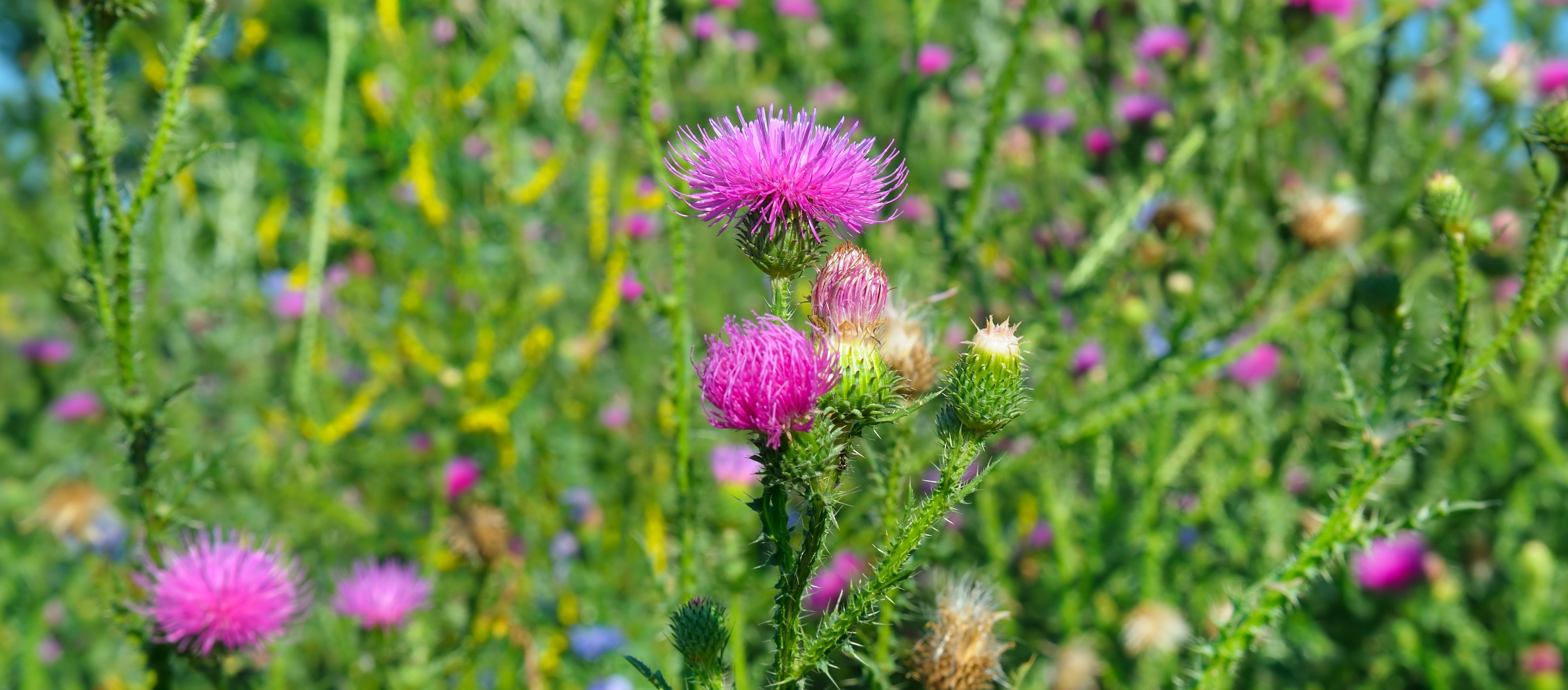
© Adobe Stock / alinamd
This article was translated using AI.
Herb Profile:
|
Common Name |
Milk thistle (Mary thistle, holy thistle, blessed milkthistle) |
|
Botanical Name |
Silybum marianum (Syn. Carduus marianus) |
|
Traditional Uses |
Known as a medicinal plant since antiquity; root and herb were historically considered diuretic and emetic. In the 19th century, rural physician Johann Gottfried Rademacher popularized the fruits as a liver remedy, and his tincture made from the seeds was used for liver and spleen complaints. In folk medicine, it was also used for digestive complaints, bloating, and gallbladder issues. In horses, milk thistle is traditionally fed to support the liver during periods of increased strain, such as during coat change, after deworming and medication administration, or in the case of metabolic issues. |
|
Scientifically Proven Effects |
Silymarin (1.5–3%), a flavonolignan complex composed of silibinin A and B, isosilibinin, silicristin, and silidianin; taxifolin, fatty oil (20–30%, rich in linoleic and oleic acid), phytosterols (including sitosterol), tocopherols (vitamin E), protein Hepatoprotective (liver-protecting), antioxidant, cell-membrane stabilizing, promotes regeneration of liver cells (stimulates protein synthesis), anti-inflammatory, antifibrotic, digestive, choleretic (promotes bile flow) |
|
Contraindications |
Do not use in case of a known allergy to Asteraceae (daisy family). Insufficient data is available for pregnant and lactating mares. Consult a veterinarian before concurrent medication administration, as high doses of silymarin can affect the breakdown of certain pharmaceutical drugs in the liver. Mildly laxative in very large amounts. In horses with detoxification disorders (KPU), use only after consultation with a therapist. Elevated liver values must always be examined by a veterinarian first. |
|
When is it harvested? |
The seed heads in late summer from August to September, when the flower heads dry out and the white pappus appears. Due to the spines, only harvest wearing sturdy gloves. |
|
Which plant parts are used? |
The mature fruits, colloquially referred to as seeds (botanically achenes), without the pappus. Historically also the root, herb, and young flower heads (receptacles), which were consumed as vegetables like artichokes. |
|
How is it prepared? |
Freshly crush or grind the seeds shortly before feeding and mix them into the feed, as whole seeds are very hard and can barely be broken down by the horse. As a tea (pour hot water over crushed seeds, steep for 10 minutes), it is more suitable for digestive complaints, as silymarin is barely water-soluble. Milk thistle oil contains virtually no silymarin. |
|
Trivia |
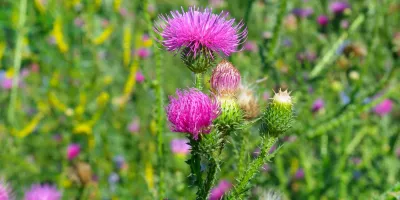
According to legend, the white veins on the leaves originate from the milk of the Virgin Mary dripping onto the plant. Hence the German name and the English “milk thistle”. The genus name Silybum goes back to the Greek “silybon”, which Dioscorides used to refer to a thistle-like plant. It belongs to the Asteraceae family, can grow to over 2 meters tall, and bears around 200 purple tubular florets per flower head. Silibinin, a component of silymarin, is used in human medicine as an antidote for death cap mushroom poisoning because it inhibits the uptake of mushroom toxins into liver cells. |
Herbal Tip:
In horses, milk thistle is primarily used to support the liver. Its beneficial action is based on silymarin, a mixture of various flavonolignans, of which silibinin is the most important. Silymarin scavenges free radicals, stabilizes the membranes of liver cells, and thereby makes it harder for harmful substances to enter. At the same time, it stimulates protein synthesis within liver cells, promoting the regeneration of previously damaged tissue. The strength of this protective mechanism is highlighted by human medicine, where silibinin is used as an antidote in death cap mushroom poisoning. In addition, milk thistle stimulates digestion and can help ease feelings of fullness and gas.
The liver is the horse’s central organ for metabolism and detoxification, and there are numerous situations that put it under heightened strain. These include the coat change, deworming, anesthesia, and prolonged courses of medication, such as pain relievers or antibiotics. Moldy hay, haylage, or straw contaminated with mycotoxins, poisonous plants like tansy ragwort with its liver-damaging pyrrolizidine alkaloids, a diet excessively rich in protein, as well as metabolic disorders such as EMS and Cushing’s all strain equine liver function. In easy-keeper ponies and donkeys, fasting periods—often used to manage weight—can trigger dangerous hyperlipidemia. Elevated liver values in blood work must always be examined by a veterinarian first.
It is precisely during these phases that milk thistle is fed to horses: during the spring and autumn coat changes, alongside deworming treatments and medications and for several weeks thereafter, following sedation, or whenever contaminated feed is suspected.
The scientific evidence specifically in horses is still modest, but promising. In a Czech study, horses that received milk thistle press cake for eight weeks demonstrated lower levels of the enzyme AST than the control group. An American study confirmed that silibinin is well tolerated even at high doses, but also revealed that horses only absorb a small fraction of the active substance from the intestinal tract. However, a portion of the absorbed silymarin is excreted via bile and reabsorbed in the intestine (enterohepatic circulation), meaning the liver repeatedly encounters the active compound as the first-pass organ. In practice, however, we frequently observe that horses with detoxification disorders such as cryptopyrroluria (KPU) seem to tolerate milk thistle poorly and may react with skin issues like hives or even laminitis. Therefore, for such horses, a qualified therapist should definitely be consulted prior to administration.
The question often arises whether milk thistle seeds or milk thistle oil are more suitable for horses. When it comes to the liver, the answer is clearly the seeds. The relevant active compounds, first and foremost silymarin, are predominantly concentrated in the seed coat and are neither readily water- nor fat-soluble; as a result, they largely remain behind in the press cake during oil extraction. Milk thistle oil therefore contains virtually no silymarin. While it is a high-grade oil rich in linoleic acid and vitamin E for human consumption, for the horse it is by no means an equivalent substitute for the seeds.
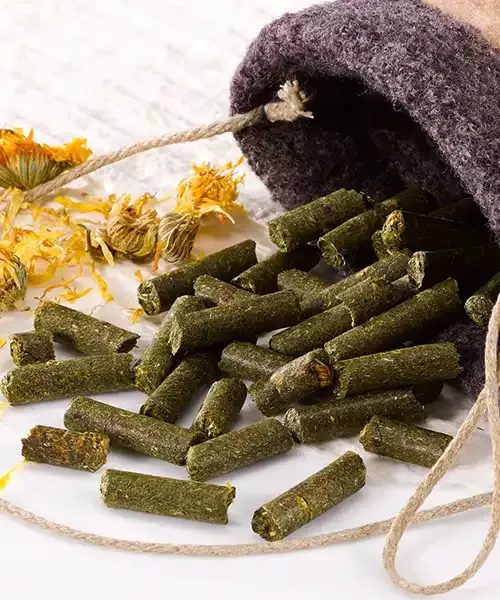
For dosing, 20 to 30 g of milk thistle seeds daily has proven effective for a large horse weighing around 500 kg, which corresponds to roughly two to three heaping tablespoons. Ponies receive proportionately less, around 10 to 15 g. It is crucial to freshly crush or grind the seeds and then blend them into the feed, as whole seeds are so hard that they often pass through the digestive tract undigested. An electric coffee grinder is ideal for freshly crushing the seeds. Alternatively, you can use (advertisement) OKAPI Liver Care, which consists of pure milk thistle press cake and therefore features a particularly high silymarin content.
Milk thistle is usually fed as a course over four weeks, followed by a break. This cycle can be repeated as needed; for horses under chronic strain, longer-term supplementation is also possible. In chronic conditions, it is advisable to coordinate with a veterinarian or a Sanoanimal therapist.
Side effects from milk thistle are rarely expected—except in horses with KPU—as it is considered exceptionally well tolerated. In the equine study, even high doses of silibinin caused no signs of toxicity; in excessively large amounts, milk thistle may at most have a mild laxative effect. Horses allergic to Asteraceae should not receive it. In pregnant mares or when medications are being administered concurrently, consulting a veterinarian is recommended.
Milk thistle pairs well with other liver-supportive herbs for horses. Combined with dandelion, which stimulates bile flow, and artichoke leaves, it creates a classic liver blend; stinging nettle complements the formula with a diuretic component, thereby involving the kidneys. Whether indiscriminate detox cures without a clear indication are sensible is discussed in our dedicated article on detox cures for horses.
A practical tip: Whole milk thistle seeds keep for a long time when stored in a cool, dry, and dark place. It is best to only grind the amount needed for a few days at a time, because once the seeds are ground, the oil they contain begins to oxidize and turns rancid quickly.
Quellen:
- Fritz, C: Kräuter, die Pferde fit machen. Sanoanimal Verlag 2024
- Hackett, Eileen S., et al. “Pharmacokinetics and safety of silibinin in horses.” American Journal of Veterinary Research 74.10 (2013): 1327-1332. https://avmajournals.avma.org/view/journals/ajvr/74/10/ajvr.74.10.1327.xml
- Hackett, Eileen S., David C. Twedt, and Daniel L. Gustafson. “Milk thistle and its derivative compounds: a review of opportunities for treatment of liver disease.” Journal of Veterinary Internal Medicine 27.1 (2013): 10-16. https://academic.oup.com/jvim/article/27/1/10/8451910
- Dockalova, Hana, Ladislav Zeman, and Pavel Horky. “Influence of milk thistle (Silybum marianum) seed cakes on biochemical values of equine plasma subjected to physical exertion.” Animals 11.1 (2021): 210. https://pmc.ncbi.nlm.nih.gov/articles/PMC7829787/
- Tedesco, Doriana, et al. “Silymarin, a possible hepatoprotector in dairy cows: biochemical and histological observations.” Journal of Veterinary Medicine Series A 51.2 (2004): 85-89. https://onlinelibrary.wiley.com/doi/10.1111/j.1439-0442.2004.00603.x
- Tedesco, Doriana, et al. “Efficacy of silymarin-phospholipid complex in reducing the toxicity of aflatoxin B1 in broiler chicks.” Poultry Science 83.11 (2004): 1839-1843. https://www.sciencedirect.com/science/article/pii/S0032579119427168
- Abenavoli, Ludovico, et al. “Milk thistle in liver diseases: past, present, future.” Phytotherapy Research 24.10 (2010): 1423-1432. https://onlinelibrary.wiley.com/doi/10.1002/ptr.3207
- Bijak, Michal. “Silybin, a major bioactive component of milk thistle (Silybum marianum L. Gaernt.) – chemistry, bioavailability, and metabolism.” Molecules 22.11 (2017): 1942. https://pmc.ncbi.nlm.nih.gov/articles/PMC6150307/
- Federico, Alessandro, Marcello Dallio, and Carmelina Loguercio. “Silymarin/silybin and chronic liver disease: a marriage of many years.” Molecules 22.2 (2017): 191. https://pubmed.ncbi.nlm.nih.gov/32065376/
- Gillessen, Anton, and Hartmut H.-J. Schmidt. “Silymarin as supportive treatment in liver diseases: a narrative review.” Advances in Therapy 37.4 (2020): 1279-1301. https://pmc.ncbi.nlm.nih.gov/articles/PMC7140758/
- Tamayo, Carmen, and Suzanne Diamond. “Review of clinical trials evaluating safety and efficacy of milk thistle (Silybum marianum [L.] Gaertn.).” Integrative Cancer Therapies 6.2 (2007): 146-157. https://journals.sagepub.com/doi/10.1177/1534735407301942
- Saller, Reinhard, et al. “An updated systematic review with meta-analysis for the clinical evidence of silymarin.” Forschende Komplementärmedizin 15.1 (2008): 9-20. https://pubmed.ncbi.nlm.nih.gov/18334810/
- Křen, Vladimír, and Daniela Walterová. “Silybin and silymarin – new effects and applications.” Biomedical Papers of the Medical Faculty of Palacký University 149.1 (2005): 29-41. https://pubmed.ncbi.nlm.nih.gov/16170386/