Your Knowledge Hub
for Horse Health
At Sanoanimal, we believe knowledge is the best protection a horse can have. Most health problems — from laminitis to metabolic disease — are far easier to prevent than to treat, and prevention starts with an owner who understands why.
That’s why we share what we know. Explore our free, science-based eBooks and a shelf of books we genuinely recommend — no sales pitch, just knowledge you can put to work for your horse today.

eBooks – Completely Free
Download directly to your device. No registration, no purchase — just knowledge, ready when you are.
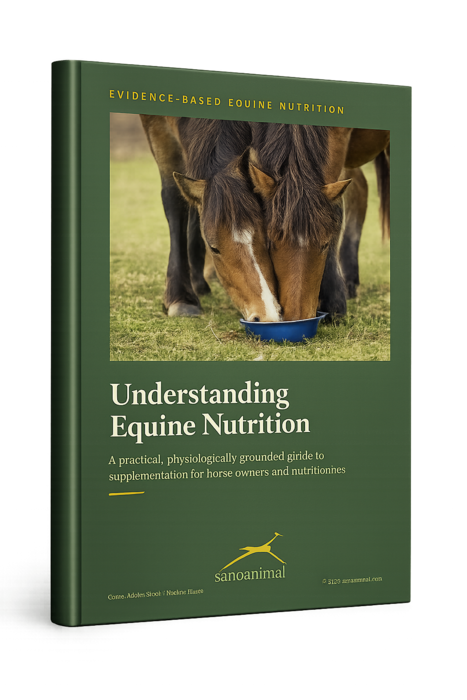
Understanding Equine Nutrition
Is your horse really getting too much iron? Is the protein in your hay adequate? Should you be supplementing vitamin E? These are the questions horse owners bring to their nutritionists after reading alarming claims online — and they deserve honest, science-based answers.
This guide gives you a physiologically grounded framework for thinking about supplementation, built on peer-reviewed research, NRC data and decades of clinical experience with horses across Europe. It promotes no product. As the guide puts it: the fear of getting it wrong is precisely what supplement marketing is designed to exploit.
What’s inside
- Iron — the most misunderstood mineral. Why 25,000+ hay samples make the “overload” panic statistically meaningless
- Vitamin E — when supplementation genuinely helps, and when it doesn’t
- Protein — quality over quantity
- Calcium, phosphorus and magnesium — the ratios that actually matter
- How to read a mineral feed label without being misled
- Organic selenium — the risk no one talks about
- A framework for advising clients — for nutritionists and therapists
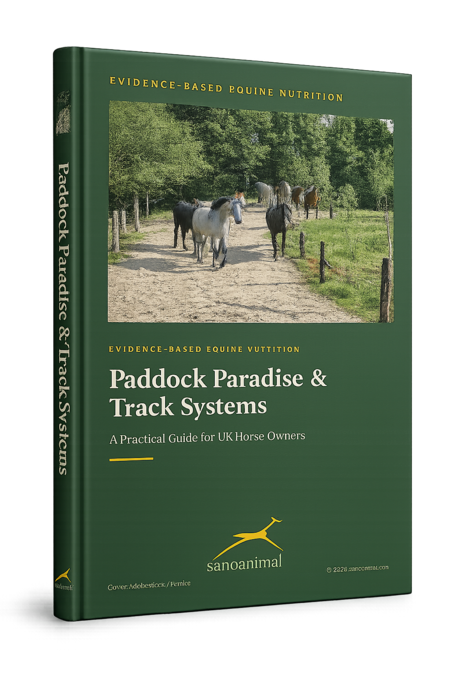
Paddock Paradise & Track Systems
Most books on Paddock Paradise were written for dry climates, wide open spaces and post-and-rail budgets. This one was written for the UK — for clay that turns to porridge in October and stays that way until May, for the native pony that is laminitic again despite “barely any grass”, and for everyone who priced up post-and-rail fencing and quietly abandoned the idea.
The principle is simple: instead of a static paddock, horses live on a looped pathway with hay, water and shelter spread out along it — mimicking the wild horses that travel up to thirty kilometres a day between resources. Mainstream in Germany and Austria for over a decade; still largely unknown in Britain. This is the complete build guide, from first sketch to winter management.
What’s inside
- Part 1 — Understanding the why. The wild horse blueprint, and the two things UK keeping gets wrong: grass and movement
- Part 2 — The track system explained. Width, length, layout variants, where each resource goes — and what actually changes for your horse
- Part 3 — The UK-specific challenges. Ryegrass, sugar and laminitis; clay, peat and hills; electric fencing on a real budget
- Part 4 — Building your track. From paper to posts: planning permission, groundwork, surfaces, shelters, and the four-part transition
- Part 5 — Living with it. Seasonal management, the nine mistakes people make, and what a track does for the ridden horse
- Part 6 — Real questions from real owners. UK FAQs, plus the refractometer method for testing your own hay for sugar
Forage First – The Honest Guide
Roughage is not simply filler. It is the foundation of your horse’s digestion, dental health, gut motility, hydration — and psychological wellbeing. Get it wrong and the consequences show up everywhere, from ulcers to behaviour; get it right and a surprising number of problems never appear.
This guide cuts through the confusion around hay, haylage and everything in between, and gives you an honest, practical framework for choosing and using forage wisely — whether you keep a good-doer, a senior, or a metabolically sensitive horse.
What’s inside
- Every type of forage — hay, haylage, straw, pasture, silage and wrapped hay, and when each one belongs in the ration
- How to assess forage quality — including a simple at-home sugar test you can do yourself
- The sensitive horses — practical guidance for good-doers, seniors and metabolically sensitive horses
- A yard checklist — must-haves, nice-to-haves, and the red flags worth walking away from
Factsheets – Practical Guides
Concise, printable one-pagers on specific topics — ready to download, pin up in the yard, or share with your barn. Free, no sign-up.
Metabolism and Detox
Published Books
Our experts have hand-picked the most valuable books on horse health, nutrition, training, and holistic care — available via Amazon and specialist booksellers.
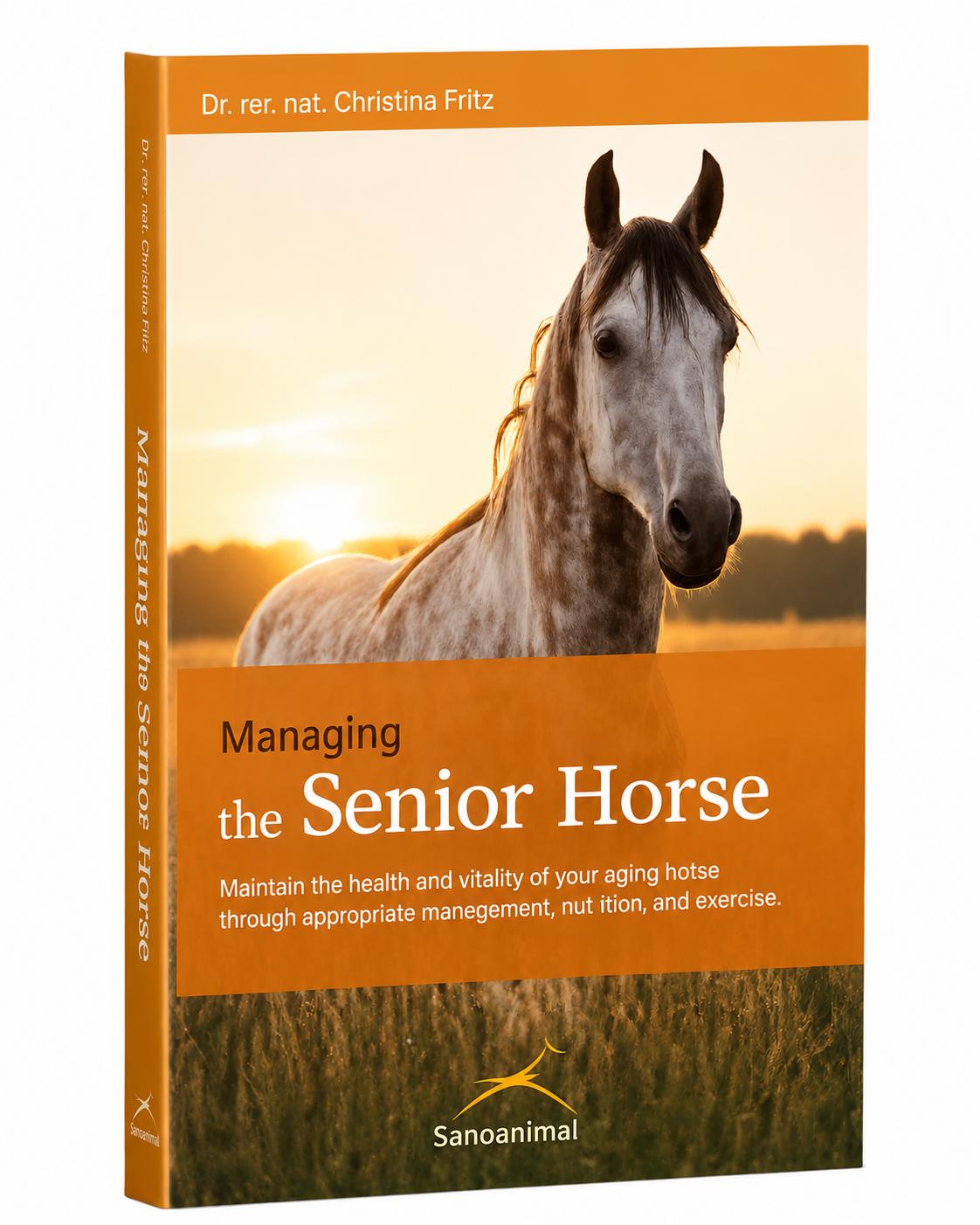
Managing the Senior Horse
Maintain the health and vitality of your aging horse through appropriate management, nutrition, and exercise.
More on sanoanimal.com
Expert articles, webinars and podcasts on all topics around your horse — from species-appropriate feeding & husbandry to illness and rehabilitation.