Feeding studies vs. practice: Why measurement errors and short study durations are deceptive. Overview of all findings on the various forms of roughage.
Recurring Tendon Problems in Horses: The Underestimated Role of Insulin Resistance
© Adobe Stock / Osetrik
This article was translated using AI.
Key facts in brief
- In practice, there is an increasing number of horses with recurring tendon and ligament problems for which hoof care, shoeing, arena footing, and training provide no explanation.
- In humans, tendon diseases are a well-documented complication of diabetes and insulin resistance – the risk is significantly increased depending on the specific tendon.
- The main mechanism is known: Permanently elevated sugar and insulin levels alter the collagen, making tendons stiffer and more brittle and interfering with their self-repair.
- This mechanism can be physiologically transferred to horses – especially Warmbloods, which often carry insulin resistance unrecognized and without classic signs such as obesity or laminitis.
- In cases of inexplicably recurring tendon and ligament problems, it is therefore worth looking at the metabolism – and the insulin situation belongs on the list of possible causes.
An observation from the stable
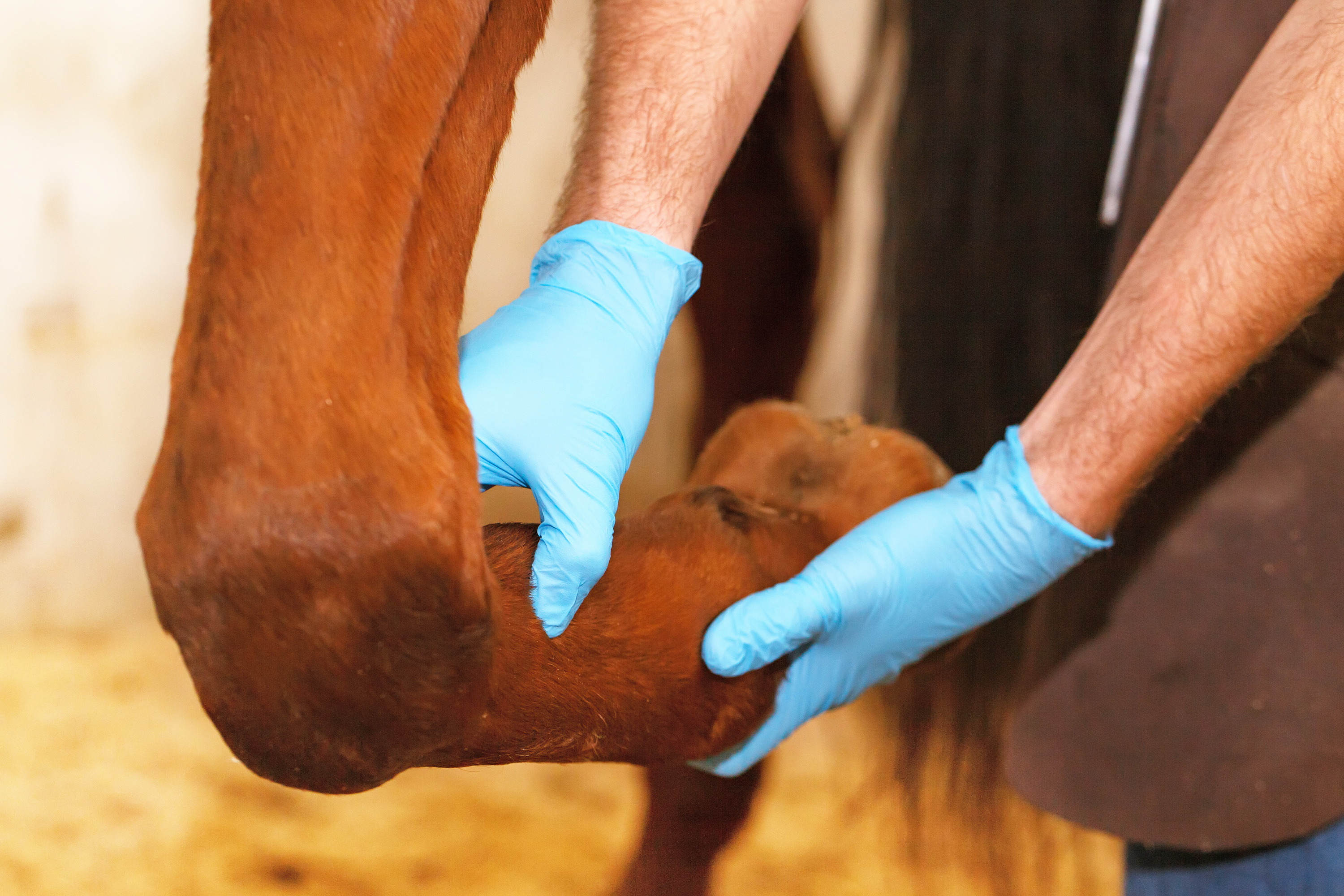
There is a pattern that we encounter more and more frequently in consultations. A horse arrives with a tendon or ligament injury – flexor tendon damage, an irritated suspensory ligament, a thickened annular ligament, or an inflamed check ligament. It is treated professionally, rested, and slowly rehabilitated. And as soon as it is back in work, it starts all over again: either the same structure or the next one right next to it.
The first thing one reviews in such a case is the obvious. Is the hoof care correct? Does the shoeing fit? Is the arena footing too deep or too hard? Is the training too fast, too much, or too one-sided? These are the usual suspects, and often the answer is found here. But there remains a growing group of horses for which all of these factors have already been optimized – and yet the problems keep returning. At that point, it is worth broadening the perspective and asking: What if the cause doesn't lie in the musculoskeletal system at all, but in the metabolism?
What we know from humans
This question has long been answered in human medicine – or at least very well researched. There, tendon diseases are among the known side effects of diabetes and insulin resistance. The connection is so consistent that it is now referred to as a distinct clinical picture, known as diabetic tendopathy.
The figures are clear. People with diabetes have a significantly increased risk of shoulder tendon problems. The notorious "Frozen Shoulder," or painful shoulder stiffness, occurs in them about three to five times more frequently than in metabolically healthy individuals. Ultrasound examinations show that even asymptomatic diabetics have degenerative changes in the shoulder tendons twice as often as control subjects. The Achilles tendon and other heavily loaded tendons are also affected significantly more often, and after tendon surgeries, the repaired structures in diabetics tear again measurably more frequently.
Crucially, this increased risk exists regardless of whether someone is overweight or not. The driving factor is not body weight, but the disturbed sugar and insulin metabolism itself.
Why sugar ruins the tendon
To understand why this is transferable to the horse, one must look at the mechanism – and it is surprisingly illustrative.
Tendons and ligaments consist largely of collagen, a protein structured like an organized bundle of ropes. This order makes the tendon simultaneously tensile and elastic: it can stretch a bit under load and spring back. Collagen is also a very long-lived tissue – once formed, it remains for years and is only slowly renewed. It is precisely this characteristic that becomes its downfall in metabolic disorders.
If there is permanently too much sugar in the blood, it gradually attaches itself to the collagen. This connection results in so-called Advanced Glycation Endproducts, or AGEs – you can think of them as sticky cross-links that glue the neatly aligned collagen ropes together. A tendon glued in this way becomes stiffer and more brittle. It can no longer stretch properly, loses its elasticity, and tears more easily under load. Particularly insidious: These adhesions block the very mechanism with which a healthy tendon absorbs and repairs minor overload damage itself. The tissue thus becomes not only more vulnerable but also less capable of repair.
In addition, there is a second factor. A disturbed insulin metabolism is associated with a permanent, low-grade inflammatory tendency throughout the entire body. This silent inflammation further worsens circulation and healing in tendon tissue, which already has a poor blood supply. Stiff, brittle fibers thus encounter an environment that makes repair difficult – a highly unfavorable combination.
Practical Tip: In addition to a strictly low-sugar and low-starch diet, the administration of OKAPI PankrEMS forte has proven effective for horses with disturbed blood sugar regulation.
The bridge to the horse
A horse is, of course, not a human, and the direct connection between insulin resistance and tendon damage in horses has not yet been studied to the same extent as in humans. However, the building blocks are the same, and research is beginning to look exactly in this direction.
Equine collagen functions according to the same rules as ours, and tendons or ligaments such as the suspensory ligament are among the most heavily loaded and poorly circulated structures in the entire body. The adhesion caused by excess sugar occurs physiologically here just as it does in humans. In fact, current veterinary review articles now explicitly define the consequences of insulin dysregulation more broadly than just laminitis – they list muscle atrophy as well as the degeneration of the suspensory ligament. The connection is most clearly proven so far in horses with the hormonal disease PPID: their suspensory ligaments show typical changes – disordered collagen fibers and embedded sugar proteins – as known from degenerative tendon tissue. It is important to know that approximately 60% of horses diagnosed with PPID also demonstrably suffer from insulin resistance.
The perspective on Warmbloods is particularly enlightening. We are used to identifying insulin resistance in the overweight pony with a fat neck, round belly, and a tendency towards laminitis. In Warmbloods, however, we often do not see these classic signs – no obesity, no laminitis. This tempts us to not even consider insulin resistance. Yet, disturbed insulin regulation is not bound to obesity: what matters is the insulin response to feeding, not the Body Condition Score. It is quite possible that insulin resistance in the Warmblood does not manifest in the hoof, but in the tendon – as that mysterious, recurring problem for which no other explanation seems to fit.
Listening Recommendation: Why the steady increase in metabolic derangements in horses is closely linked to management and feeding is highlighted in the podcast episode #22 Insulin Resistance in Horses – The Overlooked Metabolic Crisis.
What this means for practice
This does not result in a new dogma, but rather an expanded checklist. If a horse repeatedly develops tendon or ligament problems and the usual explanations from hoof care, shoeing, footing, and training do not apply, the metabolism belongs on the list of possible causes – and with it, insulin dysregulation. This can be assessed through a feeding history and, where appropriate, a targeted blood test.
Therapy must then begin where the cause lies. Instead of always just treating the tendon, one should restore insulin sensitivity. Insulin resistance or insulin dysregulation in horses is usually not congenital, but "fed into" the horse over years – very similar to insulin resistance or Type 2 diabetes in humans. And conversely, this means: it is largely reversible. A diet that consistently reduces sugar and starch and focuses on lean, low-sugar hay, combined with adapted exercise that makes the muscles more insulin-sensitive again – this is the same foundation used to help a horse recover from metabolic laminitis. Only here, the target is a different tissue: a tendon that can become elastic again and heal in peace.
Science has not yet fully illuminated this connection in horses. But human medicine, the physiology of collagen, and the first veterinary findings all point in the same direction. And sometimes it is worth following practical observation before the all-explaining study is written.
Reading Recommendation: When insulin levels remain at critically high levels despite consistent feeding and management adjustments, novel active ingredients such as SGLT2 inhibitors are increasingly being used in veterinary medicine. A detailed analysis of the opportunities, risks, and limits of this medicinal intervention is offered in the technical article Ertugliflozin & Co. (SGLT2 inhibitors) in horses: Effects, risks, new insights.
Sources
- Abate, M., Schiavone, C., & Salini, V. (2010). Sonographic evaluation of the shoulder in asymptomatic elderly subjects with diabetes. BMC musculoskeletal disorders, 11(1), 278. https://pmc.ncbi.nlm.nih.gov/articles/PMC3019220/
- Borton, Z., Shivji, F., Simeen, S., Williams, R., Tambe, A., Espag, M., Cresswell, T., Clark, D. (2020). Diabetic patients are almost twice as likely to experience complications from arthroscopic rotator cuff repair. Shoulder & Elbow, 12(2), 109-113. https://pmc.ncbi.nlm.nih.gov/articles/PMC7153207/
- Davis, E. L., Wood, A. D., & Potier, J. F. (2025). Prevalence and Progression of Resting ACTH, Insulin and Adiponectin Values as Indicators of Suspected Endocrine Diseases in Sport Horses and Ponies Compared to Non-Sport Horses, Ponies and Donkeys. Animals, 15(9), 1316. https://pmc.ncbi.nlm.nih.gov/articles/PMC12071170/
- Ellis, K., Van Zeeland, E. M., Ashton, L., Wist, S., Broeckling, C., Harris, M., Frisbie, D.D. & Sikes, K. J. (2025). Metabolic heterogeneity exists across equine distal limb tendons and ligaments in healthy, metabolically normal horses. American Journal of Veterinary Research, 86(9). https://avmajournals.avma.org/view/journals/ajvr/86/9/ajvr.25.01.0015.xml
- Frank, N. (2018). Endocrine disorders of the equine athlete. Veterinary Clinics: Equine Practice, 34(2), 299-312. https://www.sciencedirect.com/science/article/abs/pii/S0749073918300166
- Haythorn, A., Young, M., Stanton, J., Zhang, J., Mueller, P. O. E., & Halper, J. (2020). Differential gene expression in skin RNA of horses affected with degenerative suspensory ligament desmitis. Journal of Orthopaedic Surgery and Research, 15(1), 460. https://pmc.ncbi.nlm.nih.gov/articles/PMC7541307/
- Hernigou, P., & Scarlat, M. M. (2026). The diabetic shoulder: association between diabetes mellitus and adhesive capsulitis—a systematic review and meta-analysis. International Orthopaedics, 1-13. https://pmc.ncbi.nlm.nih.gov/articles/PMC13079542/
- Hofberger, S. C., Gauff, F., Thaller, D., Morgan, R., Keen, J. A., & Licka, T. F. (2018). Assessment of tissue-specific cortisol activity with regard to degeneration of the suspensory ligaments in horses with pituitary pars intermedia dysfunction. American journal of veterinary research, 79(2), 199-210. https://avmajournals.avma.org/view/journals/ajvr/79/2/ajvr.79.2.199.xml
- Lai, C., Li, R., Tang, W., Liu, J., Duan, X. D., Bao, D., Liu, H. & Fu, S. (2024). Metabolic syndrome and tendon disease: a comprehensive review. Diabetes, Metabolic Syndrome and Obesity, 1597-1609. https://pmc.ncbi.nlm.nih.gov/articles/PMC11015851/
- Lee, J. M., & Veres, S. P. (2019). Advanced glycation end-product cross-linking inhibits biomechanical plasticity and characteristic failure morphology of native tendon. Journal of applied physiology, 126(4), 832-841. https://pmc.ncbi.nlm.nih.gov/articles/PMC6485690/
- Xu, Jian, et al. "The impact of diabetes mellitus on tendon pathology: a review." Frontiers in Pharmacology 15 (2024): 1491633. https://www.frontiersin.org/journals/pharmacology/articles/10.3389/fphar.2024.1491633/full
- Manfredi, J. M., Jacob, S. I., Boger, B. L., & Norton, E. M. (2023). A one-health approach to identifying and mitigating the impact of endocrine disorders on human and equine athletes. American journal of veterinary research, 84(2). https://avmajournals.avma.org/view/journals/ajvr/84/2/ajvr.22.11.0194.xml
- Manfredi, J. M., Jacob, S., & Norton, E. (2023). A one-health lens offers new perspectives on the importance of endocrine disorders in the equine athlete. Journal of the American Veterinary Medical Association, 261(2), 153-164. https://avmajournals.avma.org/view/journals/javma/261/2/javma.22.11.0485.xml
- Menzies‐Gow, N. J., & Knowles, E. J. (2025). Sodium‐glucose transport protein 2 inhibitor use in the management of insulin dysregulation in ponies and horses. Journal of Veterinary Pharmacology and Therapeutics, 48, 31-40. https://pmc.ncbi.nlm.nih.gov/articles/PMC11736997/
- Pratt-Phillips, S. (2024). Effect of exercise conditioning on countering the effects of obesity and insulin resistance in horses—a review. Animals, 14(5), 727. https://pmc.ncbi.nlm.nih.gov/articles/PMC10931081/