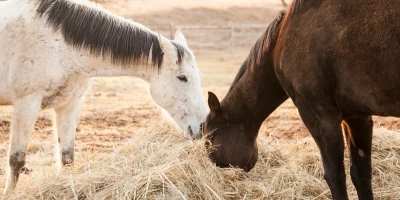
Feeding studies vs. practice: Why measurement errors and short study durations are deceptive. Overview of all findings on the various forms of roughage.
Roughage & Fiber Length in Horses: How the Form of Roughage Influences Digestion
© Adobe Stock / Ella
This article was translated using AI.
Anyone caring for horses with chronic digestive problems knows the situation. The horse has been suffering from fecal water for months, is bloated, or reacts with soft manure or colic. Teeth have been checked, parasites ruled out, mineral supplements adjusted, and concentrates reduced, yet the digestion fails to stabilize. Therapists working with such horses have observed a recurring pattern for years: the rations remarkably often include chopped fiber, haylage, soaked hay, or steamed hay. For many of these horses, the breakthrough only occurs when the feeding is consistently switched to long-stalked, hygienically perfect, dry hay.
This observation is the reason why we advise against chopped fiber, haylage, and other such feedstuffs. And because this is a practical observation, we are regularly told that it is not scientifically sound.
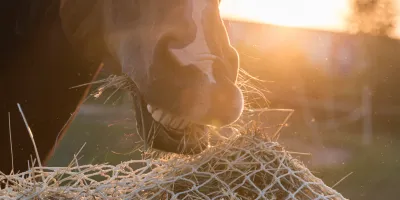
This criticism is justified and deserves a serious answer. Because if you only look at the nutrient analysis, you will find almost no difference between one kilogram of hay and one kilogram of chopped hay from the same crop. Crude fiber, NDF, protein, and sugar are nearly identical. For the horse, however, they are two different feedstuffs. One must be picked up with the lips and incisors, formed into a bolus, and ground between the molars. With the other, a machine has already taken over part of this work—but in a different way than the horse's masticatory apparatus would do it. Similar principles apply to hay that has been soaked, steamed, or ensiled: the ingredients are similar, but the fiber is softer, moister, and more elastic—and this influences how the feed is chewed. Chewing, in turn, influences digestion.
Digestion in the horse begins in the mouth. How a plant particle is chewed determines the form in which it is swallowed. And the form in which it arrives in the large intestine partly determines how well the microorganisms there can work with it and how much time they are given to do so.
So, let's follow the natural process of feed utilization, from chewing to manure. For every form of roughage, we ask: What do we observe in practice? What can be scientifically proven? Where are there physiologically plausible explanations that no one has investigated yet? And which studies seem to speak for or against this, and what do they actually state?
The answer will not be as simple as many would like. But it shows that "not scientifically sound" and "not yet scientifically investigated" are two very different things.
Not All Chewing Is the Same
In feeding consultations, "chewing" is often spoken of as a simple matter: the horse takes in feed, chews it, and swallows it. The more it chews, the better. This idea also shapes many product descriptions. Chopped fibers are supposed to "encourage chewing," and mueslis with fiber content are said to be "chew-intensive." However, looking at what is actually measured in studies on chewing behavior, it quickly becomes clear that "chewing" is not a uniform metric. There are at least four different things that can be measured, and they each convey something different.
Four Metrics, Four Different Statements
The most frequently recorded metric is chewing frequency, i.e., the number of chewing movements per minute. it describes how fast a horse chews, but not what happens to the feed in the process. From the frequency and the duration of feeding, the number of chewing strokes per kilogram of dry matter can be calculated. This indicates how many chewing movements a certain amount of feed receives and is often used as a measure of "chewing intensity." According to classic telemetric measurements by Meyer and colleagues, a horse needs about 3,000 to 3,500 chewing strokes for one kilogram of hay, whereas it only needs about 800 to 1,200 for one kilogram of concentrate.
Less common is the measurement of chewing muscle activity, usually by means of electromyography of the M. masseter. This shows the force with which the muscle works. And in only very few studies has jaw kinematics been recorded—the actual path the lower jaw travels during a chewing cycle in all three spatial dimensions.
This distinction is not an academic triviality. Because only the last metric answers the question that is crucial for fiber digestion: Is the plant material ground between the molars or merely squeezed?
How a Horse Grinds Fibers
To understand this, it is worth taking a brief look at the masticatory apparatus. In the horse, the upper jaw is wider than the lower jaw. The upper rows of molars are further apart than the lower ones, and the chewing surfaces are angled. Therefore, the horse can only chew on one side at a time. When grinding, it shifts the lower jaw sideways to the outside, closes the mouth, and then pulls the lower teeth inward across the upper ones under pressure. In this movement, plant fibers are sheared and ground between the sharp enamel ridges of the teeth. The chewing side changes regularly.
For a long fiber to be processed in this way, it must be held between the rows of teeth. In practice, horses can be seen using their lips, tongue, and cheeks to form long hay into a kind of bolus or bundle that lies between the molars and is gradually pulverized by the grinding motion. The cheeks and tongue keep the material on the chewing surface. This observation is known to every dental practitioner, but it has never been systematically described or measured.
This leads to a hypothesis that is central to the question of chopped fiber. Very short plant pieces are harder to form into a coherent bolus. If the horse were to process them with a full lateral grinding motion, the short pieces could easily be pushed off the chewing surface. It is therefore conceivable that short-cut material is processed more with a vertical, squeezing movement. This would compress and partially break open the fibers, but grind them less thoroughly. This hypothesis is physically plausible but has not been directly investigated yet.
What Is Actually Being Measured
The only study to date that directly measured jaw movement in horses for different feed forms was conducted by Bonin and colleagues. They examined seven horses using three-dimensional motion analysis while eating hay and pellets. With pellets, the chewing frequency was higher than with hay. With hay, however, the lower jaw moved significantly further in all three spatial dimensions, especially laterally, compared to pellets. This greater lateral excursion with hay was sufficient for the opposing rows of molars to slide completely over each other during the grinding process. This was not the case with pellets, where the movement was more of a squeezing action than a grinding action.
The study is small and only compares two very different feed forms. However, it shows something fundamental: the horse adapts its chewing motion to the structure of the feed. And a higher chewing frequency does not automatically mean more thorough grinding of the feed. A horse can chew quickly and grind very little in the process.
There is no comparable study for chopped fiber. Vervuert and colleagues measured the activity of the masseter in four horses while eating hay, haylage, and a chopped mixture of straw and alfalfa. The chopped mixture produced high muscle activity with significantly shorter chewing cycles: about 0.22 seconds compared to about 0.31 seconds for hay. This study is often cited as evidence that chopped fiber (also referred to as chaff) is "intensively chewed." However, what was measured was the force of the muscle, not the movement of the jaw. Short, powerful chewing cycles are at least as compatible with a squeezing movement as with a grinding one. The study, therefore, can neither support nor refute our hypothesis.
More Chewing Strokes Does Not Mean Smaller Particles
How little the number of chewing strokes says about actual pulverization is shown by a Japanese study by Miyaji and colleagues. They compared Timothy hay with Timothy grass silage. The silage was eaten with more chewing strokes per gram of dry matter than the hay. Nevertheless, significantly more large particles were found in the feces: 51 percent compared to 29 percent for the hay. If one were to count only chewing strokes as a measure of pulverization, the opposite result would be expected. Why the silage appeared coarser in the feces despite more chewing work was not investigated. Possible reasons include a different chewing motion, different breakage behavior of the moist, elastic fiber, or faster passage.
For the basics, it suffices to state: The number of chewing strokes describes the effort, not the result.
Even Hay Is Not Just Hay
Even with long-stalked hay, no fixed chewing performance can be specified. Plant species, harvest time, leaf-to-stem ratio, stem thickness, lignification, and degree of dryness significantly alter mechanical properties. In a study published in 2026 with eight horses, fine-stemmed Bermudagrass hay led to significantly fewer chewing strokes per kilogram than alfalfa, bluegrass, or orchardgrass hay. The authors themselves point out that it remains unclear whether lower chewing work is related to digestive disorders. Jaw movement was not measured here either.
Additionally, there are large differences between individual horses. In an experiment by Müller with long-stalked and chopped haylage from the same source material, the differences between horses were often greater than many differences between the feed variants for a single horse. This is an important hint for practice: the same form of feed can be problematic for one horse and unproblematic for another.
This would also confirm that there are horse owners who state that their horses apparently have no problems with chopped fiber.
Grass: Many Jaw Movements, but Which Ones?
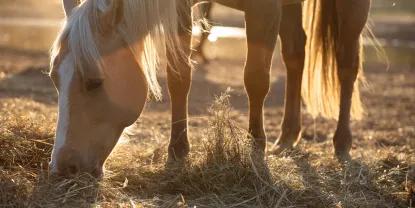
The natural comparative feed is fresh grass. Here, the body of study is surprisingly thin. A frequently cited study by Weinert and colleagues found a higher rate of jaw movements in eight mares on pasture than when fed hay. However, the sensor system used could not reliably distinguish between the ripping of grass with the incisors and the actual chewing. The measured "chewing rate" is therefore the sum of both.
That this distinction is important is shown by Edouard and colleagues. On short grass, horses took significantly more but smaller bites than on tall grass, and the number of chewing movements per gram of dry matter intake was higher on the short sward. How the lower jaw moves in the process—whether a horse on a short sward grinds as laterally as when processing a large bite of long stalks—has not yet been investigated by anyone.
Hunger and Time Pressure Change Chewing
In addition to the feed structure, the feeding situation also influences how a horse eats. Glunk and colleagues gave eight horses three, six, nine, or 24 hours of pasture access. The shorter the access, the faster the horses consumed dry matter during the available time. They thus compensated for the restriction, at least partially, by eating faster.
Whether they also chew differently in the process was not measured. But if more plant material passes through the mouth in the same amount of time, there are only a few possibilities: the horse chews faster, takes in more material per chewing cycle, or each gram of feed is processed for less time before being swallowed. For pellets, Bochnia and colleagues showed that a higher intake rate can be accompanied by lower chewing intensity. For hay, the connection is less clear. In a slow-feeder study by Hart and colleagues, feeding duration changed without the number of chewing strokes per kilogram changing accordingly.
For our topic, an important limitation follows from this, which is missing in almost all chewing studies. Whether a horse had nothing to eat for hours before the experiment, whether it knows that the feeder will close again after half an hour, or whether it can eat in peace and without competition, possibly changes the chewing behavior as much as the feed itself. In practice, both influences often overlap: haylage, chopped fiber, hay cobs, or soaked hay are often fed in rations, especially when horses need to lose weight or their feed is specifically dosed.
Saliva: The Underestimated Part of Chewing
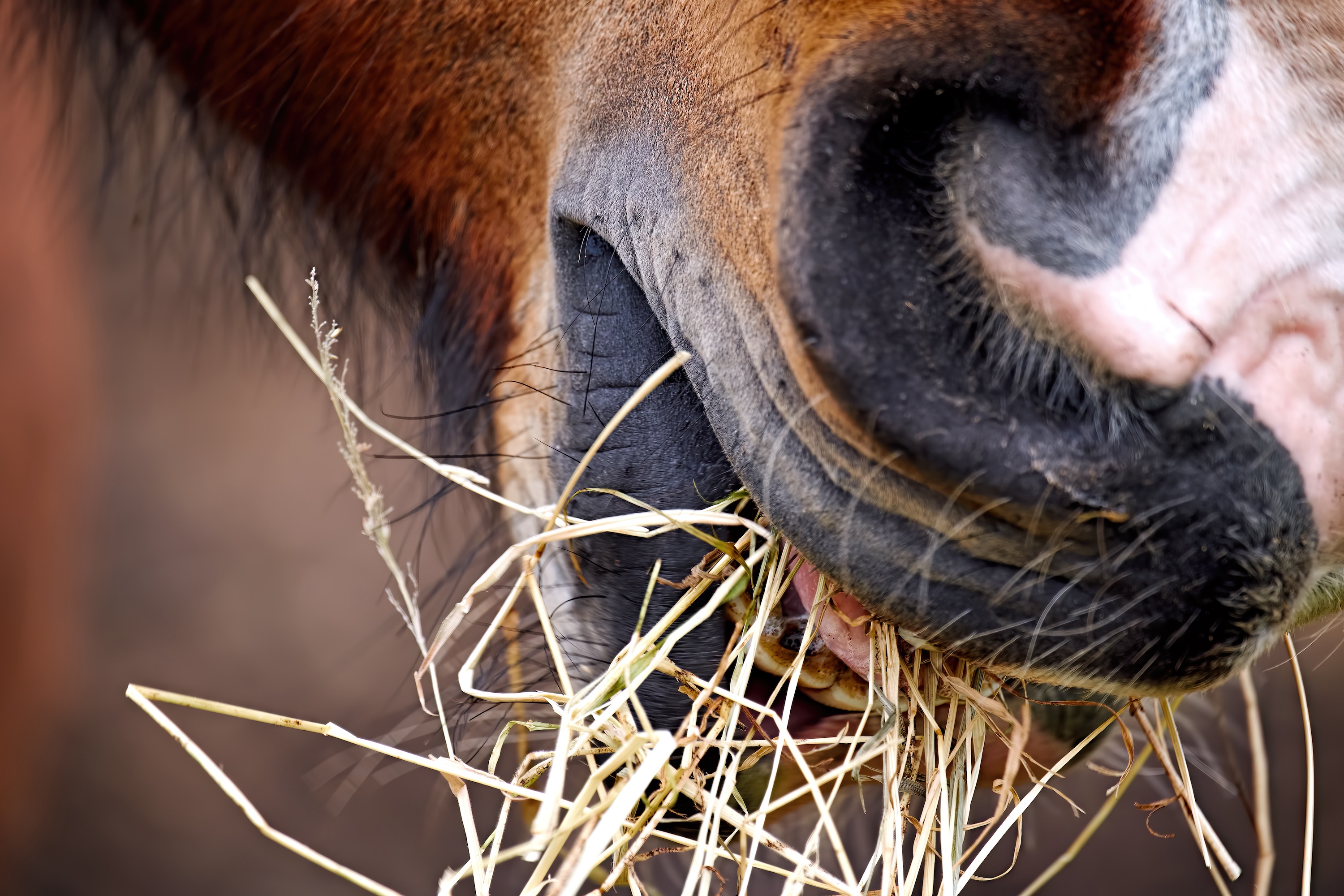
Chewing serves not only for pulverization. The horse only produces saliva while it chews, and the amount is closely linked to the chewing work. According to Meyer and colleagues, unchopped hay is salivated with about 3 to 3.5 liters of saliva per kilogram, while manger feed receives only about one liter. The saliva moistens the feed, makes it swallowable, and buffers stomach acid.
For soaked and steamed hay, an obvious question arises: if the feed already enters the mouth wet, does the horse then need less chewing work to form a swallowable bolus? And does it produce less saliva as a result? Both are plausible. There are no measurements on this.
 © Adobe Stock / HighlandBrochs.com
The Black Box Between Mouth and Cecum
This brings us to the largest gap in this entire field. To evaluate how well a feed was chewed, one would actually have to examine the swallowed bolus: How large are the particles? Are the fibers ground or just squeezed? How heavily are they salivated? Exactly this measurement is practically non-existent. Studies describe the feed before it enters the mouth, count chewing strokes, and later usually examine the feces, or at best, the contents of the cecum of fistulated horses. What happens in between remains largely unobserved.
Regarding the question of why certain forms of roughage are repeatedly associated with digestive problems in practice, this is the decisive point. We know that the horse adapts its chewing motion to the feed structure. We know that more chewing strokes do not automatically lead to smaller particles. And we know that hunger and time pressure change the intake speed. However, we do not know what the bolus actually looks like after chewing chopped fiber, soaked hay, or haylage compared to long, dry hay. And thus, we do not know in what form these fibers ultimately arrive in the large intestine.
What Happens with Different Fiber Lengths in the Large Intestine
When a horse swallows plant fibers, their digestion is far from complete. The stomach and small intestine cannot break down cellulose and hemicellulose. This is handled by microorganisms in the cecum and colon. For them, it is crucial in what form the fiber arrives and how much time they have to break it down. Whether the length and structure of the fibers play a role in this is the second half of our guiding question.
Why Particle Size and Retention Time Go Together
Microorganisms break down plant fibers from the surface. They attach to the fiber, decompose the cell walls, and work their way inward from broken-open spots. The larger the accessible surface area and the more the fiber is broken open, the more target area they have. This is the basic principle behind pulverization during chewing.
Time is at least as important. Fiber breakdown is a slow process, and digestibility depends heavily on how long the material remains in the fermentation chamber. Longer retention times are associated in most investigations with better digestibility and higher microbial activity. Frape also describes that a significantly shortened retention time is associated with lower digestibility. Conversely, excessively long retention times can lead to fermentation errors and dysbioses, which can then negatively affect digestion.
For digestion, two things count simultaneously: how accessible the fiber is for the microorganisms and how long it is available to them. Both can be influenced by the form of the roughage.
An Intestine That Brakes
The large intestine of the horse is not a straight tube through which the food pulp flows evenly backward. From the cecum, the contents enter the right ventral colon, run forward, turn at the sternal flexure to the left side of the body, run backward, then turn at the pelvic flexure toward the back, run forward in the dorsal colon, pass across the diaphragmatic flexure back to the other side of the body and from there backward, and then pass into the rectum. At several points, the intestine narrows significantly, particularly at the transition from the cecum into the colon and at the flexures. The changes in direction at the flexures and the narrow passages act as brakes.
Frape describes in the third edition of his textbook that the resistance against transport increases from barrier to barrier, with the last one offering the greatest resistance. According to his presentation, particles of about two centimeters in length can sometimes be retained for more than a week. He does not cite a source for this information.
That the intestine actively holds back the food pulp is well documented. Sellers and colleagues investigated thirteen chronically instrumented, non-anesthetized horses and 25 intestinal preparations as early as 1979. They described the transition zone between the ventral and dorsal colon as a zone of resistance to transport and as a likely pacemaker region. In a follow-up study in 1982, they showed that a pacemaker in the area of the pelvic flexure triggers both forward-directed and retrograde contraction waves. The retrograde waves keep the cecum and ventral colon filled, thus giving the microorganisms time to break down the cellulose.
The equine large intestine thus possesses countercurrent peristalsis that specifically extends the retention time in the fermentation chamber. This is well-researched and has been described in physiology for decades.
What these studies do not show is a retention that specifically reacts to particle size. The retropulsion holds back the content as a whole. Whether long fibers are held back longer than short ones cannot be deduced from the works of Sellers.
Are Large Particles Retained Longer?
This is exactly what Frape's textbook statement claims, and here the literature becomes contradictory.
Presumably, the oldest basis is the work of Argenzio and colleagues from 1974. They introduced markers directly into the cecum of cecum-fistulated horses and found selective retention of large particles at the transition from the ventral to the dorsal colon. Frape's indication of two centimeters likely goes back to these or similar experiments. However, Argenzio and colleagues used plastic particles. Such markers are neither chewed nor microbially degraded and retain their size throughout the passage. A plant fiber, on the other hand, becomes continuously smaller in the large intestine.
Other works, particularly by Björnhag, Sperber, and colleagues, found the opposite at a later point: an enrichment of small particles at the transition from the dorsal colon into the transverse colon.
Newer investigations have revisited the question using markers made from real roughage. Hummel and colleagues fed ponies unchopped, marked roughage, then sieved the feces into different size classes and determined the retention time for each class. Large particles remained in the intestine slightly longer than small ones, but the difference was so small that the authors classified it as biologically irrelevant. In 2022, Schwarm and colleagues introduced fiber markers of one to two millimeters and eight millimeters in length directly into the cecum of five cecum-fistulated horses. The mean retention time in the large intestine was 26.2 and 26.3 hours, respectively—practically the same. Schwarm and colleagues attribute the earlier contrary finding of Argenzio to the plastic particles and their very large dimensions.
Both newer studies have confirmed a well-known difference: solid particles remain in the large intestine slightly longer overall than the liquid phase.
At first glance, this speaks against the idea that long fibers get stuck in the large intestine. However, the authors themselves draw a more cautious conclusion. They consider it possible that large particles are retained at the transition from the ventral to the dorsal colon and small particles at a later transition, and that both effects cancel each other out over the entire passage. Their experiment cannot rule out such regional sorting. The keyword in the title of their study is therefore "net": there is no size-dependent net particle retention. This says little about local sorting processes.
In addition, there are the methodological limitations described at the beginning, which apply to both sides. Argenzio, Drogoul, and Schwarm worked with fistulated animals, and there are indications that fistulation changes the passage of the food pulp. Austbø and Volden found different retention times in the same horses before and after the placement of a cecum fistula. Furthermore, experiments with markers introduced directly into the cecum bypass the mouth, stomach, and small intestine completely. The fibers were machine-cut to a defined length, not chewed. They therefore answer the question of whether a large intestine retains two machine-cut fiber lengths for different periods. They do not answer how it reacts to fibers that are differently broken, squeezed, ground, or salivated depending on the chewing movement.
Fine In, Coarser Out
If the length of the fiber alone does not decide, then what does? Some experiments in which the same feed was fed in different forms provide surprising answers.
Drogoul and colleagues fed ponies a mixture of alfalfa and orchardgrass hay, either chopped or ground to 1.5 millimeters and pelletized. According to common perception, the finely ground material should pass faster and be more easily digested. The opposite was the case: the retention time in the large intestine increased for both the liquid and the particle phases. In four fistulated ponies, the microorganisms in the cecum and colon broke down the dry matter and fiber of the ground hay more slowly and less completely. Nevertheless, the total digestibility of the fiber hardly differed. The authors suspect that the longer retention time compensated for the slower breakdown.
Silva and colleagues fed four horses with fistulas in the ventral colon hay in four forms: long, chopped, and ground to 5 and 3 millimeters. The ground variants extended the transit time of the solid phase by about three hours. The mean retention time did not differ. In the colon, the smallest particles were found, as expected, with the hay ground to 3 millimeters.
Starrett and colleagues compared a pure pellet diet with a ration of Bermudagrass hay and pellets in twenty healthy horses in 2026. The authors expected smaller fecal particles with the pellet diet. In fact, they found more large particles and lower fiber digestibility. However, the rations differed not only in structure but also in composition and feed intake, so pelleting cannot be considered the sole cause.
And in the study by Miyaji and colleagues already mentioned, grass silage led to significantly more large fecal particles than hay from the same grass, despite more chewing strokes, with a simultaneous shorter retention time.
These findings do not necessarily have the same mechanism. Together, however, they show that the particle size in the feces cannot simply be predicted from the particle size before eating. Technically finely comminuted material is not automatically digested faster or better. And a feed that was more heavily chewed does not automatically appear finer in the feces. Between the mouth and the manure, mechanical, microbial, and motor processes occur that we only partially understand.
A possible explanation for Drogoul's finding is physiologically obvious but not proven. Machine grinding creates particles with a different breakage structure than grinding between the teeth. It is possible that for the microorganisms, it is less about the size of a particle and more about how its surface is configured: whether the cell walls are torn and the fibers are frayed, or whether the surface is smooth and compacted. If this is true, it would not be the length of the fiber that is decisive, but the way it was comminuted. Exactly this question also arises for chopped fiber, soaked hay, and haylage.
More Movement Does Not Mean More Transport
The motor activity of the intestine also reacts to the form of the feed. In another investigation by Starrett and colleagues, intestinal contractions were counted via ultrasound at three points for four minutes each in twelve Quarter Horses. On the pellet diet, more contractions were found at the sternal flexure, but not at the cecum and left ventral colon. The authors point out that ultrasound cannot detect in which direction a contraction moves the content: backward, forward, in circles, or hardly at all. More movement can thus mean more transport, but just as well more retention or more mixing. However, the study shows that the form of feed can influence regional intestinal motor activity. Which direction this motor activity takes remains open.
What Large Fibers in the Feces Mean and What They Don't
Large, visible fibers in the feces are often seen in practice as a sign of poor teeth or poor chewing. This can be true, but it is not the only possible explanation. Martuzzi and colleagues compared different roughages in six horses. Straw had the lowest digestibility at about 45 percent and led to larger fecal particles, while a ryegrass-clover mixture was at about 74 percent. The lignification and microbial degradability of the plant material thus determine which particles appear in the feces. Large fecal fibers are a hint to be taken seriously. However, they can only be evaluated in connection with the feed the horse receives, as well as the state of the teeth, the duration of the chewing process, and the chewing movement—whether grinding or rather squeezing.
What We Take Away From This
Regarding the connection between chewing and large intestine digestion, it can be stated: The equine large intestine actively retains its contents, including through retrograde contraction waves. This gives the microorganisms time for fiber breakdown, and this time is crucial for digestibility. That the intestine specifically retains long fibers longer than short ones was described with plastic markers, but has not yet been confirmed as a net effect with markers made from roughage. Regional sorting processes are not ruled out by this. Several experiments also show that technically pre-chopped roughage neither passes automatically faster nor is broken down better, and that particle size in the feces cannot be predicted from the form of the feed before consumption.
From this follows a refinement of our initial hypothesis: the way a feed was chewed determines the nature of the fibers that arrive in the large intestine, their breakage structure, their surface, their hydration. This changes how well and how quickly the microorganisms can break them down, and thus possibly also how the intestine transports and mixes them. Individual components of this chain are proven. The chain as a whole has never been investigated for the forms of roughage in question here.
This article marks the beginning of a three-part technical series. Learn in Part 2: "Hay, Grass, Haylage, Chopped Fibre and Cobs: Roughage in Horses in Practice and Science" how individual forms of roughage affect chewing behavior and intestinal passage. In Part 3: "Feeding Studies in Horses: Why Practical Observations Often Prove Right Regarding Roughage", the scientific body of research is critically evaluated, showing why feeding trials and practical observations in the stable often lead to different conclusions.
Sources
- Argenzio, R. A., Lowe, J. E., Pickard, D. W., & Stevens, C. E. (1974). Digesta passage and water exchange in the equine large intestine. American Journal of Physiology-Legacy Content, 226(5), 1035-1042.
- Austbø, D., & Volden, H. (2006). Influence of passage model and caecal cannulation on estimated passage kinetics of roughage and concentrate in the gastrointestinal tract of horses. Livestock Science, 100(1), 33-43.
- Björnhag, G., Sperber, I., & Holtenius, K. (1984). A separation mechanism in the large intestine of equines. Canadian Journal of Animal Science, 64 (Suppl.), 89-90.
- Bochnia, M., Goetz, F., Wensch-Dorendorf, M., Koelln, M., & Zeyner, A. (2019). Chewing patterns in horses during the intake of variable quantities of two pelleted compound feeds differing in their physical characteristics only. Research in Veterinary Science, 125, 189-194.
- Bonin, S. J., Clayton, H. M., Lanovaz, J. L., & Johnston, T. (2007). Comparison of mandibular motion in horses chewing hay and pellets. Equine Veterinary Journal, 39(3), 258-262.
- Brüssow, N. (2006). Effekte verschiedener Futtermittel und Bearbeitungsformen auf die Futteraufnahmedauer, die Kaufrequenz und die Kauintensität beim Pferd. Dissertation, Tierärztliche Hochschule Hannover.
- Clauss, M. et al. (2008). An isthmus at the caecocolical junction is an anatomical feature of domestic and wild equids. European Journal of Wildlife Research, 54(2), 347-351.
- Drogoul, C., Poncet, C., & Tisserand, J. L. (2000). Feeding ground and pelleted hay rather than chopped hay to ponies: 1. Consequences for in vivo digestibility and rate of passage of digesta. Animal Feed Science and Technology, 87(1-2), 117-130.
- Drogoul, C., Tisserand, J. L., & Poncet, C. (2000). Feeding ground and pelleted hay rather than chopped hay to ponies: 2. Consequences on fibre degradation in the cecum and the colon. Animal Feed Science and Technology, 87(1-2), 131-145.
- Earing, J. E., Hathaway, M. R., Sheaffer, C. C., Hetchler, B. P., Jacobson, L. D., Paulson, J. C., & Martinson, K. L. (2013). Effect of hay steaming on forage nutritive values and dry matter intake by horses. Journal of Animal Science, 91(12), 5813-5820.
- Edouard, N., Fleurance, G., Dumont, B., Baumont, R., & Duncan, P. (2009). Does sward height affect feeding patch choice and voluntary intake in horses? Applied Animal Behaviour Science, 119(3-4), 219-228.
- Ellis, A. D. et al. (2015). Effect of forage presentation on feed intake behaviour in stabled horses. Applied Animal Behaviour Science, 165, 88-94.
- Ellis, A. D., Thomas, S., Arkell, K., & Harris, P. (2005). Adding chopped straw to concentrate feed: The effect of inclusion rate and particle length on intake behaviour of horses. Pferdeheilkunde, 21, 35-37.
- Frape, D. (2004). Equine Nutrition and Feeding (3. Aufl.). Blackwell Publishing, Oxford.
- Geor, R. J., Harris, P. A., & Coenen, M. (Hrsg.) (2013). Equine Applied and Clinical Nutrition. Saunders Elsevier, Edinburgh.
- Glatter, M., Bochnia, M., Wensch-Dorendorf, M., Greef, J. M., & Zeyner, A. (2021). Feed intake parameters of horses fed soaked or steamed hay and hygienic quality of hay stored following treatment. Animals, 11(9), 2729.
- Glunk, M. E. C., Pratt-Phillips, P. S. E., & Siciliano, P. P. D. (2013). Effect of restricted pasture access on pasture dry matter intake rate, dietary energy intake, and fecal pH in horses. Journal of Equine Veterinary Science, 33(6), 421-426.
- Harris, P. A., Ellis, A. D., Fradinho, M. J., Jansson, A., Julliand, V., Luthersson, N., Santos, A. S., & Vervuert, I. (2017). Review: Feeding conserved forage to horses: Recent advances and recommendations. Animal, 11(6), 958-967.
- Hart, R., Bailey, A., Farmer, J., & Duberstein, K. (2024). Chewing analysis of horses consuming bermudagrass hay in different styles of slow feeders as compared to loose hay. Journal of Equine Veterinary Science, 140, 105133.
- Hillyer, M. G., Taylor, F. G. R., Proudman, C. J., Edwards, G. B., Smith, J. E., & French, N. P. (2002). Case control study to identify risk factors for simple colonic obstruction and distension colic in horses. Equine Veterinary Journal, 34(5), 455-463.
- Hummel, J., Scheurich, F., Ortmann, S., Crompton, L. A., Gerken, M., & Clauss, M. (2018). Comparative selective retention of particle size classes in the gastrointestinal tract of ponies and goats. Journal of Animal Physiology and Animal Nutrition, 102(2), 429-439.
- Jansson, A., Harris, P., Larsdotter Davey, S., Luthersson, N., Ragnarsson, S., & Ringmark, S. (2021). Straw as an alternative to grass forage in horses: Effects on post-prandial metabolic profile, energy intake, behaviour and gastric ulceration. Animals, 11(8), 2197.
- Lindroth, K. M., Dicksved, J., Vervuert, I., & Müller, C. E. (2022). Chemical composition and physical characteristics of faeces in horses with and without free faecal liquid – two case-control studies. BMC Veterinary Research, 18(1), 2.
- Lindroth, K. M., Lindberg, J. E., Johansen, A., & Müller, C. E. (2021). Feeding and management of horses with and without free faecal liquid: A case-control study. Animals, 11(9), 2552.
- Long, J. F., Hutton, R., Abrams, A., Duberstein, J. A., & Duberstein, K. J. (2026). Mastication characterization of horses fed bermudagrass hay in a two-part field study. Journal of Equine Veterinary Science, 106068.
- Luthersson, N., Nielsen, K. H., Harris, P., & Parkin, T. D. H. (2009). Risk factors associated with equine gastric ulceration syndrome (EGUS) in 201 horses in Denmark. Equine Veterinary Journal, 41(7), 625-630.
- Martuzzi, F., Danese, T., Simoni, M., Valle, E., & Righi, F. (2024). Faecal particle size distribution in relation to forage type and digestibility in horses: Preliminary results. Italian Journal of Animal Science, 23(1), 1146-1152.
- Meyer, H. V., Ahlswede, L., & Reinhardt, H. J. (1975). Untersuchungen über Fressdauer, Kaufrequenz und Futterzerkleinerung beim Pferd. Deutsche Tierärztliche Wochenschrift, 82, 54-58.
- Meyer, H., Coenen, M., & Vervuert, I. (2014). Pferdefütterung (6. Aufl.). Enke, Stuttgart.
- Miyaji, M., Ueda, K., Hata, H., & Kondo, S. (2011). Effects of quality and physical form of hay on mean retention time of digesta and total tract digestibility in horses. Animal feed science and technology, 165(1-2), 61-67.
- Miyaji, M., Ueda, K., Yamada, F., Kobayashi, Y., Hata, H., Nakatsuji, H., & Kondo, S. (2004). Chewing activity, particle size distribution of feces and total tract mean retention time of digesta in horses fed timothy hay or silage. Animal Science Journal, 75(4).
- Moore–Colyer, M. J., & Longland, A. (2004). Exploiting dietary fibre in equid diets. BSAP Occasional Publication, 32, 113-128.
- Moore-Colyer, M., Longland, A., Harris, P., Zeef, L., & Crosthwaite, S. (2020). Mapping the bacterial ecology on the phyllosphere of dry and post soaked grass hay for horses. PLoS One, 15(1), e0227151.
- Mostert, N. L., Williams, K., & Witherow, B. A. (2024). A preliminary study on feeding straw to horses and its effects on equine chewing and consumption rates. International Journal of Equine Science, 3(2), 115-122.
- Muhonen, S., Julliand, V., Lindberg, J. E., Bertilsson, J., & Jansson, A. (2009). Effects on the equine colon ecosystem of grass silage and haylage diets after an abrupt change from hay. Journal of Animal Science, 87(7), 2291-2298.
- Müller, C. E. (2009). Long-stemmed vs. cut haylage in bales – Effects on fermentation, aerobic storage stability, equine eating behaviour and characteristics of equine faeces. Animal Feed Science and Technology, 152(3-4), 307-321.
- Müller, C. E. (2018). Silage and haylage for horses. Grass and Forage Science, 73(4), 815-827.
- Müller, C. E., & Udén, P. (2007). Preference of horses for grass conserved as hay, haylage or silage. Animal Feed Science and Technology, 132(1-2), 66-78.
- Müller, C. E., von Rosen, D., & Udén, P. (2008). Effect of forage conservation method on microbial flora and fermentation pattern in forage and in equine colon and faeces. Livestock Science, 119(1-3), 116-128.
- Müller, P. C. E. (2014). Microbial composition before and after conservation of grass-dominated haylage harvested early, middle, and late in the season. Journal of Equine Veterinary Science, 34(5), 593-601.
- Raspa, F., Chessa, S., Bergero, D., Sacchi, P., Ferrocino, I., Cocolin, L., et al., & Valle, E. (2024). Microbiota characterization throughout the digestive tract of horses fed a high-fiber vs. a high-starch diet. Frontiers in Veterinary Science, 11, 1386135.
- Ringmark, S., Connysson, M., Segerkvist, K. A., & Müller, C. E. (2026). Harvested Forages for Horses From a Feeding Perspective—A Systematic Literature Review. Grass and Forage Science, 81(3), e70068.
- Schwarm, A., Clauss, M., Ortmann, S., & Jensen, R. B. (2022). No size-dependent net particle retention in the hindgut of horses. Journal of Animal Physiology and Animal Nutrition, 106(6), 1356-1363.
- Sellers, A. F., & Lowe, J. E. (1986). Review of large intestinal motility and mechanisms of impaction in the horse. Equine Veterinary Journal, 18(4), 261-263.
- Sellers, A. F., Lowe, J. E., & Brondum, J. (1979). Motor events in equine large colon. American Journal of Physiology-Endocrinology and Metabolism, 237(5), E457.
- Sellers, A. F., Lowe, J. E., Drost, C. J., Rendano, V. T., Georgi, J. R., & Roberts, M. C. (1982). Retropulsion-propulsion in equine large colon. American Journal of Veterinary Research, 43(3), 390-396.
- Sellers, A. F., Lowe, J. E., Rendano, V. T., & Drost, C. J. (1982). The reservoir function of the equine cecum and ventral large colon. Cornell Veterinarian, 72(3), 233-241.
- Silva, V. P., Almeida, F. Q., Pimentel, R. R. M., Godoi, F. N., Santos, T. M., & Pires, M. S. (2014). Passage kinetics of digesta in horses fed with coastcross hay ground to different degrees. Ciência e Agrotecnologia, 38(5), 506-514.
- Sperber, I., Björnhag, G., & Holtenius, K. (1992). A separation mechanism and fluid flow in the large intestine of the equine. Pferdeheilkunde, 1st European Conference on Equine Nutrition, 29-32.
- Starrett, A., Arnold, C. E., Burr, A., Sarturi, J. O., Leatherwood, J. L., Pilla, R., et al., & Chaffin, M. K. (2026). Diet composition influences equine large intestinal motility as measured by transcutaneous ultrasound. American Journal of Veterinary Research, 87(5).
- Starrett, A., Sarturi, J. O., Leatherwood, J. L., Chaffin, M. K., Mukhopadhyay, S., Pilla, R., & Arnold, C. E. (2026). The effects of diet on the physical characteristics of feces and fiber digestibility in healthy horses. Journal of Animal Science, 104, skag255.
- Tkaczyk, E., Gazda, I. E., Humięcka, M., Łuszczyński, J., Basińska, K., Kaczmarek, B., ... & Janczarek, I. (2026). Do Polish Konik Horses Find Soaked Hay to Be Palatable?. Animals, 16(11), 1663.
- Van Weyenberg, S., Sales, J., & Janssens, G. P. J. (2006). Passage rate of digesta through the equine gastrointestinal tract: A review. Livestock Science, 99(1), 3-12.
- Vervuert, I., Brüssow, N., Bochnia, M., Cuddeford, D., & Coenen, M. (2013). Electromyographic evaluation of masseter muscle activity in horses fed (i) different types of roughage and (ii) maize after different hay allocations. Journal of Animal Physiology and Animal Nutrition, 97(3), 515-521.
- Vervuert, I., Brüssow, N., Bochnia, M., Hollands, T., Cuddeford, D., & Coenen, M. (2010). Electromyographic evaluation of masseter muscle activity in horses fed different types of roughage. In: The impact of nutrition on the health and welfare of horses (S. 75-77). Wageningen Academic.
- Vondran, S., Venner, M., & Vervuert, I. (2016). Effects of two alfalfa preparations with different particle sizes on the gastric mucosa in weanlings: Alfalfa chaff versus alfalfa pellets. BMC Veterinary Research, 12(1), 110.
- Vondran, S., Venner, M., Coenen, M., & Vervuert, I. (2017). Effects of alfalfa chaff on the gastric mucosa in adult horses. Pferdeheilkunde, 33(1), 66-71.
- Weinert, J. R., Werner, J., & Williams, C. A. (2020). Validation and implementation of an automated chew sensor-based remote monitoring device as tool for equine grazing research. Journal of Equine Veterinary Science, 88, 102971.
- Wichert, B., Nater, S., Wittenbrink, M. M., Wolf, P., Meyer, K., & Wanner, M. (2008). Judgement of hygienic quality of roughage in horse stables in Switzerland. Journal of Animal Physiology and Animal Nutrition, 92(4), 432-437.