Discover what peppermint leaves do for digestion and the stomach, the proper dosage for horses, and how to prepare soothing peppermint tea.
Herbal Advice: Peppermint
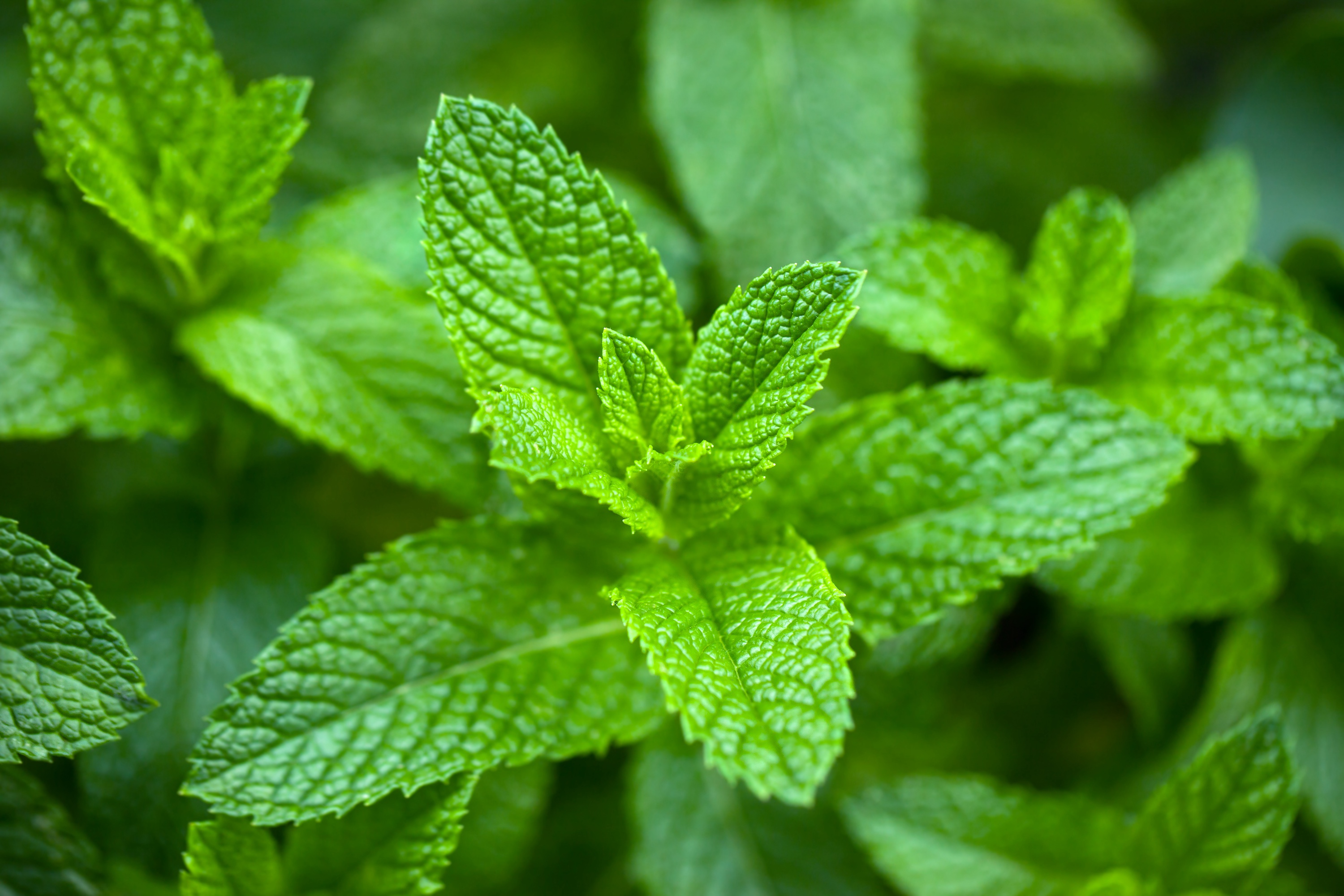
© Adobe Stock / janaph
This article was translated using AI.
Herb Profile:
|
Common Name |
Peppermint (True Peppermint, English Mint) |
|
Botanical Name |
Mentha × piperita |
|
Traditional Use |
Mints were already valued as medicinal and culinary herbs in antiquity. Peppermint itself was first described in 1696 by the English naturalist John Ray, who recommended it for stomach weakness and diarrhea. Traditionally used for gastrointestinal discomfort, bloating, nausea, cramps, and biliary complaints; as a tea or steam inhalation for colds and coughs; externally for headaches, muscle aches, and itching. In horses, traditionally fed for digestive issues, bloating, loss of appetite, and respiratory support. |
|
Scientifically Proven Effect(s) |
Essential oil (0.5–4%) containing menthol (30–55%), menthone, isomenthone, menthyl acetate, menthofuran, and 1,8-cineole; rosmarinic acid and other caffeic acid derivatives, flavonoids (including eriocitrin, luteolin, and apigenin glycosides), triterpenes. Antispasmodic, carminative, choleretic, appetite-stimulating, antimicrobial, secretolytic/expectorant, cooling, and locally analgesic. |
|
Contraindications |
Do not administer pure peppermint essential oil internally, and do not apply it to mucous membranes, eyes, or injured skin; do not use oil around the nostrils in foals. Use with caution in lactating mares, as mint is used in folk medicine to reduce milk production. Do not use in cases of known hypersensitivity to menthol. When foraging, do not confuse with toxic pennyroyal (Mentha pulegium). |
|
When Is It Harvested? |
The leaves are picked just before or at the beginning of flowering from June to August, on dry days in the late morning. After cutting back, a second harvest is possible in late summer. |
|
Which Plant Parts Are Used? |
The leaves, rarely the whole aerial herb. |
|
How Is It Prepared? |
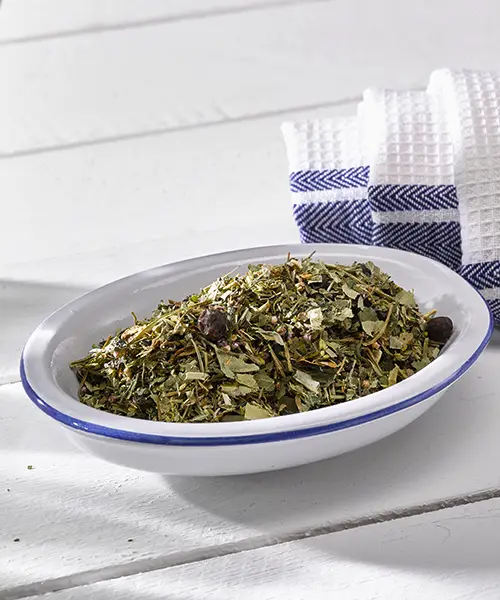
Mix fresh chopped leaves or dried, rubbed leaves into the feed. As a tea: pour boiling water over the leaves, cover and steep for 5 to 10 minutes, strain, and serve lukewarm or pour over feed. |
|
Trivia |
The name goes back to the Greek myth of the nymph Minthe, who was transformed into a plant by Persephone out of jealousy. |
Herbal Advice:
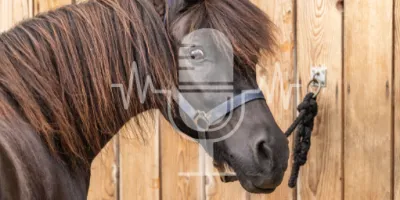
Peppermint is one of the best-known medicinal herbs of all and a proven classic in horse nutrition. Horses can safely eat peppermint, and most of them thoroughly enjoy it: in a British study on taste preferences, peppermint was among the flavors that horses readily accepted in feed and consumed swiftly. This makes it one of the most uncomplicated herbs for horses.
Peppermint owes its beneficial effects primarily to its essential oil, which consists largely of menthol. Menthol blocks calcium channels in the smooth muscles of the digestive tract, exerting an antispasmodic effect. At the same time, its active compounds promote the expulsion of gas, stimulate bile flow and appetite, and provide antimicrobial benefits. The characteristic cooling sensation arises because menthol triggers the cold receptors in mucous membranes, which also provides mild local pain relief. Rosmarinic acid and flavonoids complement this spectrum with anti-inflammatory and antioxidant properties.
Its primary area of application is digestion. In cases of flatulence, mild spasmodic abdominal discomfort, a tendency toward fecal water, or intestinal restlessness after dietary changes, peppermint can relax the digestive tract and thus support equine gut health. In humans, the antispasmodic effect of peppermint oil for irritable bowel syndrome is well documented across multiple studies; in horses, its use is primarily supported by empirical experience and its known mechanism of action. If there are signs of colic, peppermint is, of course, no substitute for veterinary care. However, you can often provide gentle comfort while waiting for the vet by rubbing a few drops of peppermint oil onto your hands and letting the horse sniff or lick it.
The horse’s stomach can also benefit. Peppermint stimulates appetite and is therefore popular for picky eaters, who often approach their feed much more willingly with the fresh aroma. In a study on horses with gastric ulcers, a herbal blend containing peppermint alongside chamomile, licorice, and marshmallow achieved healing results comparable to the medication omeprazole. This effect cannot be attributed to a single herb alone, and whenever gastric ulcers are suspected, the horse should always be examined by a veterinarian first. Pure peppermint essential oil is unsuitable for the equine stomach, as it can irritate the mucous membranes. The leaves, however, are mild and well-tolerated.
A unique anatomical feature of the horse makes its choleretic (bile-stimulating) effect especially interesting: Horses do not have a gallbladder; the liver continuously secretes bile directly into the small intestine. Peppermint supports this flow and thereby aids digestion. Consequently, the common medical warning in humans against using peppermint in cases of gallstones is irrelevant for horses. For further insight into supporting the liver during demanding periods, see our factsheet on detoxification and the liver.
Furthermore, menthol has expectorant properties and helps clear the airways. During the cold season, peppermint can therefore be a valuable component in a supportive herbal mixture for horses with mild respiratory issues.
Peppermint is typically fed during feed transitions and spring grazing transitions, for bloating and gastrointestinal restlessness, during stressful phases that affect the stomach, for waning appetite, and supportively during cold season. Many horses also appreciate the refreshing leaves on hot summer days.
For an average horse weighing around 500 kg, 10 to 20 g of dried peppermint leaves daily has proven effective, which corresponds to roughly one to two handfuls. Ponies should receive about half that amount. Fresh leaves can be chopped and mixed into the feed in correspondingly larger quantities. Peppermint is well suited for a treatment course over two to four weeks or for targeted use as needed, but should not be fed permanently in large amounts.
Peppermint tea is also very well suited for horses and readily accepted by many. To prepare it, pour one liter of boiling water over two to three tablespoons of peppermint leaves, cover and let steep for 5 to 10 minutes to prevent the essential oil from evaporating, and offer lukewarm. Alternatively, it can be poured over the feed or used as the liquid base for a grain-free mash.
Adverse effects are not expected when using leaves in standard amounts. Caution is advised with pure essential oil: It should neither be fed straight nor applied to mucous membranes or near the eyes, and never in the area of the nostrils in foals. Caution is also recommended with lactating mares, as mint is traditionally used to reduce milk production. Anyone foraging mint in the wild must be able to reliably distinguish it from toxic pennyroyal. If in doubt, consult your veterinarian or a Sanoanimal therapist.
Peppermint blends exceptionally well with other medicinal herbs for horses. Combined with chamomile, fennel, and caraway, it forms a classic mixture for the stomach and digestion; with thyme, it creates an effective blend for the respiratory system.
A practical tip: Peppermint is easy to cultivate in your own garden, but it spreads aggressively via runners and is therefore best planted in a pot or with a root barrier. Harvest just before flowering and dry in the shade at no more than 35 °C or in a dehydrator to preserve the volatile essential oils. Stored airtight, dry, and dark, the supply will keep for about a year. You can find more on foraging herbs in our dedicated article.
Sources:
- Fritz, C. Kräuter, die Pferde fit machen. Sanoanimal Verlag, 2024.
- Goodwin, D., Davidson, H. P. B., and Harris, P. “Selection and acceptance of flavours in concentrate diets for stabled horses.” Applied Animal Behaviour Science 95.3-4 (2005): 223-232. https://www.researchgate.net/publication/223267514_Selection_and_acceptance_of_flavours_in_concentrate_diets_for_stable_horses
- Kulcsár, M., et al. “Phytotherapy compared to omeprazol therapy in equine gastric ulcers.” Acta Veterinaria Brno 91.4 (2022): 309-315. https://actavet.vfu.cz/media/pdf/actavet_2022091040309.pdf
- McKay, D. L., and Blumberg, J. B. “A review of the bioactivity and potential health benefits of peppermint tea (Mentha piperita L.).” Phytotherapy Research 20.8 (2006): 619-633. https://onlinelibrary.wiley.com/doi/10.1002/ptr.1936
- Mahendran, G., and Rahman, L.-U. “Ethnomedicinal, phytochemical and pharmacological updates on peppermint (Mentha × piperita L.) – a review.” Phytotherapy Research 34.9 (2020): 2088-2139. https://onlinelibrary.wiley.com/doi/10.1002/ptr.6664
- Hills, J. M., and Aaronson, P. I. “The mechanism of action of peppermint oil on gastrointestinal smooth muscle.” Gastroenterology 101.1 (1991): 55-65. https://www.gastrojournal.org/article/0016-5085(91)90459-X/pdf
- Grigoleit, H.-G., and Grigoleit, P. “Gastrointestinal clinical pharmacology of peppermint oil.” Phytomedicine 12.8 (2005):612-616. https://www.sciencedirect.com/science/article/abs/pii/S0944711305001066
- Alammar, N., et al. “The impact of peppermint oil on the irritable bowel syndrome: a meta-analysis of the pooled clinical data.” BMC Complementary and Alternative Medicine 19.1 (2019): 21. https://pmc.ncbi.nlm.nih.gov/articles/PMC6337770/
A note on our content. Sanoanimal’s content (articles, podcasts, videos, webinars, etc.) is based partly on scientific studies and partly on more than 20 years of practical experience within the Sanoanimal therapist network. For many relationships, methods and feeding practices involving horses, independent scientific studies do not exist or are not yet available; the corresponding statements reflect knowledge gained through experience. Our aim is to combine current scientific knowledge with the practical experience of our network. Our content makes no promises of healing or effectiveness; it does not replace examination, diagnosis or treatment by a veterinarian or trained therapist. Please do not put any of it into practice without professional guidance. Learn more: Editorial principles and disclaimer