
This article was translated using AI.
Not All Coughs Are the Same
Respiratory problems in horses are often dismissively labeled as "hay dust allergy" or "COPD" without a more precise differentiation of what the problem actually is. A horse's respiratory tract is naturally quite robust, and until the 1950s, respiratory diseases in horses were described as exceptionally rare in veterinary literature. Today, however, there is hardly a stable that doesn't house a chronically coughing or asthmatically pumping horse. People often try to tackle the problem with haylage feeding, inhalation, and various supplements and medications without first conducting a thorough anamnesis of the causes and connections.
Different Cough Conditions Must Always Be Clearly Differentiated
- Acute (infectious) cough, dry or with mucus production
- Chronic cough (lasting significantly longer than 6 weeks), dry or with mucus production
- Asthma / Heaves (RAO)
- Increased respiratory rate
Different problems can occur simultaneously: for example, a horse with a chronic, dry cough can also be heaving, or a horse with heaves can have an acute infection. A "dry," suddenly occurring cough caused by inflamed airways without mucus production, usually triggered by dust ("hay dust allergy"), must be differentiated from acute or chronic cough with mucus production. The latter is usually associated with bacterial infections and can become chronic, especially in the paranasal sinuses or the guttural pouch.
A Thorough Case History Is Essential
A dry cough must also be distinguished from a true allergy, for example, against mold spores in the hay. While a "hay dust allergy" has not been proven to this day, an allergy to mold spores is common. An increased respiratory rate can be a consequence of asthma, but its cause does not necessarily have to lie in respiratory problems.
An increased respiratory rate in horses can have wide-ranging causes, from a lack of thermoregulation to heart problems or even acidification of the connective tissue. Administering cough medications will not be successful here because the cause of the high respiratory rate lies elsewhere.
Therefore, a thorough anamnesis is the focal point for successful therapy in respiratory diseases. It is very important for affected horses not just to see the symptom of the airways, but to consider the horse holistically against the background of its medical, management, and feeding history. Especially in chronic respiratory patients, the airways are often just the "valve" for metabolic problems located elsewhere.
Recent studies show that dysbiosis (malfermentation) in the large intestine and associated intestinal mucosal inflammation are very common causes of respiratory diseases. Intestinal mucosal inflammation leads to a deficiency of sulfur-containing amino acids in the body, which in turn can lead to dry respiratory mucous membranes that become susceptible to either allergic reactions or infections.
The cause is in the gut, but the symptom is in the airways. Logically, treating only the respiratory tract cannot lead to permanent success; the root cause must be addressed. The immune system also plays a central role, especially in infections and respiratory allergies, and is unfortunately too often forgotten in therapy.
Therapeutic Strategies
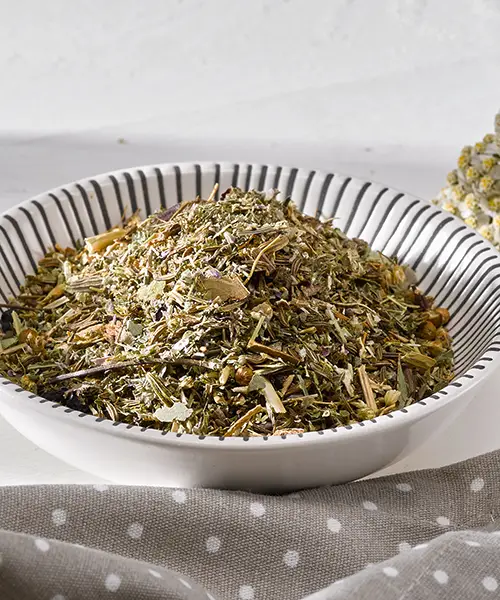
Not all coughs are the same. Therefore, respiratory problems must always be approached from different angles and with different therapeutic strategies. For dry airways that react sensitively to dust triggering a cough ("hay dust allergy"), one must work with anti-inflammatory and mucus-forming measures. Nature's pharmacy offers a range of herbs traditionally used for dry, irritating coughs. We generally recommend the respiratory blend OKAPI Sekretosan in such cases.
The pelleted structure (pelleted without "adhesives") also avoids dust development, which naturally occurs with dry herb mixtures and can trigger coughing. This allows Sekretosan to be fed by the stable manager or colleagues because no preparation as tea is necessary. For dry coughs, feeding OKAPI Sulfur Plus has also proven effective in stimulating the formation of the sulfur-containing amino acid cysteine, which is essential for building the natural protective mucus layer and thus sustainably calming the condition. Inhalation with physiological saline solution and, if necessary, acetylcysteine (from the vet) also has a soothing effect on inflamed respiratory mucous membranes and can accelerate the healing process.

Cough with Mucus Production
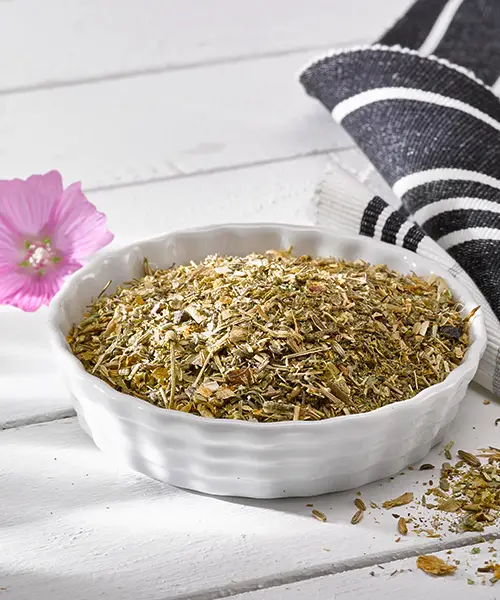
For a cough with mucus production, which occurs in both acute and chronic infections, one should instead work with expectorant herbs found in most good bronchial herb mixtures, such as OKAPI Cough Herbs. These can also be brewed as a tea: pour a liter of hot water over a handful of herbs (30-50g) and let it steep for about 15 minutes. Once the tea is lukewarm, you can stir in a tablespoon of honey, which has a mild disinfecting effect.
The expectorant effect of Cough Herbs helps liquefy the mucus residing in the respiratory tract so it can be coughed up. Since the mucus is often full of bacteria, it is important to remove it quickly from the airways, and this works best when the horse can cough it out.
It is therefore important not to suppress the cough reflex by giving bronchodilators such as cortisone or other bronchodilators. Unfortunately, infectious coughs are very often treated with combination preparations that act as both an expectorant and a bronchodilator.
The result is often the liquefied mucus sinking into the lower respiratory tract. Visually, the cough is gone after 2-3 days of powder administration (because dilated bronchi usually no longer trigger a cough reflex), but as soon as the container is empty and the medication is stopped, the cough returns. This is because the cause was not treated, but only a symptom was suppressed, shifting the problem elsewhere.
In this case, one should use OKAPI Cough Herbs and OKAPI Sulfur Plus in combination with inhalation of a high-percentage NaCl solution to liquefy the mucus again so it can be transported upwards and coughed out.
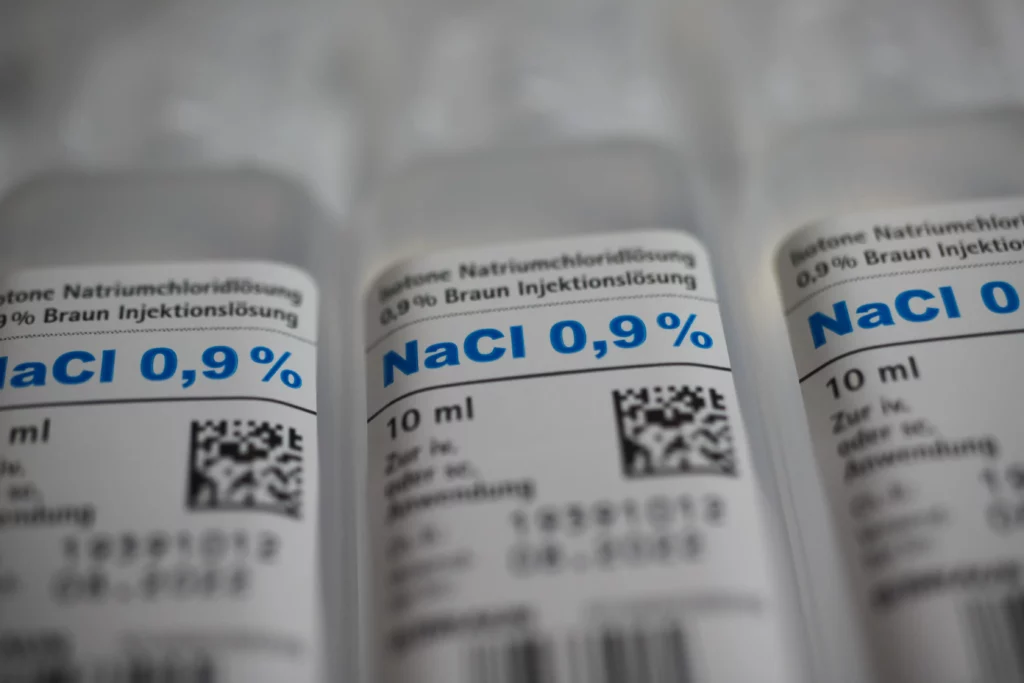
For a productive cough (i.e., a cough accompanied by mucus production), always give expectorants and, if possible, support mucus clearance through inhalation. Use physiological (0.9%) saline for light congestion, or high-percentage (6%) saline for stubborn, chronic, or viscous congestion of the sinuses or lower respiratory tract, ideally with a mobile inhaler.
© Adobe Stock / Ralf
Proper Use of Inhalers
We have had the best experience with the system from Flexineb. This mobile inhaler can nebulize almost all medications and is generally well-accepted by horses. Ideally, start the inhaler and then take your horse for a brisk walk so it breathes deeply and the inhalant reaches the entire respiratory tract (with stationary inhalers, many horses breathe very shallowly and the inhalant remains mostly in the upper airways).
After inhalation, remove the inhaler and ideally move the horse a bit more briskly, for example, letting it trot loosely on the longe, so the loosened mucus can be coughed up.
Strengthening the Immune System Helps Fight Infections
At the same time, the immune system should be supported in all respiratory problems so that infections are fought off faster and the development of secondary respiratory allergies is avoided if possible. Nature also offers a range of herbs that strengthen the immune system. We therefore usually recommend the additional administration of OKAPI Imuno Herbs during respiratory therapy.
The regeneration of damaged respiratory mucous membranes can also be supported by the daily administration of Mucosa comp. (Heel) over a period of about 14 days. A well-functioning mucous membrane, restored with its natural protective mucus layer, is significantly less susceptible to respiratory infections and does not react as easily to dust with a cough reflex.
Whether and which further therapeutic approaches are important for sustainable healing of the airways depends on the underlying disease. For most horses with chronic respiratory problems, optimizing the diet towards species-appropriate nutrition is just as important as restoring the disturbed intestinal environment, calming inflamed mucous membranes of the digestive tract, and supporting the detoxification systems of the liver and kidneys or the cardiovascular system. Here, a thorough anamnesis helps identify the underlying disease and address it with targeted therapy.
Summary: What to Do When?
OKAPI Sekretosan – for dry or allergic coughs to build up the natural mucus barrier and calm inflammation in the airways.
OKAPI Cough Herbs – expectorant herb mixture for acute and chronic infections with mucus production, so the mucus can be coughed up.
OKAPI Sulfur Plus – for dry or allergic coughs to build up the natural mucus barrier, as well as for congestion that has sunk into the lower respiratory tract.
FLEXINEB Inhaler – for coughs with normal mucus using 0.9% NaCl solution; for stubborn or viscous mucus using 6% NaCl solution; for dry airways using 0.9% NaCl solution plus ACC for inhalation (vet); for respiratory distress / bronchospasm immediate inhalation with cortisone (vet) to dilate the bronchi so the horse can breathe again.
OKAPI Imuno Herbs – the power of nature for a healthy immune system, so the horse can better defend against infections and repair damage to the respiratory mucous membranes.
HEEL Mucosa comp. – for accelerated regeneration of damaged respiratory mucous membranes, in both acute and chronic cases, for dry, allergic, and productive coughs.
Honey – dissolved in herbal tea or warm water for all inflammatory and infectious respiratory diseases; has a mild disinfecting and soothing effect.
There are, of course, many other herbal and homeopathic remedies, old home remedies, and various tricks to tackle respiratory diseases. We can only give a general idea here of which direction to think in when the horse coughs, and point out that a quick "fixing" of the cough (bronchodilators) is not always the sensible solution and often contributes to the condition becoming chronic.
The anamnesis should always be conducted in each individual case by a competent therapist, who then builds a suitable therapy plan based on it. You can find competent therapists through our Sanoanimal Therapist Network.