This article was translated using AI.
Key Takeaways
- Coat discoloration in black horses is often an early indicator of liver problems and detoxification disorders
- Bay horses often show reddish tips on the mane and tail as a first sign
- Zinc deficiency, not copper deficiency, is frequently the true cause of brownish-reddish discoloration of black coats
- The enzyme TYRP1 requires zinc for normal melanin production and coat pigmentation
- Normal copper levels in blood tests do not rule out pigment formation disorders if a zinc deficiency is present
- Liver detoxification disorders can lead to secondary zinc deficiency and thus to coat pigmentation problems
The Phenomenon: When Black Fur Suddenly Turns Brown
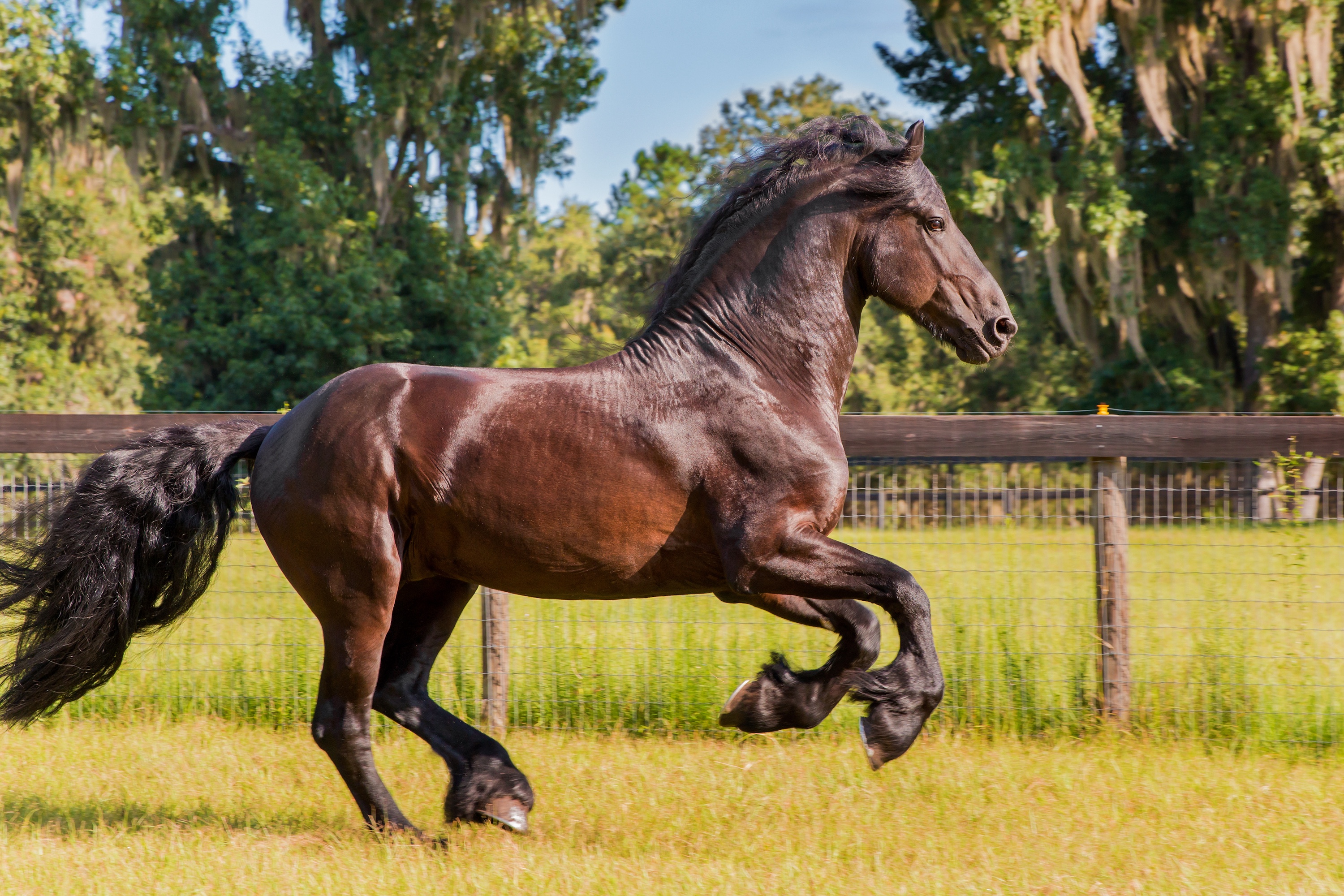
Many owners of black horses, especially Friesians and other black horse breeds, are familiar with the problem: the once deep black, shiny coat of their horse is increasingly becoming brownish or reddish. Often, a diagnosis of "copper deficiency" is quickly made, and corresponding supplements are administered. But what if the copper levels in the blood test are completely normal and no improvement occurs despite copper supplementation?
At Sanoanimal, we view such coat pigment changes as important early warning signals from the body. When black horses develop reddish-brown coats or bay horses (with black manes and tails) show reddish tips on their mane and tail, our practical experience suggests this often points to beginning liver problems – even if the liver values in the blood test still look completely normal.
The Connection Between the Liver, Zinc Deficiency, and Coat Color
When biotransformation in the liver does not function optimally, horses develop a detoxification disorder also known as cryptopyrroluria (KPU). This can have various causes – from chronic stress or stomach ulcers to nutritional factors – which ultimately lead to dysbiosis (faulty fermentation) in the large intestine. As a result of this disrupted biotransformation in the liver, a secondary zinc deficiency often arises, even if the zinc intake via feed would actually be sufficient.
The Science Behind Coat Pigmentation
To understand why zinc deficiency leads to coat discoloration, we must take a look at the complex biochemistry of hair pigmentation:
Previously, attention focused mainly on the enzyme tyrosinase, which requires copper as a cofactor. This enzyme catalyzes the conversion of tyrosine to DOPA and further to dopa-quinone – important steps on the path to the dark pigment eumelanin. Hence the widespread belief that copper deficiency is the main cause of pigment disorders. This is indeed the case when we talk about depigmentation, also known as "copper goggles": the loss of pigment in the skin around the eyes, creating the impression of pink "spectacles."
For a hair (coat hair as well as mane or tail) to be pigmented as intended in the genome, it undergoes the following steps, among others:
- Melanocytes / Melanosomes
In the skin (more precisely in the hair root) sit pigment-forming cells called melanocytes. These form pigment granules called melanosomes. Within the melanosomes, melanin is synthesized from precursors (e.g., tyrosine). - Tyrosine → DOPA → Dopa-Quinone → Melanin
The most important reaction pathway, called melanogenesis, involves the conversion of tyrosine to DOPA, then to dopa-quinone, etc., until the final pigment, usually eumelanin (black/brown pigment) or pheomelanin (reddish/yellowish), is produced. This pathway is enzymatically regulated. An essential enzyme is tyrosinase, which acts as an oxidase to catalyze tyrosine conversion. Tyrosinase requires copper as a cofactor. This is why copper is frequently referenced regarding pigmentation. But the whole process is a bit more complicated: - Tyrosinase-Related Proteins (TYRP1, TYRP2, etc.)
Other enzymes exist that act in the later stages of melanin production — e.g., TYRP1. Recent research [1] shows that zinc is important for the expression and stability of TYRP1 (i.e., not necessarily as a redox cofactor, but as a stabilizer or structural metal). In the study, the authors show: the expression and function of TYRP1 requires zinc, mediated via specific zinc transporters such as ZNT5–ZNT6 and ZNT7. When these transporters failed, hypopigmentation, immature melanosomes, and reduced melanin content were observed. It was also demonstrated in the molecular structure of TYRP1 that two zinc ions are located in the active site, suggesting that zinc is directly integrated into the active structure [2]. - Transport & Incorporation into the Hair
The generated melanin is then incorporated into the growing horn cells (keratinocytes) that form the hair and is pushed outward with hair growth, so that the hair grows out pigmented. If something goes wrong in production — e.g., enzyme disorders, lack of cofactors, or interruptions in melanocyte function — the hair can develop weakened pigmentation (lighter, brownish instead of black, etc.).
The Role of Zinc in Pigment Synthesis
Latest scientific findings show, however, that pigment production is significantly more complex. In addition to tyrosinase, other enzymes play a decisive role, particularly TYRP1 (Tyrosinase-related Protein 1). This enzyme is responsible for the later stages of melanin production.
TYRP1 requires zinc for its expression and stability. Special zinc transporters are responsible for ensuring that sufficient zinc is transported into the pigment-forming cells (melanocytes). If zinc is missing or if these transporters do not function optimally, the results are:
- Hypopigmentation (reduced pigment formation)
- Immature melanosomes (pigment granules)
- Reduced melanin content in the hair
The Structural Significance of Zinc
Particularly noteworthy is the discovery that two zinc ions are located in the active site of TYRP1. This means that zinc does not just act as a cofactor but is directly integrated into the structure of the enzyme and significantly determines its function. If zinc is missing, unstable TYRP1 is formed, which cannot fully fulfill its task.
Practical Implications for Horse Owners
These findings explain why many horses with coat discoloration show normal or even elevated copper levels in their blood tests. The problem lies not with copper, but with the zinc supply to the pigment-forming cells. Zinc is often deficient or just above the lower reference value in the blood tests of affected horses. Even with sufficient zinc intake through feed, a zinc deficiency can occur at the cellular level if:
- The liver is not functioning optimally
- Detoxification processes are disrupted
- Zinc is consumed at an increased rate during the coat change
- Other factors impair zinc availability
Early Warning System: Coat Color
Coat discoloration is thus a valuable early warning system that indicates incipient metabolic problems long before other symptoms appear or disruptions are visible in blood tests. Horses with these signs should therefore be viewed holistically and not just treated symptomatically. Instead of only supplementing copper or zinc, as is frequently recommended in such cases, the underlying cause – disrupted liver function – should be addressed. A well-thought-out concept includes:
Liver Support:
- Optimization of biotransformation
- Regeneration of the natural large intestine microbiome
- Reduction of toxin exposure
Targeted Mineral Supply:
- Additional zinc supplementation during times of higher consumption (e.g., coat change)
- Bioactive zinc forms as supplementary feed, which are more readily available
- Balanced mineral balance for everyday life
Researching the Root Cause:
- Optimization of feeding with regard to large intestine health, because this is usually where the cause of KPU and the associated zinc deficiency lies
- Identification of additional burdens, e.g., moldy hay, toxic plants, etc., which place excessive demands on the liver
- Consideration of environmental factors such as stress (e.g., due to suboptimal housing), which have negative effects on liver performance
Experience shows that horses where the underlying metabolic problems are addressed show not only an improvement in coat color but also a better overall constitution, increased performance, and more stable health.
A New Understanding of Old Problems
The realization that zinc deficiency can lead to coat discoloration revolutionizes our understanding of this common issue. Horse owners should take reddish or browning coats in black horses or reddish tips on the mane and tail in bay horses seriously as an important warning signal and not just dismiss them as a "cosmetic flaw."
Professional advice from a competent nutritionist who has the necessary background knowledge and can relate it to the horse's history is the key to sustainable improvements. Ultimately, it is not just about the aesthetics of the coat color, but about the health and well-being of our horses.
Sources:
1. Wagatsuma, T., Suzuki, E., Shiotsu, M. et al. Pigmentation and TYRP1 expression are mediated by zinc through the early secretory pathway-resident ZNT proteins. Commun Biol 6, 403 (2023). https://doi.org/10.1038/s42003-023-04640-5
2. X. Lai, H. J. Wichers, M. Soler-Lopez, B. W. Dijkstra, Angew. Chem. Int. Ed. 2017, 56, 9812.