Low sugar, low starch – and yet dangerous insulin spikes? Find out here why pea protein for horses with EMS, insulin dysregulation, and laminitis risk is by no means harmless.
Read articleRice Bran Oil for Horses: Miracle Cure or Overrated Cooking Oil?
© Adobe Stock / K
This article was translated using AI.
The Essentials in Brief
-
Rice bran oil is the fat obtained by extraction from rice bran – it contains no starch and no sugar, making it safer for metabolic horses than rice bran itself in this respect, but that doesn't automatically make it healthy.
-
The fatty acid profile is Omega-6 dominant: rice bran oil contains significantly more Omega-6 than Omega-3 fatty acids, which can promote inflammation in the body if fed long-term.
-
Gamma-oryzanol – the heavily advertised active substance – shows interesting effects in studies on rodents. Whether these are transferable to horses is not scientifically proven and questionable, as human studies have reached very inconsistent results.
-
For horses with EMS or insulin resistance, there are indications that gamma-oryzanol and the high Omega-6 content can worsen insulin sensitivity in the long term – making rice bran oil problematic for exactly those horses for whom it is often recommended.
Rice bran oil is enjoying growing popularity in equine nutrition. It is touted as a high-energy, starch-free alternative to concentrated feed, with reference to its special fatty acid profile and the antioxidants it contains. What of this stands up to closer scrutiny – and for whom is rice bran oil actually suitable?
How is Rice Bran Oil Produced?
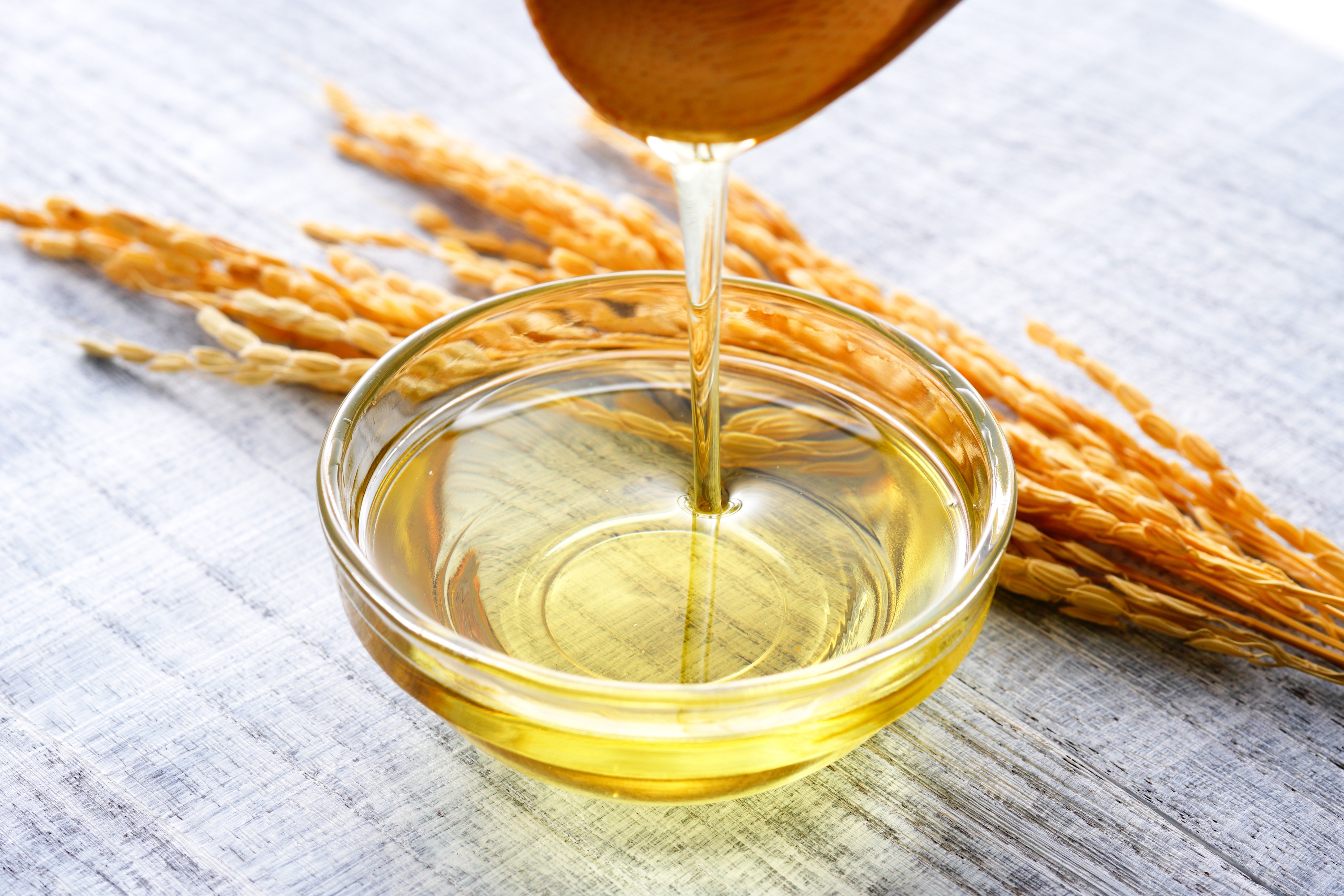
Rice bran oil is obtained from rice bran – a waste product of the rice mill – by solvent extraction or mechanical cold pressing. Industrial production is primarily carried out by solvent extraction (usually with hexane), followed by refining, bleaching, and deodorizing. The result is a tasteless, light to golden yellow oil with a smoke point of approx. 250 degrees Celsius.
What remains after the extraction process is defatted rice bran meal – also a commercial product that appears under various names in equine nutrition.
What is in Rice Bran Oil?
Rice bran oil contains approx. 20% saturated fatty acids, 47% monounsaturated fatty acids (mainly oleic acid), and about 33% polyunsaturated fatty acids. The Omega-6 to Omega-3 ratio is about 20:1 to 25:1 depending on the source – strongly Omega-6 weighted.
In addition, rice bran oil contains bioactive substances that are heavily highlighted in marketing: gamma-oryzanol (a mixture of ferulic acid esters of phytosterols), tocopherols and tocotrienols (forms of vitamin E), and phytosterols.
Gamma-Oryzanol: What is Really Behind It?
Gamma-oryzanol is the most frequently cited active substance in rice bran oil. In human medicine and animal research, various effects have been observed: cholesterol-lowering effects in rats and humans with lipid metabolism disorders, anti-inflammatory properties in certain rodent models, and effects on insulin metabolism – albeit with highly contradictory results depending on dosage and animal model.
The central problem: almost all available studies were conducted on rats, mice, or humans. Reliable studies on the use of gamma-oryzanol in horses are lacking. The transferability of rodent models to horse nutrition is very limited for physiological reasons. What improves insulin sensitivity in a laboratory rat may have a different or even opposite effect in a horse – with its completely different digestive system and insulin metabolism.
Why Rice Bran Oil Can Be Problematic for EMS Horses
This is exactly where the decisive contradiction in marketing lies: rice bran oil is not only advertised for sport horses but is also frequently recommended for metabolic horses – i.e., horses with EMS, insulin resistance, or a history of laminitis. Yet there are concrete indications that it is the wrong choice for these horses.
The Omega-6-dominant fatty acid profile promotes inflammatory processes in the body if sufficient Omega-3 fatty acids are not present as counterparts. Depending on the feeding management, many horses already have an Omega-6-heavy ration – an oil with a 20:1 ratio further exacerbates this imbalance.
Furthermore, there are indications that gamma-oryzanol can worsen insulin sensitivity in already insulin-resistant individuals in the long term – exactly those horses for whom it is recommended.
Why Oil Feeding in Horses Should Generally Be Viewed Critically
Regardless of which oil is fed, there is a fundamental physiological objection to oil feeding in horses – one that is consistently ignored in the marketing of rice bran oil and other edible oils.
In order for the body to utilize fat at all, it must first be emulsified in the small intestine and then broken down into its components, the fatty acids, by the enzyme lipase. Bile fluid is necessary for emulsification. And this is exactly where the problem lies: horses do not have a gallbladder. They cannot store bile fluid and release it into the small intestine all at once when needed – as is the case with dogs, cats, or humans. The horse excretes bile fluid continuously in small amounts because its digestive system is designed for a steady stream of plant fibers, not for fat quantities occurring in portions.
If a large portion of oil arrives in the small intestine all at once, there is simply not enough bile fluid available to fully emulsify it. What is not emulsified cannot be digested. Instead, the oil forms a fine film of fat over the entire food pulp – further preventing other digestive enzymes from doing their work. Starches and proteins from the rest of the ration are poorly broken down. Part of the feed that should actually be digested in the small intestine reaches the large intestine undigested – with all the consequences for the microbiome.
In addition: horses partially absorb undigested foreign fats directly. Since these cannot be biologically processed further, the body temporarily stores them in the fatty tissue and finally disposes of them via the sebaceous glands of the skin. This leads to the shiny coat that many horse owners interpret as a sign of good health – but it is not a sign of health, but of waste disposal through the skin.
Anyone wishing to provide their horse with valuable fatty acids is much better off with oily seeds: linseed (freshly ground), sunflower seeds, rosehip seeds, or a high-quality wild seed mix. In this form, the fatty acids enter the intestine embedded in a plant cell structure and can be broken down and utilized much better than if the same oil comes in liquid form from a bottle.
Rice Bran Oil - Good or Not?
Rice bran oil is not toxic and not generally unsuitable – but it is also not a miracle cure. An endurance- or performance-enhancing effect has not been proven for horses, which is why feeding it to sport horses is already questionable. For horses with metabolic problems, EMS, or insulin resistance, it is not the first choice due to the Omega-6-dominant fatty acid profile and the potential effects of gamma-oryzanol on insulin metabolism. Anyone truly looking for help for their metabolic patient will not find it on the shelf of trend products, but in a consistent forage base with a suitable hay analysis and targeted mineral supply.