What are the dangers of carpet fibers and synthetics in riding arenas? Christina Fritz discusses microplastic risks for horses and the environment.
Cooling Horses Correctly in the Heat: What Really Helps – and Which Myths Can Actually Harm Your Horse
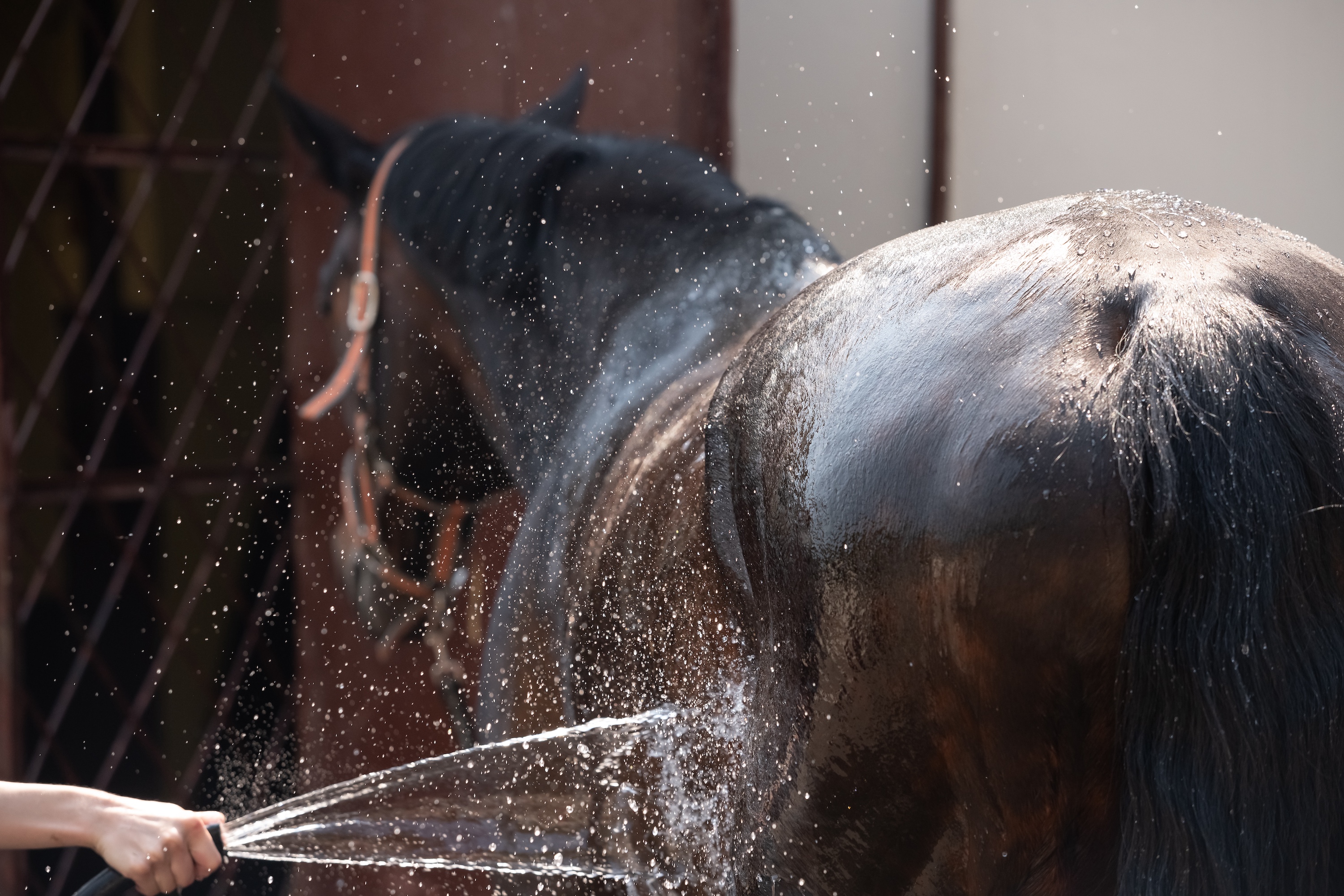
© Adobe Stock / spritnyuk
Table of contentsclose
This article was translated using AI.
Key Points at a Glance
- During physical exertion, an enormous amount of heat is generated in the horse's muscles – around 80 percent of the energy used. Because horses have a small body surface area relative to their mass, they quickly reach their cooling limit in heat and especially in high humidity.
- Cold water on a hot horse is not dangerous: it triggers neither shock, colic, nor tying-up (exertional rhabdomyolysis) - if done correctly. On the contrary – in the event of an impending heatstroke, plenty of cold water is the most effective and sometimes life-saving immediate measure.
- Immediately scraping off the water with a sweat scraper is not a must. Water conducts heat better than air, and a wet horse cools down faster than a dry one – those who constantly apply new cold water cool most effectively.
- A wet blanket or a wet towel on the horse hinders evaporation and acts more like an insulating layer – they are unsuitable for cooling.
- Every horse reacts differently, and the peak temperature value is sometimes only reached during the recovery phase. A calming heart rate does not necessarily mean that the core body temperature is back in the safe zone.
- Prevention is most important: shade, working during cooler times of the day, slow acclimation to heat, access to fresh water at all times, and replenishing electrolytes lost through sweat.
Heatwaves are becoming more frequent in Germany – and with them, the question of how to get horses safely through the day and through work during intense heat. Persistent beliefs about cooling are passed down from generation to generation: that cold water harms a heated horse, for example, or that sweat and water must be scraped off immediately. Much of this is well-intended but physiologically outdated. Research in recent years paints a clear picture of what really helps horses in the heat – and what can actually harm them in an emergency.
Why Heat Quickly Becomes a Problem for Horses
Horses are endurance athletes, but their muscle metabolism does not work particularly efficiently: by far the largest part of the energy converted during movement – around 80 percent – is not converted into propulsion but released as heat. The body must get rid of this heat to keep the core temperature within a tolerable range. The blood transports the excess heat to the skin surface, where it is released through sweat and, above all, through its evaporation. To make matters worse, horses have a relatively small body surface area in relation to their large body mass – per kilogram of body weight, they have less "cooling surface" available than smaller animals.
If the load increases, the core body temperature can quickly climb to 41 to 42 °C and beyond. In this range, circulatory problems, muscle and organ damage, and even life-threatening heatstroke are imminent. High humidity is particularly treacherous: sweating only cools if the sweat can also evaporate. If the air is already saturated with moisture, it evaporates more slowly – the horse sweats, but the cooling effect is absent. A humid 28-degree day is therefore often more stressful than dry heat at 35 degrees. Poor stable ventilation, blazing sun without shade, overweight, transport, and intensive work also upset the delicate balance between heat production and heat dissipation.
|
Horse sweat is not just water. It consists of water, electrolytes – primarily sodium, plus chloride and potassium – as well as a foam-forming protein called latherin, which causes the typical white foam. A heavily sweating horse therefore loses not only fluid but also minerals. Both must be replaced so that the water balance and muscle function remain stable. |
Heat Stress is Not Just a Midsummer Topic
A common misconception is that heatstroke or heat exhaustion can only occur in midsummer weather. In fact, a horse's body temperature can rise significantly even during intensive work on days that are actually cool. And even during transport in a heated, poorly ventilated trailer, a horse can heat up dangerously, regardless of the season. Heat stress is therefore less a matter of the calendar than the interplay of exertion, ambient temperature, humidity, and ventilation. Those who only pay attention on record-breaking days overlook the less obvious risk situations.
Myth: "Cold Water Harms a Hot Horse"
Probably the most long-lived myth states that you must not pour cold water over a hot, sweaty horse – as it would trigger shock, colic, tying-up, or muscle cramps. This concern is unfounded. Studies consistently show that even very cold water does not harm an overheated horse and does not cause any of these feared reactions. On the contrary: with an acutely overheated horse, every minute counts, and cold water applied over a large area is the fastest and most effective method to lower the body temperature. The old advice to only wet the large blood vessels on the legs is also outdated – the temperature drops fastest when as much water as possible runs over the entire body. However, it is important to always start cooling at the hooves and work your way slowly towards the heart. Simply dumping ice water over a heated horse can indeed trigger shock.
|
In the event of an impending heatstroke: cool as quickly and over as large an area as possible. Plenty of cold water over the whole body is not a danger, but the best first aid. |
Myth: "You Must Scrape Off the Water Immediately"
Closely related is the conviction that water must be scraped off immediately with a sweat scraper because it would otherwise "insulate" the horse and trap heat. This is also based on a physical error. Water conducts heat significantly better than air – a wet horse therefore releases its body heat faster than a dry one and cools down more quickly even in high humidity. If you scrape the water off immediately, you shorten the exact contact through which the heat dissipates. It makes more sense to continuously apply fresh cold water because the water sitting on the hot body warms up quickly. Scraping is not harmful in itself, but it is superfluous – and with an acutely overheated horse, it costs valuable time that is better spent on re-pouring.
For the same reason, it is not a good idea to put a wet blanket or a wet towel on the horse for cooling. Such a covering prevents water and sweat from evaporating freely and thus blocks the very mechanism that is supposed to cool. Cooling requires free evaporation – anything that covers the skin over a large area tends to have the opposite effect.
How to Cool Your Horse Correctly in the Heat
A clear, simple procedure can be derived from the current state of research:
- Remove the saddle, bridle, and other equipment so that as much body surface as possible is exposed.
- Apply plenty of cold water over a large area of the whole body – using a hose or buckets, starting at the legs and working towards the body. The colder the water, the faster the cooling; in an emergency, it can even be ice-cold.
- Cool continuously instead of just spraying briefly. The water warms up quickly on the hot body, so keep applying new water – continuous pouring cools faster than isolated pours with scraping in between.
- Lead the horse quietly at a walk throughout, instead of letting it stand still; this supports the circulation.
- Provide shade and air movement – a breezy location or a fan further improves evaporation.
- Continue cooling until the horse visibly recovers: above all, breathing should calm down and the eyes should look more alert. Offer fresh water for drinking.
Every Horse Reacts Differently – and the Heat Peak Sometimes Comes Later
A general cooling scheme based on the "one size fits all" principle falls short and can even be risky in an emergency, as horses differ significantly in their reaction to heat. Some animals cope well with heat, others overheat faster or take longer to cool down again. It is therefore worth knowing your own horse: how it normally reacts to exertion and heat and how long it needs for recovery.
In addition, there is an important, often underestimated observation: the peak temperature value is not necessarily reached during the greatest exertion. During short, intensive work, the core body temperature can reach its peak only during the recovery phase – in trotters, on average, around half an hour after the race. It is particularly deceptive that a normalizing heart rate does not yet mean the all-clear: the core temperature can still be significantly elevated while the pulse has already dropped again. Those who only look at the pulse may lull themselves into a false sense of security. And even the common rectal thermometer only measures the true core temperature with a delay and slightly too low. The consequence: after heavy exertion, one should continue to observe the horse not only during but also after cooling.
Electrolytes and Water: What is Lost Through Sweating
Because not only water but also minerals are lost with sweat, heat management involves more than just cooling from the outside. Sodium is central: together with other electrolytes, it controls the body's water balance, which is why fluid and electrolyte losses are closely linked. Fresh water available at all times is therefore the most important foundation. In addition, every horse should have access to salt – for example, via a salt lick along with their forage.
During heavy, long sweating – for example in sport or during persistent heat periods – targeted electrolyte administration can be useful to compensate for losses. It is important to use moderation: a healthy horse with moderate exertion covers much of its needs through good roughage and an appropriate mineral and salt supply. Electrolyte preparations should be used in measured amounts and on a case-by-case basis, not as a permanent, possibly sugar-rich addition. And they never replace free access to water – on the contrary, they only work if the horse drinks enough.
Prevention is Better Than Cooling
The most effective cooling is the one that doesn't become necessary in the first place. Thoughtful heat management significantly reduces the risk. Proven methods include: scheduling strenuous work for the cooler times of the day in the early morning or evening and avoiding the midday heat; providing shade, whether through trees or a breezy shelter; providing fresh water at all times; ensuring good ventilation in the stable and trailer; and reducing overweight, as it further complicates heat dissipation. Acclimation to heat also takes time – true acclimatization only occurs after about two to three weeks of regular movement in the heat. In the event of a sudden heatwave, a horse is not yet adapted and should be spared accordingly.
Equally important is to know the warning signs of heat stress: fast, shallow breathing that does not calm down, lethargy or stumbling, a significantly elevated body temperature. A special alarm signal is when a horse suddenly stops sweating during heat and exertion – then the most important cooling mechanism has failed, and it is an emergency. In such cases: cool immediately over a large area with cold water and contact a veterinarian immediately.
Physics Beats Tradition
Many traditional cooling rules do not stand up to scientific scrutiny. Cold water does not harm a hot horse, scraping off water is superfluous, and wet blankets even hinder cooling. The correct way is the simple, consistent one: plenty of cold water, applied over a large area and continuously, equipment off, shade and air movement – and keeping an eye on your own horse, even during the recovery phase. The best heat protection, however, is management that avoids overheating from the start. Those who understand the physics of cooling will make the right – and sometimes life-saving – decision at the decisive moment.
Sources
1. Takahashi Y, Ohmura H, Mukai K, Shiose T, Takahashi T. “A Comparison of Five Cooling Methods in Hot and Humid Environments in Thoroughbred Horses.” Journal of Equine Veterinary Science, 2020;91:103130. DOI: 10.1016/j.jevs.2020.103130
2. Verdegaal E-LJMM, Howarth GS, McWhorter TJ, Boshuizen B, Franklin SH, Vidal Moreno de Vega C, Jonas SE, Folwell LE, Delesalle CJG. “Continuous Monitoring of the Thermoregulatory Response in Endurance Horses and Trotter Horses During Field Exercise.” Frontiers in Physiology, 2021;12:708737. DOI: 10.3389/fphys.2021.708737
3. Verdegaal E-LJMM, Delesalle C, Caraguel CGB, Folwell LE, McWhorter TJ, Howarth GS, Franklin SH. “Evaluation of a telemetric gastrointestinal pill for continuous monitoring of gastrointestinal temperature in horses at rest and during exercise.” American Journal of Veterinary Research, 2017;78(7):778–784. DOI: 10.2460/ajvr.78.7.778
4. Marlin DJ, Scott CM, Roberts CA, Casas I, Holah G, Schroter RC. “Post-exercise changes in compartmental body temperature accompanying intermittent cold water cooling in the hyperthermic horse.” Equine Veterinary Journal, 1998;30(1):28–34.
5. Klous L, Siegers E, van den Broek J, Folkerts M, Gerrett N, van Oldruitenborgh-Oosterbaan MS, et al. “Effects of Pre-Cooling on Thermophysiological Responses in Elite Eventing Horses.” Animals, 2020;10(9):1664. DOI: 10.3390/ani10091664
6. Morgan K. “Thermoneutral zone and critical temperatures of horses.” Journal of Thermal Biology, 1998;23(1):59–61. DOI: 10.1016/S0306-4565(97)00047-8