This article was translated using AI.
PSSM1 / PSSM2 / MIM / MFM / RER – when sugar becomes a problem
What is behind PSSM, MIM, MFM, and RER and how can they be diagnosed?
All of the mentioned conditions are disorders of the muscle metabolism that can only be correctly diagnosed via a muscle biopsy.
The MIM genetic test is scientifically controversial because the identified genetic variants are not clearly linked to PSSM 2, MFM, or RER. Furthermore, the test mixes different myopathies that require different causes and management strategies. While PSSM 2 is primarily influenced by training and a low-sugar diet, MFM affects the myofibrillar structure and requires targeted nutritional support. RER is a dysregulation of muscle contraction and requires a modified diet with low starch. MIM is not a scientifically recognized term. A reliable diagnosis should always be based on clinical symptoms, muscle biopsy, and individually adapted husbandry and feeding.
PSSM (Polysaccharide Storage Myopathy) 1:
Which horse breeds are mainly affected?
Certain horse breeds, including Appaloosas, Paint Horses, Quarter Horses, and various draft horse breeds as well as their crosses, are affected by an autosomal dominant hereditary disease associated with abnormal glycogen storage in the muscles, known as PSSM1.
Sugar storage in the muscle damages the musculature
Affected horses show a two- to four-fold increase in the amount of glycogen in the muscle compared to healthy control horses. Excessive storage can lead to muscle damage. In Quarter Horses and Paint Horses, the problem often manifests in the form of tying-up (exertional rhabdomyolysis), while draft horses tend to suffer more from general weakness and muscle atrophy.
Young horses are already affected
Even foals and young horses can develop tying-up under certain conditions, such as respiratory or gastrointestinal diseases. Abnormal glycogen storage begins at around 16 months of age and primarily affects Type II muscle fibers. Horses that also possess a Malignant Hyperthermia (MH) mutation respond less well to a low-sugar diet and regular training.
Treatment and prevention
The combination of an adapted diet and targeted training can lead to a significant reduction in creatine kinase (CK) levels in the blood after just three weeks. Without continuous training, these levels can rise to over 1000 U/L. A slow build-up of training is crucial: starting with a few minutes of walking and trotting, with the training duration increased by one to two minutes daily. However, excessive exertion too quickly can be counterproductive – even ten minutes of walking at the beginning can trigger a tying-up episode.
Diagnosis
Diagnostically, the disease is determined by a genetic test for the Gys-1 mutation as well as by dramatically increased CK levels in the blood. A muscle biopsy confirms the suspicion that the symptoms are attributable to PSSM1.
Feeding plays a central role
Low-sugar hay with a sugar content of less than 6% and a balanced supply of minerals are essential, but can only achieve their full effect in combination with exercise. If the sugar content in the hay is too high, it should be soaked. The use of feed containing chromium is contraindicated, as it further increases sugar uptake into the cells. Caution is also advised when administering L-carnitine, as it also improves glucose uptake into the muscles and could thus negatively influence the course of the disease.
PSSM 2/MIM (Muscle Integrity Myopathy):
Signs only in older horses
PSSM 2 is an umbrella term for several myopathies that differ from PSSM 1 in that no Gys-1 mutation is present. Unlike PSSM 1, PSSM 2 can theoretically affect all horse breeds, although Warmbloods are particularly susceptible. Dressage horses are affected more frequently than show jumpers. Initial clinical signs usually appear from the age of six.
PSSM 2 is more visible in the gait
Tying-up is significantly less common in PSSM 2. Instead, PSSM 2 often manifests through stiff movements, a shortened stride length, a lack of forward impulse, and slight hindlimb lameness, the cause of which often cannot be precisely diagnosed. Gait abnormalities and rideability problems are the most common initial symptoms in Warmbloods – they occur as the first clinical sign in about 66% of affected horses.
Diagnosis difficult
Within Warmbloods, older horses and geldings are affected more frequently than in other breeds. Unlike PSSM 1, however, no specific genetic line has been identified as particularly susceptible. Examinations of the musculature show that glycogen concentrations in Warmbloods with PSSM 2 are similar to those of healthy horses. In Quarter Horses, on the other hand, the muscle glycogen content is increased. The values of the muscle enzymes CK (creatine kinase) and AST (aspartate aminotransferase) are usually within the normal range in PSSM 2 horses.
Diagnosis via dietary change
Clinical symptoms can be improved through a targeted combination of feeding and exercise. However, even the smallest changes in feeding management can lead to setbacks. If the recommended PSSM 2 diet shows no effect, switching to the feeding recommended for MFM (Myofibrillar Myopathy) may be useful. There are indications that PSSM 2 may be a precursor to MFM.
Feeding in PSSM 2
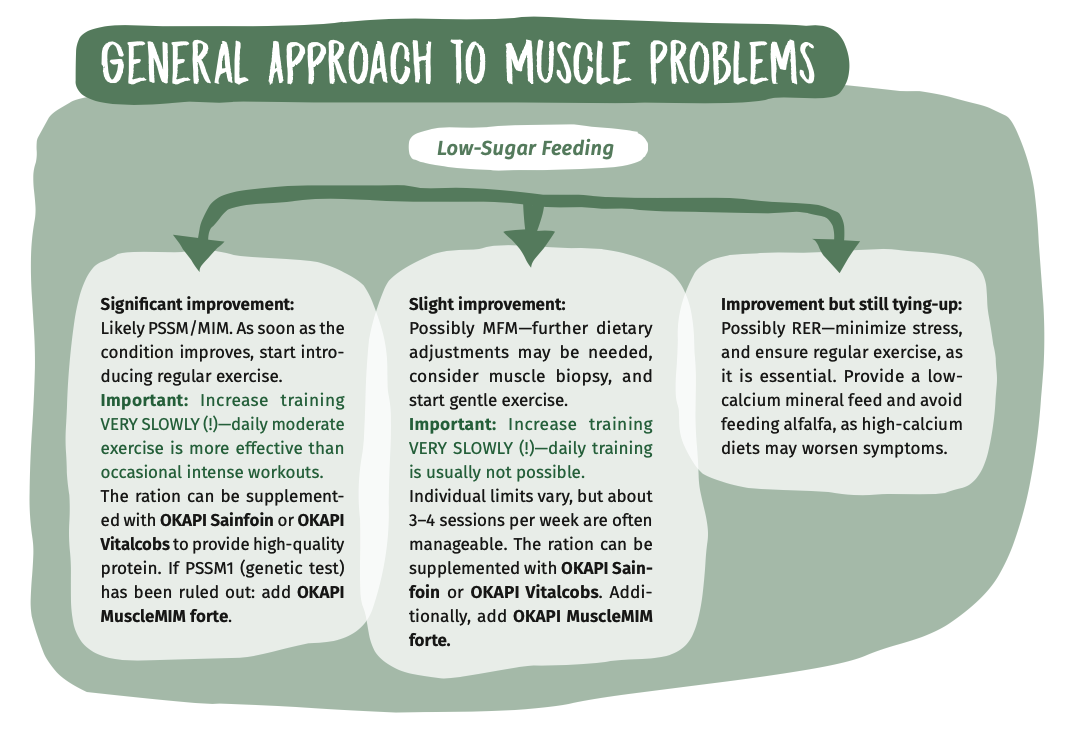
When feeding, it is important to use low-sugar hay with a sugar content of less than 6% and to supplement the ration with a high-quality mineral feed. To support muscle development, sainfoin can be integrated into the diet. At the same time, exercise must be adjusted accordingly – a slow, steady build-up of training is crucial to avoid overload and stabilize the muscle metabolism.
Note:
MIM is a term introduced to justify the genetic tests associated with it. It is not an independent disease. Affected horses are assigned to the PSSM 2 spectrum.
MFM (Myofibrillar Myopathy):
Mostly Arabians and Warmbloods affected
MFM (Myofibrillar Myopathy) primarily affects Arabians and Warmbloods, with affected horses usually being older (8–10 years).
Tying-up or PSSM 2 symptoms
While MFM can trigger muscle stiffness and sporadic tying-up in Arabians, Warmbloods show clinical symptoms similar to PSSM 2. CK and AST levels usually remain normal in Warmbloods with MFM, while they may be slightly elevated in Arabians – however, not to the extent seen in classic tying-up.
Diagnosis via muscle biopsy
Typical for MFM is the presence of desmin aggregates and glycogen accumulation, which are detected in the muscle fibers of affected horses in a muscle biopsy.
No mutation but less muscle regeneration
A desmin mutation does not appear to be the cause of MFM in Arabians. It is possible that the glycogen accumulation is due to degenerated myofilaments and remnants of the Z-discs. In addition, there is a reduced expression of genes important for muscle regeneration.
More fatty acid transport and disrupted cysteine biosynthesis
MFM horses have an increased ability to transport fatty acids into the mitochondria. However, this leads to an increase in reactive oxygen species (ROS), while at the same time the ability to break them down is reduced. The antioxidant PRDX6 is expressed four times lower in MFM horses. Furthermore, disrupted cysteine biosynthesis could play a role, as a cysteine deficiency means that irreversible oxidation cannot be sufficiently buffered by glutathione.
Feeding and management
Feeding should consist of low-sugar hay (< 6%) and inorganic mineral feed. For muscle development, the ration can be supplemented with sainfoin or alfalfa. Furthermore, targeted amino acid supplementation is useful, especially lysine, methionine, and threonine. In addition, cysteine (important for antioxidants), valine, leucine, and isoleucine (to promote protein synthesis after training), and sulfur can be considered. Horses that do not have access to pasture also benefit from vitamin E supplementation.
Training important, but individual
A slow increase in training is essential. The load capacity of MFM horses is individual, but moderate units 3–4 times a week are usually possible.
RER (Recurrent Exertional Rhabdomyolysis):
Mainly Thoroughbreds, Trotters, and Arabians affected
Recurrent Exertional Rhabdomyolysis (RER) is a hereditary muscle disease in horses caused by faulty regulation of calcium metabolism in the muscle cells. This leads to recurring muscle cramps and stiffness, especially after or during training. RER occurs particularly frequently in Thoroughbreds, Trotters, and Arabians.
No mutation detectable so far
There is a genetic predisposition; however, no specific mutation has been identified to date. Horses with a nervous temperament or increased stress levels have a higher risk of developing RER.
Symptoms
The main symptoms of RER manifest as muscle stiffness and cramps during or after physical exertion. Affected horses often show restlessness, heavy sweating, and refuse to move. In severe cases, there may be dark discoloration of the urine, which indicates myoglobinuria due to the breakdown of muscle cells. Muscle tremors or cramping are also possible signs.
Multiple triggers
Stress and excitement lead to increased muscle tension, while unusual or excessive exertion can promote RER. Faulty calcium regulation in the muscle causes excessive contractions, which intensifies the symptoms. A diet high in starch and sugar can also increase the risk, as it influences the excitability of the nervous system.
Diagnosis
Diagnosis is made through a clinical examination during or after an episode, as well as a blood test in which elevated muscle enzymes such as creatine kinase (CK) and aspartate aminotransferase (AST) are found. In some cases, a muscle biopsy is performed to confirm the diagnosis.
Management and feeding
An adapted diet with a reduced starch and sugar content ensures a more stable energy supply. Regular exercise is essential to prevent muscle tension. In addition, a low-stress environment and an adapted training routine can help prevent episodes. In some cases, medicinal support with muscle relaxants or electrolyte supplements may be useful to regulate muscle tension and improve the horse's well-being.
Illus: © Adobe Stock / Наталья Дьячкова