
This article was translated using AI.
Key Takeaways:
- Hay cobs are essential in the basic forage supply for many senior horses
- The right amount depends on the horse's weight and individual requirements
- Quality and soaking time are crucial for digestibility
- Dividing the daily ration into multiple meals is vital for digestion
- The transition to hay cobs should be done gradually
- One kilogram of dry hay cobs roughly corresponds to one kilogram of hay
- Special care is needed when soaking during hot summer weather
Sometimes it is the inconspicuous things that make the biggest difference. Hay cobs are definitely one of them. While these small, compressed pellets of chopped hay may not look particularly exciting, they are the key to a balanced diet for many senior horses. But as is so often the case, the devil is in the details.
From Hay to Hay Cobs – The Natural Transition
"My horse is still eating hay just fine!" – you often hear this phrase when recommending hay cobs for senior horses. In fact, right when your horse is still eating hay well is the best time to start introducing hay cobs. A gradual transition is much easier than waiting until they can barely eat anything at all. There is hardly anything more exhausting than trying to bring a senior horse that has already lost significant weight back to good condition.
The Science Behind the Pellets
Hay cobs are nothing more than chopped, compressed hay. By chopping and pressing the forage, the cellulose fibers are broken down similarly to thorough chewing, making them more readily accessible to the digestive tract. This means your horse needs to spend less time thoroughly chewing its feed while obtaining more nutrients from it.
The Art of Proper Dosing
One of the most common questions is: "How much hay cobs does my horse actually need?" The answer comes down to simple math. An average horse requires about two to three percent of its ideal body weight in forage daily. For a 500-kg horse, that equates to 10–15 kilograms. If your horse can only consume half of this amount as long-stem hay, the missing 5–7.5 kilograms must be replaced with hay cobs. If your horse's current weight is below its ideal weight, aim toward 3%. If it is at the upper end of its ideal weight, stick to 2%.
Soaking to Perfection
Soaking hay cobs correctly is a science in itself. Too much water makes them soupy, while too little leaves them hard. As a rule of thumb: add three times the amount of warm water to the dry cobs. That means roughly three liters of water per one liter of dry hay cobs. The optimal soaking time is 15–30 minutes with warm water and up to one hour with cold water. Depending on the manufacturer and batch, soaking times can vary. Therefore, when opening a new bag, take a little more time rather than too little.
Practical tip: Use the finger test. Well-soaked hay cobs should be easy to crush between your fingers, but should not fall apart on their own. They should be moist, but not swimming in water.
Distribution Throughout the Day
Just like with hay, the rule for hay cobs is: many small portions are better than a few large ones. Ideally, provide three to five meals spread throughout the day. While this may sound like a lot of work, it is easily manageable in most barns. A larger portion in the morning and evening, a smaller one at midday – and your senior horse already has a solid basic forage supply.
If someone is only at the barn once a day to feed, consider separating your senior from the herd overnight. Here, you can offer them a large tub of soaked hay cobs along with a net of loose hay exclusively. Overnight, they will gradually consume the hay cobs in small portions. Using a one-way gate or a timer-controlled gate (easy to build yourself with an automatic chicken coop door opener, for example), the senior horse can rejoin the herd in the morning and eat hay together with them during the day, before being separated again with their hay cobs in the evening.
Recognizing Differences in Quality
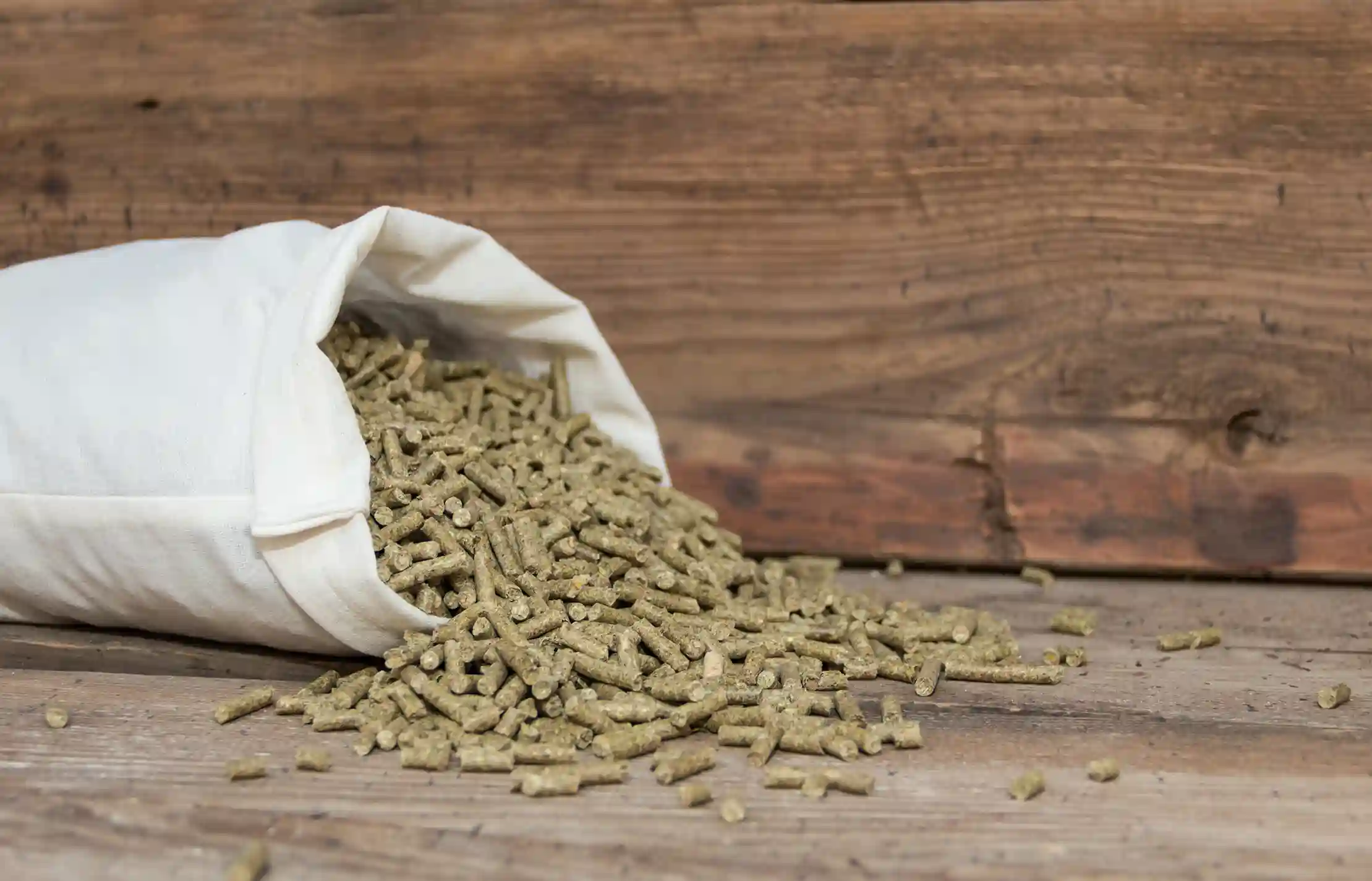
Not all hay cobs are created equal. High quality is recognizable by:
- a uniform, greenish-brown color
- a pleasant, fresh hay aroma
- a firm pellet structure
- a dust-free consistency
Avoid hay cobs that smell musty, are excessively dusty, or contain a large amount of crumbled pellets. You should also pay attention to nutritional values. The crude protein content should generally be between 6–9% for horses, and the sugar content should be <6% for older horses.
Hot Summer Days – Hygiene Is Everything
In summer, feeding hay cobs requires particular attention to hygiene. Soaked hay cobs can ferment quickly in warm temperatures. Therefore, only prepare as much as your horse can eat within two to three hours. For large portions, feeding them overnight helps, as temperatures generally cool down, reducing the risk of fermentation. If the hay cobs smell fermented or slightly alcoholic, start bubbling, or if your horse turns up its nose when offered them, they have spoiled and must be discarded.
Clever Combinations
Hay cobs are versatile because you can easily combine them with other feeds – for example, with herbs for enhanced flavor, freshly ground linseed for added nutritional value, or supplements that your retiree horse needs for health reasons.
A word of caution: hay cobs alone are not a "muesli substitute". They are and remain a primary forage that should be balanced with a mineral feed and, if needed, targeted supplements suitable for your horse.
A Planned Transition
Introduce hay cobs slowly. Start with small amounts, around 500 grams (dry weight) daily, and increase gradually over several weeks. This gives the digestive tract time to adapt. Keep an eye on:
- Appetite and eating speed
- Manure consistency
- Drinking behavior
- General well-being
If your horse leaves hay cobs in the trough, the portion was too large and you should split the quantity into at least a second meal. For example, you can offer the first half shortly after arriving at the barn and the second half just before you leave.
Avoiding Common Pitfalls
The most common mistake is feeding too little hay cobs. Out of fear of overfeeding, many owners feed significantly below their horse's actual nutritional requirement. Another classic mistake: using too little water when soaking. This can lead to choke (esophageal obstruction) or colic. A qualified equine nutritionist can help you determine the exact amount of hay cobs your horse requires.
The Difference Lies in the Details
Hay cobs are more than just a substitute for hay – they are an essential component of senior horse nutrition. With the right amount, proper preparation, and consistent distribution, they can help your aging horse stay fit and vital. The golden rule: it is far better to start earlier and increase slowly than to start too late and be forced to switch under pressure.
Especially if your horse has never been fed soaked feed in its life, the transition can be lengthy – horses are creatures of habit and often skeptical of new textures. Early practice, whether with a handful of soaked hay cobs borrowed from barn friends or a grain-free grass-meal mash, is an invaluable step to ensure your horse readily accepts hay cobs later in life.
Remember: every horse is unique. What works perfectly for one may not work for another. Observe your horse closely and adjust feeding accordingly. With a little practice, you will quickly find out what your senior horse needs.
High-quality hay cobs & sainfoin cobs are available from our partner OKAPI.
Find more information on caring for aging horses on our topic page: Senior Horses