This article was translated using AI.
When the belly aches
How do intestinal problems arise?
Digestive problems, along with disorders of the musculoskeletal system, are among the main reasons why horses lose their performance capacity. To understand the causes, one must first understand how a horse's digestion actually works.
The digestive system in horses
Evolution has optimized the horse to be an animal of the steppes and tundras. This includes horses covering long distances at a calm pace in search of food – up to 50 km a day. In the process, they ingest plants that are low in nutrients and difficult to digest. To break down the nutrients from them, they have established microorganisms in their large intestine that live in symbiosis with them. In return for the horse providing the microorganisms with warmth, moisture, and food, they supply the horse with nutrients from otherwise indigestible structural carbohydrates and provide valuable vitamins and amino acids. For this balance between the horse and the intestinal flora, created over millennia, to work, horses primarily require forage that is low in sugar and protein and very rich in structural carbohydrates.
Small intestine
The horse's small intestine is small in relation to the size of the horse and transports food through it relatively quickly. Just 1.5 hours after the start of small intestine digestion, the food is already released into the large intestine. In the small intestine, easily digestible food such as starch, protein, and fat is digested; minerals and vitamins can mostly be absorbed. The fact that the food remains here for only a very short time is an indication that such easily available nutrients are hardly intended in the horse's natural diet. While wild horses may find a few easily digestible, nutrient-rich fruits, nuts, or plant seeds, the largest proportion of the food consists of the plants themselves, whose structure cannot be broken down in the small intestine.
Large intestine
The large intestine, consisting of the cecum and colon, is very long in horses compared to the small intestine and has a large volume. Food is transported here much more slowly. The digestion of difficult-to-digest structural carbohydrates takes place in this section of the intestine. What passes through the human intestine as dietary fiber and is excreted unchanged can be utilized by the horse. Only about 15% of the food is excreted again; about 85% are nutrients for the horse. This makes horses excellent feed converters that can extract their essential nutrients even from the poorest structural feed.
Intestinal flora
To efficiently break down structural carbohydrates, horses have established a whole range of bacteria, fungi, and protozoa in the intestine to help. Foals ingest these microorganisms through the mother's feces. These fungi and bacteria are primarily able to digest cellulose from hay and grass. Lactic acid bacteria, E. coli bacteria, and streptococci are found only in very small amounts or not at all in the healthy horse's gut. For the intestinal flora to feel comfortable, it needs a nearly neutral pH value of 6.8–7.2. If this drops, the intestinal flora dies off, and the released endotoxins from the microorganisms are absorbed by the horse, placing a considerable strain on the detoxification metabolism. The intestinal flora resides in the intestinal mucosa; both form a close connection in the horse.
Immune system
Very many cells of the immune system are found in the intestinal mucosa, which ward off harmful microorganisms and support the intestinal flora.
The gut easily loses its balance
The horse's intestine is a complex ecosystem that reacts very sensitively to disturbances. The introduction of foreign germs, changes in pH value, or changes in the speed at which the food pulp passes through the intestine quickly lead to sensitive intestinal disorders.
Consequences
Problems in the digestive tract manifest as follows:
• Fecal water
• Diarrhea
• Colic
• Gastric or intestinal ulcers
• Bloating
Rideability issues such as:
• Stiff horses
• Long warm-up phases at the start of riding
• Non-specific lameness and disorders in the musculoskeletal system
• Poor bending
Metabolic diseases such as:
• Equine Metabolic Syndrome (EMS)
• Insulin resistance
• Pseudo-Cushing
• Laminitis
• Sweet itch
• Mud fever
• Thrush
and behavioral abnormalities such as:
• Flehmen, cribbing
• Sensitivity of the belly, hooves, knees
• Resistance towards humans.
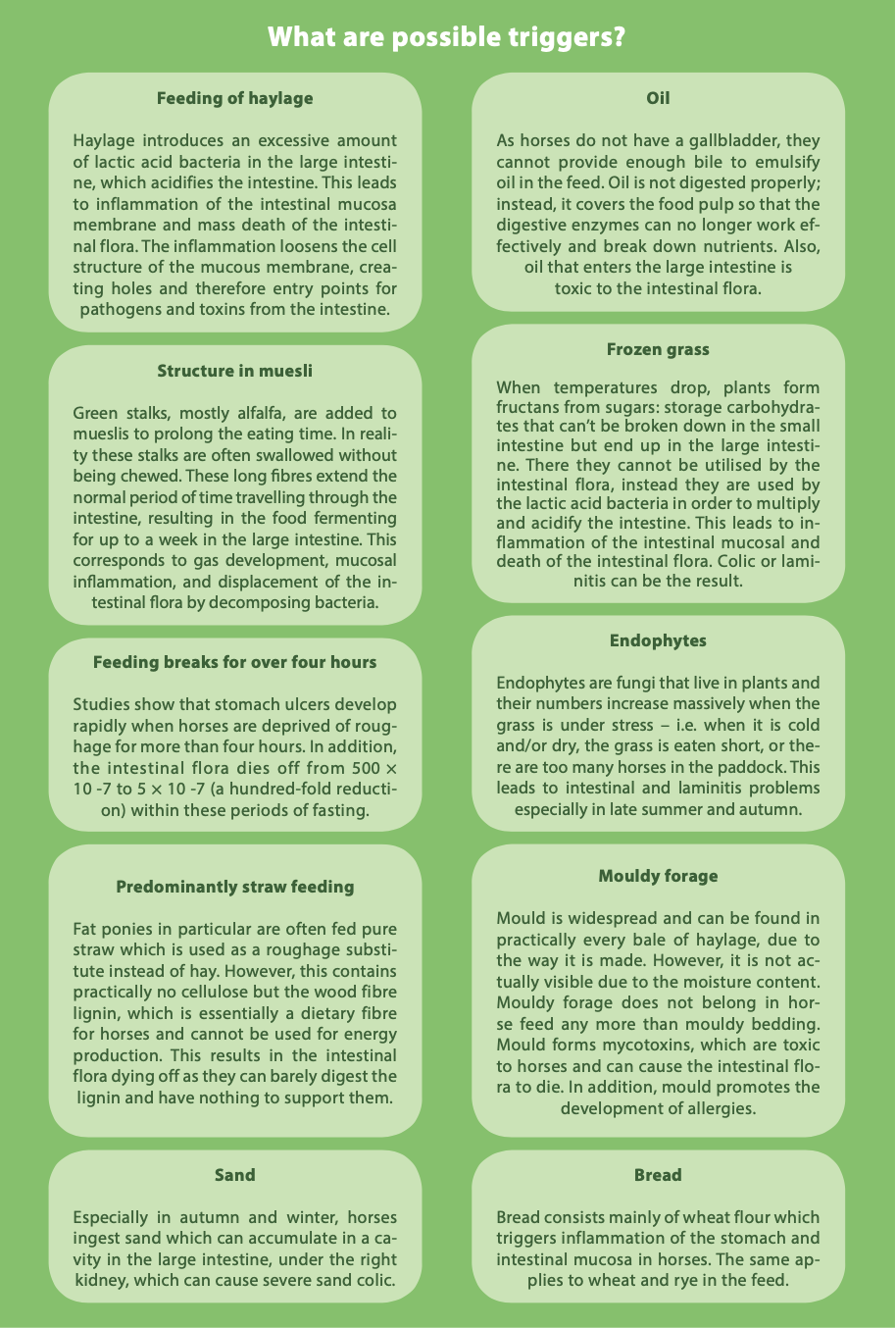
© Sanoanimal
Gut Rehabilitation
Before starting gut rehabilitation, the feed should first be changed to approx. 1.5 – 3 kg of hay per 100 kg of body weight and a tolerable concentrated feed, possibly supplemented by a suitable mineral feed. The changeover should be carried out slowly over 2–4 weeks.
Regeneration
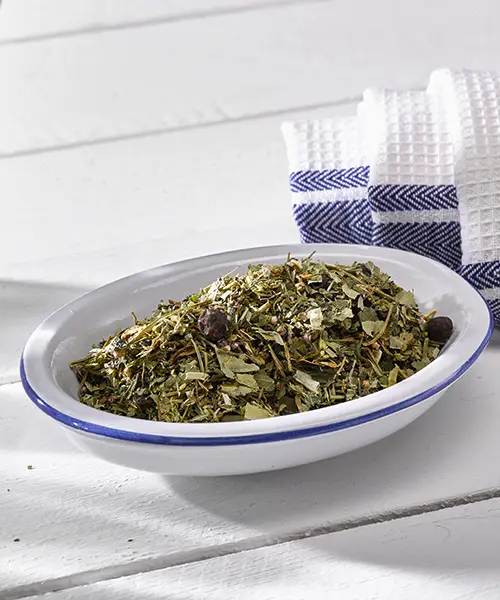
To bring the gut into balance, we recommend the combination of OKAPI Licorice Extract, which inhibits inflammation in the mucosa and stimulates regeneration, with OKAPI Bitter Herbs, which have an astringent effect. Please never give OKAPI Licorice Extract for longer than 3 weeks at a time. As an alternative to licorice extract, OKAPI Lapacho Bark can be given for a gut-flora-stabilizing effect.
In case of fecal water
Initially, the administration of OKAPI ColoProtect forte has proven effective for regenerating the intestinal environment and the intestinal mucosa. Additionally, psyllium or psyllium husks should be given, which absorb the fecal water like a sponge and break the cycle of fecal water and intestinal mucosal inflammation.
In case of moldy feed or haylage
If the feed is of moldy quality or if haylage must be fed temporarily, OKAPI EndoProtect should be supplemented to bind mycotoxins and relieve the metabolism. OKAPI Spirulina (as powder or pellets) and OKAPI Prodic can be used as additional support in weekly rotation. OKAPI Sainfoin ready-to-use without soaking) has a stabilizing effect on the intestinal environment due to the condensed tannins it contains and is a grain-free concentrated feed alternative as a base feed.
In case of intestinal sluggishness due to structural feed
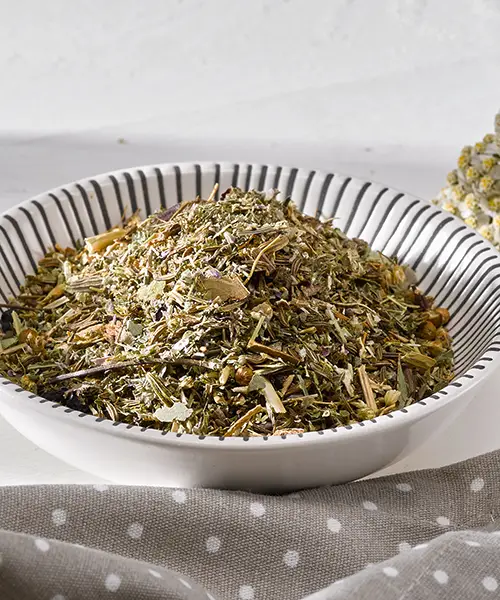
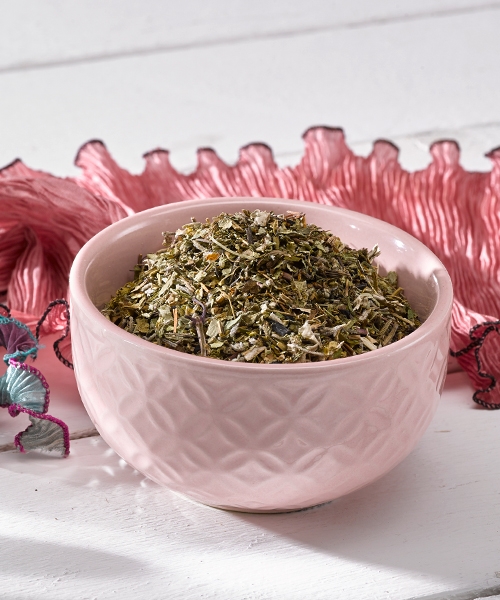
OKAPI Psyllium Husks together with OKAPI Bitter Herbs have a regulating effect on peristalsis and counteract intestinal putrefaction. OKAPI Intestinal Support Herbs soothe the gut in case of bloating.

Learn more: Digestive Tract Topic Page