This article was translated using AI.
And what can be done about it.
How does laminitis develop?
Laminitis is a disease that has been known to veterinary medicine for a long time. Recently, however, it has been occurring more and more frequently in horses where it would not normally be expected.
What is behind laminitis?
Laminitis is an inflammation of the sensitive laminae (corium), which connects the coffin bone to the hoof wall. The horse's foot is suspended within the hoof, floating over this corium. The corium is permeated by very fine capillaries and has a very strong blood supply. In the event of inflammation, blood clots form, which block the capillaries and lead to small infarctions in the hoof. Fluid can also leak from the blood vessels, leading to edema in the hoof, which is equally fatal for the tissue due to the pressure conditions within the hoof capsule. If left untreated, the result is a separation of the corium from the horn wall of the hoof. As a result, the coffin bone is no longer held in its natural position – parallel to the hoof wall – but rotates with the tip towards the ground due to the pull of the deep digital flexor tendon.
How do I recognize laminitis?
Laminitis first becomes visible when the horse tries to relieve the weight on its toes. This is particularly evident during the breakover. The steps become shorter, and the horse tries to roll over earlier. The farrier can often see the first signs early on during trimming. If left untreated, the symptoms become stronger; the horse increasingly relieves weight, lies down a lot, and refuses to trot. at a walk, a clear shortening of the stride can be seen, and the swing is lost. The symptoms are stronger on hard ground than on soft or deep ground. In the highly acute stage, horses refuse any movement and spend most of their time lying down to provide maximum relief to the painful hooves.
Early diagnosis is important
If horses are not treated or treated too late, laminitis is often fatal, sometimes within just a few weeks. Furthermore, without proper or professional treatment, laminitis frequently becomes chronic, meaning the horse may never be able to walk normally or go out to pasture again. Since there are so many different causes, triggers, and types of laminitis, and the diagnostics for metabolic disorders in horses are often insufficient, even treated laminitis cases frequently end fatally.
Toxin-induced Laminitis
The most common case is toxin-induced laminitis. However, this does not always involve the direct ingestion of poisonous plants or other toxins, but is the umbrella term for laminitis cases resulting from an overload of the metabolism; this is referred to as "internal poisoning." According to Chinese medicine, the skin and hooves are the body's auxiliary kidneys. If the kidneys are overloaded, symptoms are often seen in the hooves: as solar corium inflammation, bruising, or laminitis itself. Thrush, hoof abscesses, or mallenders also indicate overloaded kidneys and the body's attempt to excrete waste via the skin or hooves.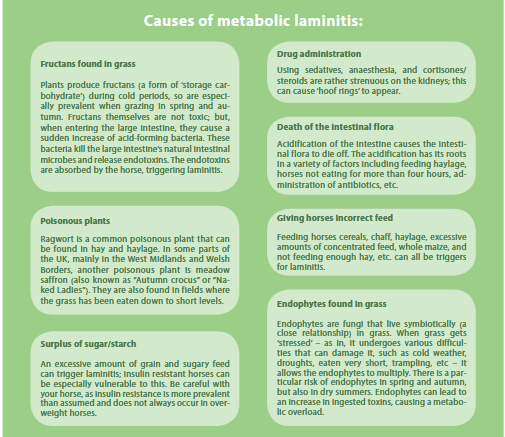
© Sanoanimal
What to do about laminitis?
Step one: Veterinarian
In the case of acute laminitis, a veterinarian must be called first. They will decide on further therapy based on the symptoms. If it is a mild case of laminitis, the shoe is usually removed to promote hoof mechanics. If the horse is already refusing to move, a laminitis shoe or a laminitis bandage is applied to relieve the toe.
Helpful in the acute stage
In the acute stage, the administration of OKAPI Prodic has proven effective, as most laminitis cases are related to malfermentation or toxic overload from the intestine. OKAPI Prodic binds such substances already in the intestine so they can be excreted with the manure. As supportive care in this stage, OKAPI HoofCool should definitely be given, which combines anti-inflammatory components with herbal active ingredients that dissolve clots and dilate blood vessels. Laminitis can also be a symptom of metabolic disorders and unrecognized insulin resistance; in such cases, a course of OKAPI PankrEMS has proven useful.

Step two: Support veterinary therapy
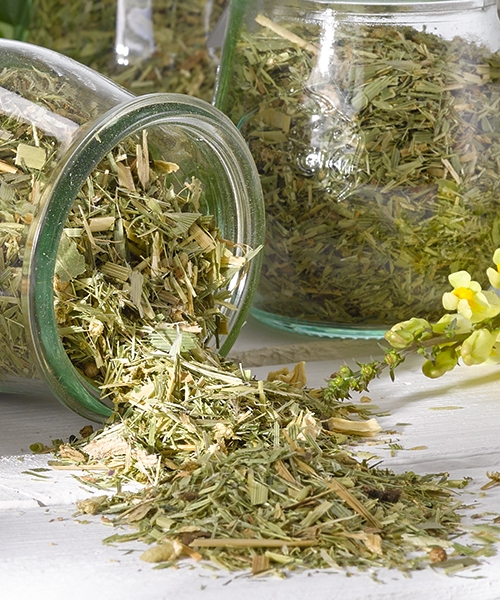
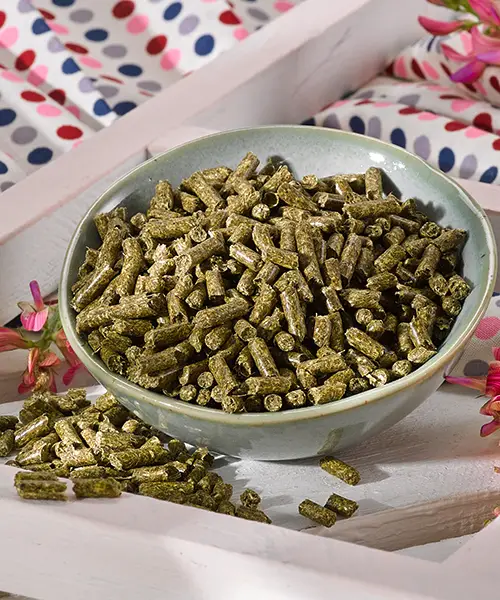
In the second step, detoxification in the body should be supported by giving OKAPI Spirulina (as powder or pellets). The spirulina algae binds toxins in the body so that they can be excreted more easily. In combination with OKAPI Detox Herbs, which promote kidney function, it ensures increased excretion of waste products and relieves the liver-kidney system. The administration of OKAPI HeparKPU forte also promotes the detoxification function of the liver, especially if the laminitis is related to malfermentation in the intestine and the destruction of the intestinal flora. These products can be used to meaningfully accompany veterinary therapy.
Step three: Eliminate the causes
Of course, for sustainable treatment of laminitis, its cause must be found and eliminated. This is not always possible with medication; however, one should try to avoid additional stress and support the body in detoxification. Hay, paddocks, and pastures should be examined for poisonous plants, and hay should also be checked for mold. Hay should be stored dry for 12 weeks after harvest before it is fed. Haylage is fundamentally not suitable for horses with laminitis. Overgrazed pastures should be closed off, even if the dry weather makes further use tempting. Under stress such as drought, overgrazing, and trampling, endophytes in the grass multiply rapidly and damage the metabolism. In autumn and spring, horses should only go onto the pasture from noon onwards and possibly with a grazing muzzle once the fructans have been broken down by the sun's warmth. Feeding should be optimized and the gut rehabilitated. For many horses, this is where the long-smoldering cause of laminitis lies, which is then triggered by acute overload. Thus, medication is often only a trigger for a metabolic derangement that has existed for years but was not yet visible.

Avoid unnecessary stress on the metabolism by only letting your horse graze on high-quality pastures.
Step four: Gut rehabilitation and dietary change
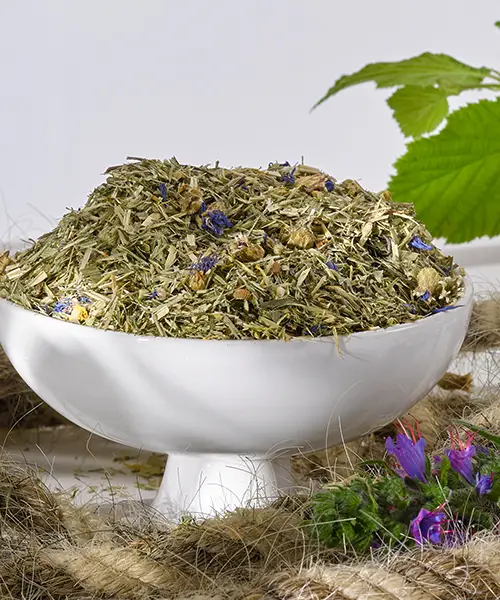
For gut rehabilitation, we recommend the combination of OKAPI Lapacho with OKAPI Bitter Herbs, which support the regeneration of the intestine. This, together with the optimization of feeding, leads to a regeneration of the digestive system and thus relief of the entire metabolism, including the kidneys. In the diet, haylage should be avoided, as should high sugar and starch contents and structured components in concentrated feed. Carrots should also not be fed in acute cases and later only up to 2–3 pieces per day because they are high in sugar and pectin. Please carry out the dietary change slowly over about 14 days to avoid stress for the gut and the metabolism. In this way, sustainable therapy is possible and a new laminitis flare-up is prevented. The administration of OKAPI Detox Herbs, OKAPI Bitter Herbs and OKAPI Imuno Herbs in two-week rotations for the first six months after acute laminitis also ensures a balanced metabolism in the long term. As a long-term alternative to concentrated feed, we recommend OKAPI Four Seasons Feed, a pure herbal feed that contains the appropriate and supportive herbs for each season and represents a healthy alternative to concentrated feed.
Even horses with rotated coffin bones can fully regenerate within about 2 years, as long as you react immediately, avoid the causative and triggering factors for laminitis, and provide sensible support for the metabolism.