Low sugar, low starch – and yet dangerous insulin spikes? Find out here why pea protein for horses with EMS, insulin dysregulation, and laminitis risk is by no means harmless.
Read articleGrass Seed Hay for Horses: Correctly Classifying Timothy, Timothy Grass, and Fescue
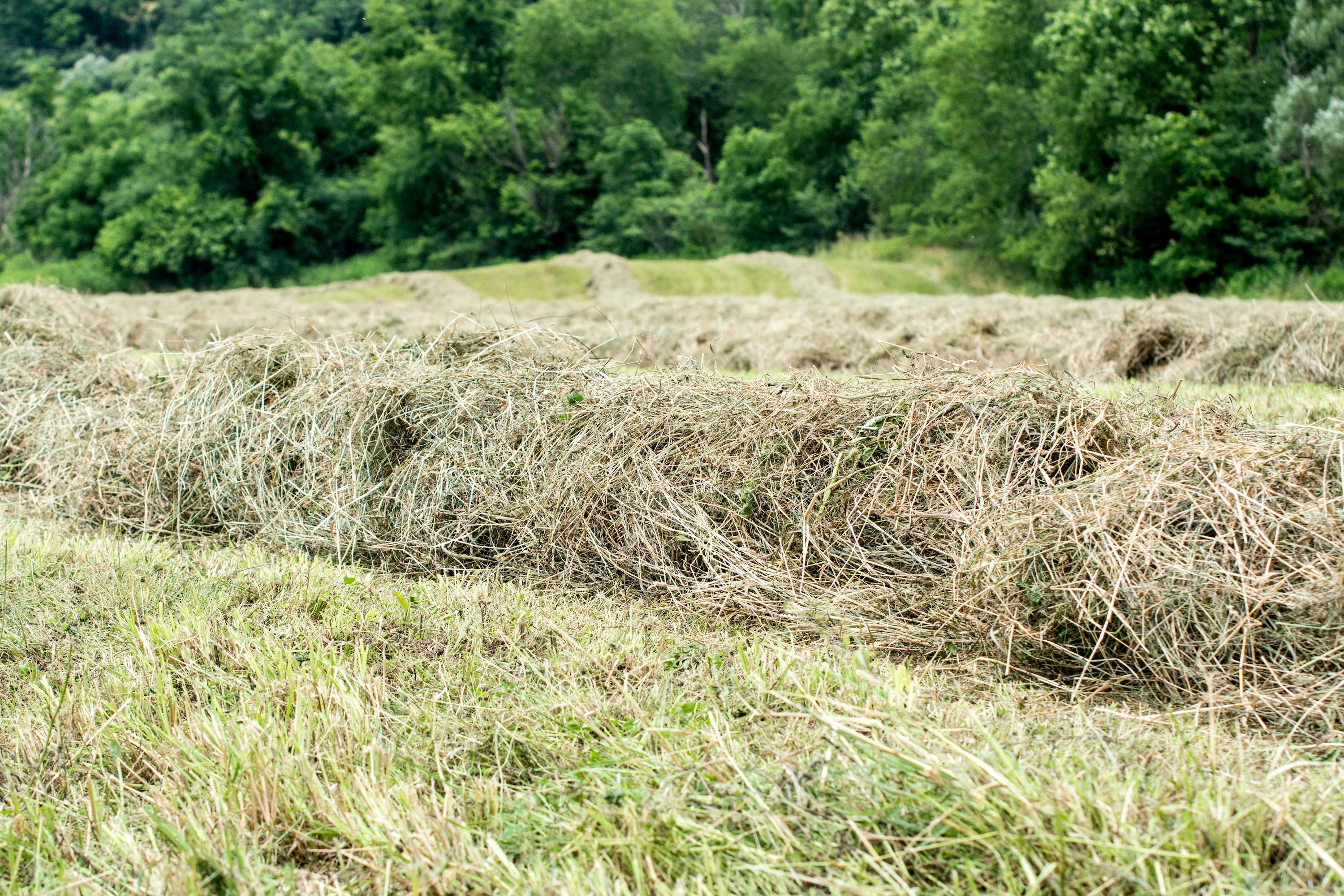
© Adobe Stock / jackienix
This article was translated using AI.
Key Points in Brief
-
Grass seed hay usually does not come from a species-rich meadow, but from targeted grass cultivation on arable land.
-
Commonly offered types include Timothy hay, Fescue hay, Orchard grass hay, and sometimes Ryegrass hay.
-
The term 'grass seed hay' is not always unambiguous: it can mean monoculture hay from seed multiplication, but also single-variety grass hay from targeted forage cultivation.
-
Nutritional values differ less by the name of the grass species than by the harvest time, degree of maturity, fertilization, location, drying, and storage.
-
Many grass seed hays are high in structure, fiber-rich, and relatively uniform, but depending on the batch, they can also be significantly higher in sugar, protein, or energy than expected.
-
For horses with metabolic problems, it is not the label “Timothy” or “Festuca” that counts, but the actual hay analysis.
-
From a health perspective, a hygienically perfect, species-rich, and appropriately analyzed meadow hay remains the more natural roughage basis for many horses.
What is Grass Seed Hay?
Grass seed hay is a term that is not always used cleanly in horse feeding. Many horse owners understand it to be a particularly high-quality, clean, single-variety hay. From an agricultural perspective, however, it usually refers to grasses that are grown specifically on arable land – either for forage production or for seed multiplication.
The decisive difference from normal meadow hay lies in the plant population. A species-rich meadow hay comes from permanent grassland with various grasses, herbs, and, depending on the location, legumes such as clover, sainfoin, or alfalfa. Grass seed hay, on the other hand, usually comes from a very uniform stand. It is often a single grass species or a strongly dominant grass species. Therefore, it can also be described as “monoculture hay from the field.”
This is not automatically a bad thing. A single-variety hay can be hygienically very clean, offer good nutritional values, and be easy to chew for horses with dental problems due to its uniform structure. At the same time, however, it lacks the natural plant diversity of a good meadow hay. Precisely for this reason, grass seed hay should not be generalized as “better,” but rather as a special type of roughage with its own advantages and disadvantages.
Why is Grass Seed Hay Grown?
Grass seed hay often originates where grasses are specifically cultivated for certain purposes. One important area is seed production. In this process, grasses are grown so that they form seeds. After the seed harvest, plant remains are left over, which can be used as grass seed hay. In other cases, the same grass species are not grown for seed harvest but directly as single-variety forage grass and processed into hay.
For agriculture, this has advantages: the stand is uniform, the harvest can be better planned, the plants provide decent yields depending on the species and location, and the product is easy to market. For horse owners, the uniformity sounds particularly attractive. A bale of Timothy hay often looks more homogeneous than a species-rich meadow hay, where every area and every cut can turn out slightly differently.
However, this uniformity is not the same as feed quality. A grass seed hay harvested very late can look beautiful, light, and clean, but – just like hay from species-rich areas – it can be low in nutrients, very hard, and poorly digestible. Conversely, an early cut can be softer, higher in sugar and protein, which is also not always good, depending on the horse population. Therefore, here too, the analysis is more important than the name.
Grass Seed Hay, Grass Seed Straw, and Single-Variety Grass Hay: What is the Difference?
When classifying these, three terms should be kept separate.
Single-variety grass hay is specifically grown and harvested as forage hay. It can consist of Timothy, Orchard grass, Fescue, or Ryegrass and is usually cut before or during flowering. Depending on the harvest time, it can have relatively high nutritional values, which can make this hay problematic for easy keepers.
Grass seed hay is often harvested a bit later because the plant is supposed to reach seed formation so that the seed can then be threshed and marketed. This increases the fiber content, while protein and digestibility tend to decrease. But depending on the grass variety, significant nutritional values can still be found in the plant even after the seed harvest. As always, the analysis provides clarity.
Grass seed straw is the same as grass seed hay, but the term “straw” makes it sound lower in quality. In cattle feeding, it is sometimes used as a cheap structural component. For horses – just like grass seed hay – it can be interesting, but it is not a full replacement for good, species-rich hay. Oregon State University describes grass seed straw generally as a rather low-value roughage and points out possible endophyte and alkaloid problems, particularly with Tall Fescue and Ryegrass. These problems apply to grass seed hay and grass hay just the same.
For horse owners, it is therefore important: if a product is offered as Timothy hay, Fescue hay, or grass seed hay, one should ask what exactly is meant. Was the grass cut as forage hay – i.e., during flowering? Does it come from seed multiplication? Was it harvested before, during, or after seed maturity? And is there an analysis? Ultimately, the analysis primarily determines whether the hay is suitable for feeding.
Timothy Hay or Timothy Grass Hay for Horses
Timothy hay comes from Timothy grass, botanically Phleum pratense. Internationally, it is known as Timothy Hay. Particularly in North America and Great Britain, Timothy hay is a very well-known horse hay. In Germany, it is increasingly offered as a special hay, often with the promise of being particularly suitable for horses.
Timothy grass prefers to grow in cooler, temperate regions. It likes fresh to moist locations and copes better with heavy, well-watered soils than with very dry, nutrient-poor locations. It forms typical cylindrical flower heads that many horse owners recognize from meadow stands.
From a nutritional physiology standpoint, Timothy hay is usually a classic grass roughage with often moderate protein and sugar content. It is frequently fiber-rich and, with an appropriate cut, can be well-suited for horses. However, the values fluctuate significantly, so it depends on the analysis of the individual batch. Feedipedia cites average values for Timothy hay of about 9.1% crude protein, 65.4% NDF, and 37.8% ADF in the dry matter; the crude protein range there spans from 5.7 to 13.8%.
|
Nutritional Value Timothy Hay |
Common orientation, in dry matter |
|
Dry Matter |
approx. 85–93 % |
|
Crude Protein |
approx. 6–14 % |
|
NDF |
approx. 62–72 % |
|
ADF |
approx. 35–42 % |
|
Crude Fiber |
approx. 25–40 % |
|
Sugar |
highly variable, individual figures around 10–12 % |
|
Calcium |
approx. 0.03–0.50 % |
|
Phosphorus |
approx. 0.02–0.30 % |
For horses, Timothy hay is particularly interesting if it is hygienically perfect, not too young, and not too energy-rich. For metabolically sensitive and easy keepers, however, a critical look at sugar and protein content should always be taken. The name alone does not provide reliable information about sugar, starch, or energy.
Fescue Hay for Horses: Not All Fescue is the Same
Hay offered under the name Festuca hay is usually fescue hay. The problem is that “Festuca” does not refer to a single grass but to an entire group. In practice, this could mean Meadow Fescue or Tall Fescue, for example. Both differ in site requirements, growth, and also in evaluation for horses.
Meadow Fescue is often listed botanically as Festuca pratensis or more recently as Schedonorus pratensis. It is a valuable forage grass for fresh to moist locations and is valued in grassland mixtures. Tall Fescue is called botanically Festuca arundinacea or Schedonorus arundinaceus. It is more robust, deep-rooted, drought-tolerant, and is used worldwide as a high-yield forage grass.
Precisely with Tall Fescue, one must look more closely. In some regions, endophyte-infected stands occur. Endophytes are fungi that live within the plant and can form alkaloids. For horses, pregnant mares are a particularly sensitive group because endophyte-contaminated Tall Fescue is associated with fertility and abortion problems. Oregon State University specifically points to Tall Fescue as a possible source of problematic alkaloids in grass seed straw.
|
Nutritional Value Festuca Hay / Fescue Hay |
Übliche Orientierung, in der Trockensubstanz |
|
Dry Matter |
approx. 89–92 % |
|
Crude Protein |
approx. 7–13 % |
|
NDF |
approx. 58–66 % |
|
ADF |
approx. 35–39 % |
|
Crude Fiber |
approx. 35–45 % |
|
Calcium |
approx. 0.30–0.51 % |
|
Phosphorus |
approx. 0.22–0.36 % |
|
Digestible Energy |
rather moderate, strongly dependent on harvest time |
In nutritional value tables for sun-dried Fescue hay, crude protein values of about 9.5 to 12.4% are usually cited, depending on maturity. Sugar values fluctuate significantly and are mostly stated between 5 and 10%, with possible upward deviations.
Fescue hay can be suitable for horses if the quality, analysis, and botanical origin are correct. For pregnant mares and horses prone to laminitis, one should be particularly careful with Tall Fescue and only use endophyte-tested products. Caution is advised if the origin is unclear or if a nutritional analysis is missing.
Orchard Grass Hay or Orchardgrass Hay for Horses
Orchard grass is botanically named Dactylis glomerata and is internationally referred to as Orchardgrass or Cocksfoot. It is a perennial, high-yielding forage grass that often copes with drought better than Timothy. It grows in clumps, forms relatively strong stalks, and can become quite coarse if harvested late.
Orchard grass is used in many grassland mixtures because it is robust and can provide good yields. As a single-variety hay, it is marketed in some countries similarly to Timothy hay. Orchard grass hay can be well-suited for horses if it was cut in time. If it is harvested too late, it can become hard, stalky, and less palatable, so many horses refuse it. On the other hand, a late harvest can be well-suited for mixing with other hay varieties to better adjust the nutritional values.
Feedipedia cites average values for Orchard grass hay of about 13.1% crude protein, 63.7% NDF, and 36.5% ADF in the dry matter. The ranges given there also show a significant spread: crude protein 7.4 to 18.3%, NDF 52.4 to 74.8%, and ADF 25.6 to 44.2%. For sugar values, ranges of 6 to 10% are found, though they can also be higher.
|
Nutritional Value Orchard Grass Hay |
Common orientation, in dry matter |
|
Dry Matter |
approx. 82–93 % |
|
Crude Protein |
approx. 7–18 % |
|
NDF |
approx. 52–75 % |
|
ADF |
approx. 26–44 % |
|
Crude Fiber |
approx. 23–37 % |
|
Calcium |
approx. 0.24–0.55 % |
|
Phosphorus |
approx. 0.20–0.35 % |
|
Magnesium |
approx. 0.13–0.26 % |
Orchard grass hay can therefore be significantly richer than one would expect from a “lean” specialty hay. Especially early or well-fertilized cuts can be higher in protein. For easy keepers, an analysis is therefore important here as well.
Ryegrass Hay for Horses: Caution with Sugar, Fructan, and Endophytes
Ryegrass is botanically known as Lolium. Frequently, it refers to Perennial Ryegrass, Lolium perenne, or Italian Ryegrass, Lolium multiflorum. Ryegrasses are very high-performance forage grasses. They are popular in intensive grassland management because they provide high yields, regrow well, and can form nutrient-rich stands.
Precisely this does not automatically make them ideal for many horses. Depending on the variety, location, fertilization, and weather, Ryegrass can reach high levels of water-soluble carbohydrates and fructans. For easy keepers, horses with EMS, insulin resistance, or a tendency toward laminitis, this can quickly become problematic, and even sport horses can have issues with such hay.
Another point is the endophyte issue. In Ryegrass, certain endophytes can form alkaloids that can trigger neurological symptoms. Particularly with grass seed hay from Ryegrass, attention is drawn to possible contamination with Lolitrem B and Ergovaline. Oregon State University therefore recommends appropriate tests for alkaloids in Ryegrass and Tall Fescue grass seed straw.
|
Nutritional Value Ryegrass Hay |
Übliche Orientierung, in der Trockensubstanz |
|
Dry Matter |
approx. 85–92 % |
|
Crude Protein |
approx. 10–18 % |
|
NDF |
approx. 55–64 % |
|
ADF |
approx. 30–52 % |
|
Sugar / Water-Soluble Carbohydrates |
partially significantly elevated, strongly weather- and cut-dependent, values are stated up to 30%! |
|
Calcium |
approx. 0.02–0.69 % |
|
Phosphorus |
approx. 0.32–0.52 % |
|
Potassium |
often relatively high |
High fluctuations are found in studies and analysis data on Perennial Ryegrass. One study cites average values for Lolium perenne of about 15.2% crude protein, 60.8% NDF, and 31.2% ADF; other data for Ryegrass hay shows significantly higher ADF values depending on the harvest and material. Sugar and protein behave inversely: with good nitrogen fertilization, the protein content increases while the sugar value decreases. If one tries to “starve” these grasses by withdrawing fertilization, the protein content drops, but the sugar content can rise exorbitantly.
For horses, Ryegrass hay is therefore to be classified rather cautiously. It can fit horses with higher requirements but is not automatically suitable for metabolically sensitive horses. Without a sugar, starch, and ideally fructan assessment, it should not be used across the board for at-risk horses.
Why Grass Seed Hay Often Appears Lower in Nutrients
Many horse owners look for grass seed hay because they need a “lean” hay for easy keepers. In fact, grass seed hay can be very rich in structure and lower in energy, especially if it was harvested late. The reason is simple: the more mature a grass becomes, the more stem mass and structural fibers it forms. At the same time, the leaf proportion, digestibility, and crude protein usually decrease.
However, this is not an automatism. A single-variety grass hay that was cut early can be relatively rich in protein and easily digestible. Conversely, a late-cut meadow hay can be significantly lower in energy than a Timothy or Ryegrass hay of the same age. Therefore, the designation “grass seed hay” is only an indication of origin and plant stand, but not a reliable statement about the feed value.
Note: Grass seed hay is not automatically lean. It is only automatically less diverse.
Grass Seed Hay Compared to Species-Rich Meadow Hay
A good meadow hay comes from a diverse plant population. It contains various grasses, herbs depending on the location, and sometimes small proportions of legumes. This diversity is not only botanically interesting for the “meadow” ecosystem but can also be valuable for eating behavior, gut flora, and the nutrient spectrum. There is evidence that plant diversity in the diet has a direct influence on the diversity of the microbiome in the horse.
Grass seed hay, on the other hand, is more uniform. This can have advantages if you are looking for a very controlled ration for a specific horse or if the meadow hay is too rich in nutrients and you want to dilute it with lean grass seed hay. However, it can also be a disadvantage if it is used permanently as the sole roughage source. Horses are designed to consume structural plant material with high species diversity over many hours. The diversity in meadow hay corresponds more to this natural eating behavior than a permanent monoculture.
Therefore, a good, species-rich, hygienically perfect, and analyzed meadow hay should basically remain the preferred roughage base. Grass seed hay can be useful if normal hay is too rich, hygienically problematic, or unsuitable for a specific horse. However, it is more of a targeted ration component than the fundamentally better solution.
What to Look for When Buying Grass Seed Hay
When buying grass seed hay, it is not enough to ask for the name of the grass species. The specific batch is decisive. Horse owners should know which grass species is included, whether it is forage hay or grass seed hay (grass seed straw), when it was harvested, and whether an analysis is available.
Crude protein, sugar, starch, crude fiber, NDF, and ADF are particularly important. For metabolically sensitive horses, easily soluble carbohydrates are decisive. For hard keepers or seniors, however, a hay harvested too late and very rich in fiber may provide too little usable energy.
The hygienic quality must also be correct; this applies to any hay you want to feed. Grass seed hay must not be dusty, smell musty, show moldy spots, or be heavily contaminated. A visually beautiful, uniform hay is not yet good horse hay if it was stored incorrectly or is microbially contaminated.
For Fescue and Ryegrass products from seed production, the endophyte and alkaloid issue should also be considered. This applies particularly to pregnant mares, horses with a history of laminitis, and products of unclear origin.
Is Grass Seed Hay Healthy for Horses?
Grass seed hay can be healthy if it fits the horse. However, it can be just as unsuitable as any other hay. What matters is not the trendy term, the beautiful packaging, or the English name, but the analysis, hygiene, plant species, harvest time, and ration context.
Timothy hay can be a good, moderate horse hay. Fescue hay can fit if the origin and endophyte question are clarified. Orchard grass hay can be very useful if it was not harvested too late and is intended for a horse with dental problems. Ryegrass hay should be checked extremely critically for metabolically sensitive horses because protein, sugar, and fructan levels can be relevant.
For healthy horses with normal requirements, a good meadow hay is often the more obvious choice. For easy keepers, overweight horses, or horses with metabolic problems, analyzed grass seed hay can be a helpful supplement or alternative. Without analysis, however, it remains a guessing game.
Grass seed hay is frequently marketed as particularly controllable, clean, and horse-appropriate hay. This can be true, but it doesn't have to be. The most important difference from normal meadow hay lies in the plant population: grass seed hay is usually poor in variety to single-variety and often comes from targeted grass cultivation on arable land.
Whether it is suitable for a horse is not decided by the name Timothy, Timothy grass, or Fescue. The harvest time, degree of maturity, nutritional values, hygienic quality, and the individual horse are the decisive factors. For some horses, grass seed hay can be a very good solution, particularly when a controlled, high-structure roughage is required. For many horses, however, a good, species-rich meadow hay remains the physiologically more sensible basis. And price also plays a role, as grass seed hay is often marketed as “higher quality,” although it can be significantly inferior to a good meadow hay.
The best decision therefore arises not from a trend, but from the analysis: What is really in the hay, and does it fit this horse? And what price is the farmer asking for this quality? These are exactly the questions that should be answered before every purchase of grass seed hay.