Key points at a glance:
- Side reins are fixed auxiliary reins that run from the girth to the bit on each side, rigidly limiting the horse’s head position—adjustment during work is not possible.
- They are mainly used for lunging, in riding school settings, and in vaulting to provide lateral guidance and prevent the horse from evading strongly upward or sideways.
- Their greatest advantage is clear lateral framing and predictability. Their greatest disadvantage is the lack of forward–downward stretch and the risk of overbending.
- Side reins are particularly prone to incorrect adjustment—set too short, they force the horse into a position it cannot yet sustain and cause severe tension.
- As a permanent solution in riding schools, side reins are problematic because they do not replace true training and can lead to long-term muscular misdevelopment.
When people think of auxiliary reins, side reins usually come to mind immediately: two straps running from the girth or lunging surcingle to the bit on either side, holding the horse within a defined frame. Side reins are the classic auxiliary rein—hardly any riding school operates without them, and they are also commonly seen when privately owned horses are lunged. But as with all auxiliary reins, their effect depends entirely on how they are used.
What are side reins and how do they work?
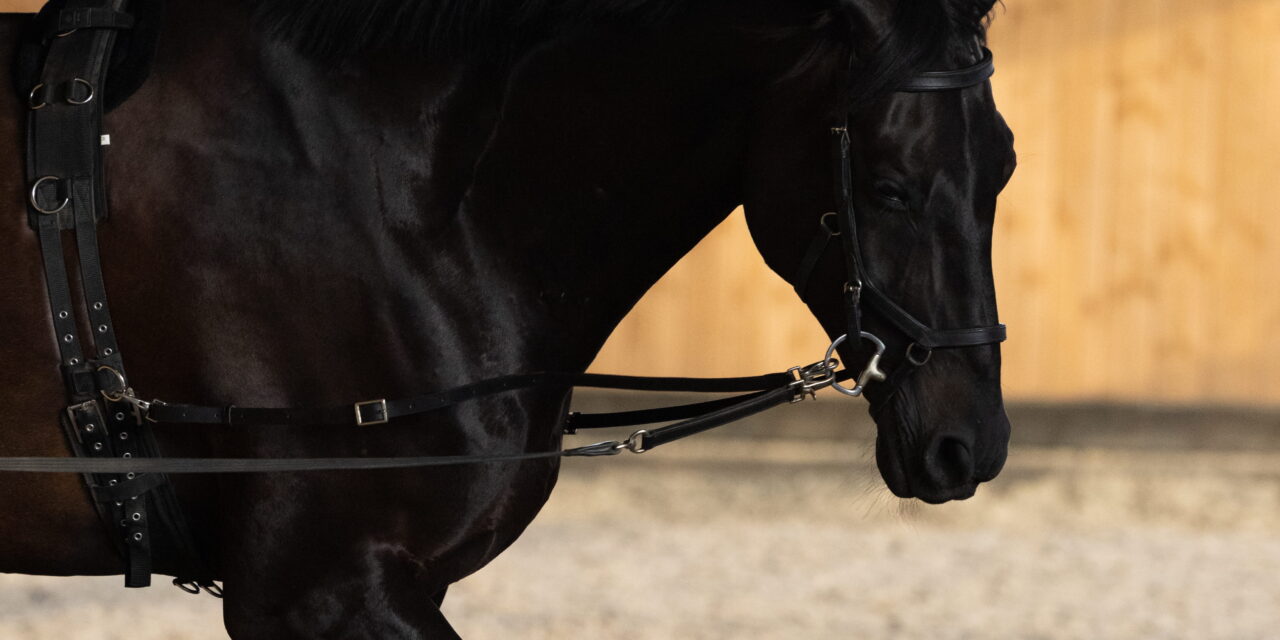
Side reins (often referred to as fixed side reins to distinguish them from more flexible variants) are leather or synthetic straps attached on both sides from the saddle or lunging girth to the bit rings. Their length can be adjusted, but once fastened they remain fixed during work—situational adjustments are not possible.
Their mode of action is simple: side reins create a rigid limit for the horse’s head and neck position. The horse can move its head within this frame, but not beyond it. If it attempts to raise its head higher or turn strongly to the side, pressure on the bit prevents further movement.
This rigid limitation is both the advantage and the disadvantage of side reins. They are entirely predictable and provide clear lateral framing, but they do not allow the horse to adapt individually to different situations, gaits, or stages of balance.
Areas of use: where are side reins applied?
Riding schools: By far the most common use of side reins is in riding school environments. They are used for several reasons: to prevent school horses—ridden daily by riders of varying skill levels—from developing extreme postural faults; to provide inexperienced riders with a sense of security by limiting excessive head movement; and to create a relatively uniform frame for different riders.
The problem is that in many riding schools, side reins become a permanent solution. School horses spend their entire working lives in side reins, never being given the opportunity to develop true self-carriage. While this may be convenient, it is problematic for the horses—more on that later.
Lunging: When lunging, side reins are often used to provide lateral guidance and to prevent the horse from leaning outward or excessively turning the head inward or outward. In theory, this can be helpful for young or unbalanced horses—provided the adjustment is correct.
Vaulting: In vaulting, side reins are almost standard equipment. They give the horse a stable frame and prevent it from throwing its head up or turning sideways in response to the movements of the vaulters on its back. Here, side reins serve a genuine safety function.
Advantages: lateral framing and predictability
The main advantage of side reins lies in their clear lateral guidance. A horse that tends to lean strongly outward or twist its head excessively to one side can, when side reins are correctly adjusted, learn to move straighter and develop more even contact.
Predictability is another benefit. Unlike hand-held auxiliary reins, there is no fluctuating influence, no accidental strong impulses. The horse always knows exactly where the boundary is. This can be calming for nervous or insecure horses, as they have a clear, reliable frame.
For lungers or instructors with limited experience, side reins are also easier to handle than more flexible or hand-held auxiliary reins. Once correctly adjusted, they require no further intervention during the session.
Disadvantages: no possibility for stretching
The most serious disadvantage of side reins is the lack of opportunity for forward–downward stretching. One of the most fundamental and important movements in horse training is stretch: the horse lengthens its neck forward and downward, the back lifts, and the entire topline is activated and lengthened. This movement is essential for developing healthy back musculature and achieving true relaxation.
With classic side reins, this stretch is not possible. The lateral attachment prevents the horse from lowering its neck sufficiently. The horse remains in a relatively elevated position—which may look appealing but is biomechanically problematic if it is not balanced by adequate stretching phases without side reins.
Another disadvantage is their lack of flexibility. A horse in canter needs more freedom of movement than in trot, and a horse in walk moves differently again. Side reins do not accommodate these differing requirements—they remain the same regardless of what the horse is doing.
The greatest danger: overbending and curling behind the bit
The most common and most problematic misuse of side reins is adjusting them too short. Many riders or lungers think, “The shorter, the better the outline.” The opposite is true.
Side reins that are too short force the horse into a position it cannot yet sustain muscularly. The typical reaction is that the horse curls behind the vertical. The nasal line drops behind the vertical, the poll is over-flexed, and the under-neck muscles bulge. This position is often mistakenly interpreted as “collection,” when in reality it is a faulty posture that causes severe tension.
In this curled position, the horse cannot work correctly. The hindquarters cannot step under the center of gravity, the back cannot swing, and true weight carrying is impossible. Instead, the horse falls onto the forehand, movements become short and stiff, and the entire biomechanical system is disrupted.
Over time, this faulty posture leads to significant muscular problems: the under-neck musculature becomes overdeveloped while the topline remains weak. The back hollows, the hindquarters cannot develop properly, and the resulting imbalance is difficult to correct—often remaining with the horse permanently.
Correct adjustment: how to do it properly
Correct length is crucial. As a rule of thumb, if you run the side reins along the horse’s side toward the nose, they should reach approximately the point of the shoulder or slightly above. The horse should be able to carry its head in a natural, lightly elevated position without constant tension on the reins.
Even more important: side reins should only come into effect when the horse moves clearly beyond the desired position. In a normal posture, they should hang loosely or make only light contact—nothing more. The horse should be able to move its head freely within a reasonable frame. Side reins are meant to be an outer boundary, not a forced position.
Another key point is symmetry. Both side reins must be exactly the same length. Otherwise, the horse will be loaded unevenly and develop crookedness. This may sound obvious, but in practice it is surprisingly often done incorrectly.
Continuous use: a problem in riding schools
In many riding schools, side reins are standard equipment—school horses are routinely fitted with them regardless of whether the individual horse actually needs them. The reasoning is understandable: convenience, a certain level of safety for inexperienced riders, and prevention of extreme postural faults.
The problem is that this practice prevents horses from ever learning true self-carriage. They do not develop balance, independence, or the ability to regulate their own head–neck position. They function only within the mechanical frame imposed by the side reins.
In addition, most school horses lack the crucial stretching phases they need. If a horse is worked for several hours every day in side reins without the opportunity to stretch freely, this leads to chronic tension and muscular imbalance. The back becomes stiff, movement loses elasticity, and the horse ages prematurely.
A responsible riding school should therefore differentiate: which horse truly needs side reins, and which could work without them? And even when side reins are used, regular stretching phases without auxiliary reins are essential, allowing the horse to work freely in a forward–downward posture.
Alternatives for greater flexibility
Those who appreciate the lateral guidance of side reins but want to allow more freedom of movement should consider more flexible alternatives. Triangle reins (Vienna reins) or sliding side reins allow forward–downward stretching while still providing lateral guidance. These will be discussed in more detail in the following articles in this series.
It is also worth asking whether any auxiliary reins are needed at all. A well-trained horse, worked by a competent rider or lunger, does not require mechanical restriction to maintain an appropriate posture.
A classic tool with clear limitations
Side reins are a classic, widely used auxiliary rein with a simple and clearly defined effect. In certain situations—vaulting, lunging unbalanced horses, or temporary use in riding schools—they can be useful. However, their rigid nature is also their greatest weakness: they allow no individual adjustment, restrict essential stretching movements, and their apparent simplicity often leads to misuse.
Skillful use of side reins lies in correct, generous adjustment, limited duration of use, and an honest assessment of whether they are truly necessary in the given situation—or whether better alternatives exist. An auxiliary rein should never be the rule, but always the exception—one that can be clearly justified.