Key points at a glance:
- Auxiliary reins are pieces of equipment used in addition to the bridle to influence the horse’s head–neck position—ranging from relatively harmless safety aids to highly problematic instruments of force.
- A distinction is made between fixed auxiliary reins (such as side reins or triangle reins), hand-held auxiliary reins (such as running reins), and purpose-specific aids (such as the martingale).
- The most common mistake with all auxiliary reins is adjusting them too short and using them permanently instead of temporarily—both lead to serious biomechanical and psychological problems for the horse.
- While some auxiliary reins may be justifiable in very specific situations and in experienced hands, most are misused in practice and cause more harm than benefit.
- The best alternatives to auxiliary reins are often a cavesson and dual lungeing, which allow genuine training without mechanical coercion—or simply no auxiliary reins at all, combined with sound, patient training.
Auxiliary reins – a controversy
Few topics in the horse world are debated as controversially as auxiliary reins. Some consider them indispensable training aids; others see them as tools of suppression. In riding schools, side reins are standard equipment, while classical trainers often reject them outright. Jumpers and event riders swear by martingales, while dressage riders consider them unnecessary. Some trainers “correct” with running reins; others see this as outright cruelty.
The truth lies somewhere in between and is far more nuanced than the polarized camps suggest. Auxiliary reins are neither inherently evil nor miracle tools. They are instruments whose benefit or harm depends on which tool is used, for what purpose, and by whom. This overview provides an introduction to the different types of auxiliary reins, their original intention, their problems—and the fundamental question of whether and when they are actually needed.
What are auxiliary reins?
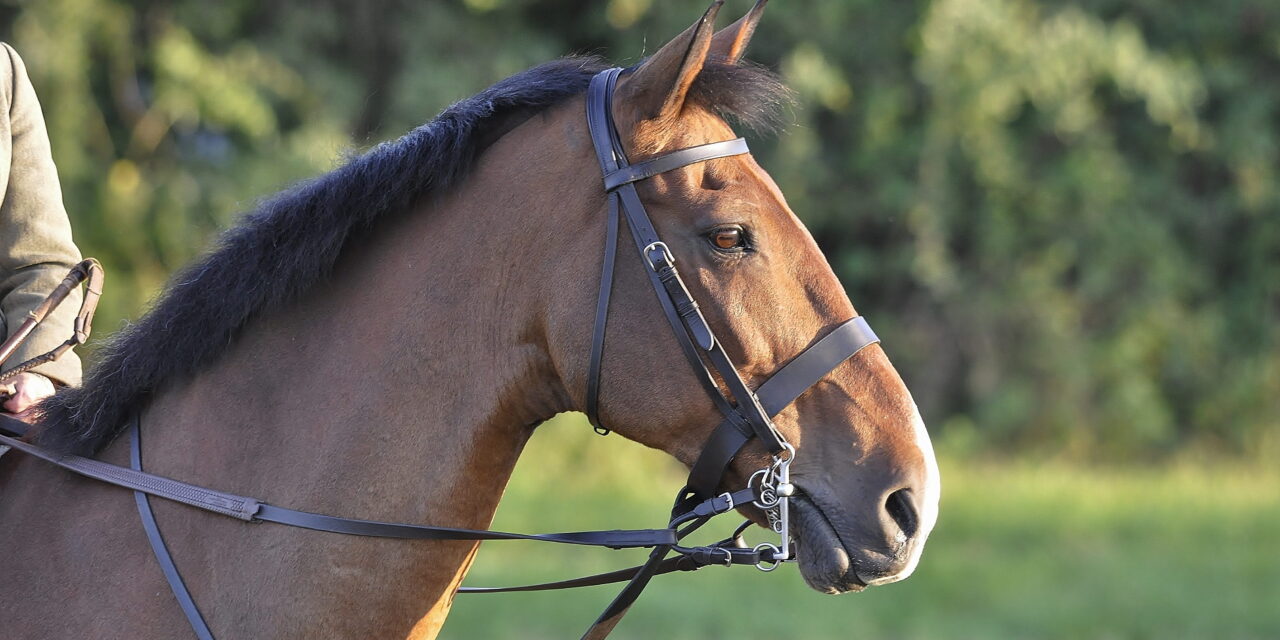
Auxiliary reins are pieces of equipment used in addition to the standard bridle to influence the horse’s head–neck posture or to restrict certain movements. They act through mechanical pressure or limitation and provide the horse with an external frame.
Auxiliary reins are pieces of equipment used in addition to the standard bridle to influence the horse’s head–neck posture or to restrict certain movements. They act through mechanical pressure or limitation and provide the horse with an external frame.
The term “auxiliary reins” is somewhat misleading, because strictly speaking they are not reins in the classical sense—there is no direct, fine connection between the rider’s hand and the horse’s mouth. Rather, they are mechanical aids with different modes of action, producing very different effects depending on their design.
The three main categories
Fixed auxiliary reins are attached before riding or lungeing and remain in the same setting throughout the entire work session. This category includes side reins, triangle reins, fixed draw reins, the chambon, the gogue, and neck stretchers. They are predictable but inflexible—and therein lies both their limited usefulness and their potential danger.
Hand-held auxiliary reins are held like normal reins and can be applied or released situationally. These include running reins, Thiedemann reins, and the riding version of the gogue. In theory, they allow finer influence, but in inexperienced hands they are particularly dangerous due to their often amplified leverage.
Safety aids such as the martingale occupy a special position. They are not primarily intended to influence posture, but to prevent the horse from throwing its head up uncontrollably and injuring the rider. This functional limitation makes the martingale the simplest and least problematic auxiliary rein.
The original idea: temporary support
Every auxiliary rein in use today was originally developed for a reasonable purpose. Side reins were meant to provide lateral guidance when lungeing. Triangle reins were intended to invite young horses into stretch. Chambon and gogue were designed to promote back activity. Running reins were meant to assist with difficult corrections in exceptional cases. The martingale was developed to prevent accidents.
Their shared original intention was temporary support. These aids were meant to be used in specific phases of training to help the horse experience a desired posture or to bridge the gap toward a solution. The goal was always to remove them again once the horse had learned to find balance independently.
In reality, however, this is rarely the case. Temporary aids have become permanent solutions. School horses spend their entire working lives in side reins. Leisure horses are lungeed exclusively with neck stretchers for years. Auxiliary reins designed for short-term professional correction are used as standard equipment by beginners.
The most common mistakes
Across all types of auxiliary reins, three recurring errors turn potentially useful tools into serious sources of harm:
Mistake No. 1: Adjusting them too short
By far the most common and damaging error. Whether side reins, triangle reins, or neck stretchers—most are adjusted far too tightly. The assumption is: “The shorter, the quicker the horse adopts the desired outline.” The opposite is true.
Over-tightened auxiliary reins force the horse into a position it cannot yet sustain muscularly. Typical consequences include curling behind the vertical, falling onto the forehand, and severe tension. Instead of correct elevation or stretch, a faulty posture develops—with long-term health consequences.
Mistake No. 2: Permanent use instead of temporary application
What was intended as a temporary aid becomes a permanent crutch. Horses that are never worked without auxiliary reins develop no self-carriage, no true balance, and no ability to regulate their posture independently. They function only within a mechanical frame—and collapse without it.
Long-term use also leads to muscular imbalances. Some muscle groups are chronically overloaded, others waste away. Incorrect muscular development is difficult to correct and often accompanies the horse for life.
Mistake No. 3: Use by inexperienced handlers
Many auxiliary reins were developed for professional use—but end up in the hands of beginners. This becomes particularly dangerous with leverage-based reins such as running reins. What might be a precise correction tool in expert hands becomes an instrument of pain and damage when used by the inexperienced.
Auxiliary reins at a glance
Side reins: the classic with clear limits
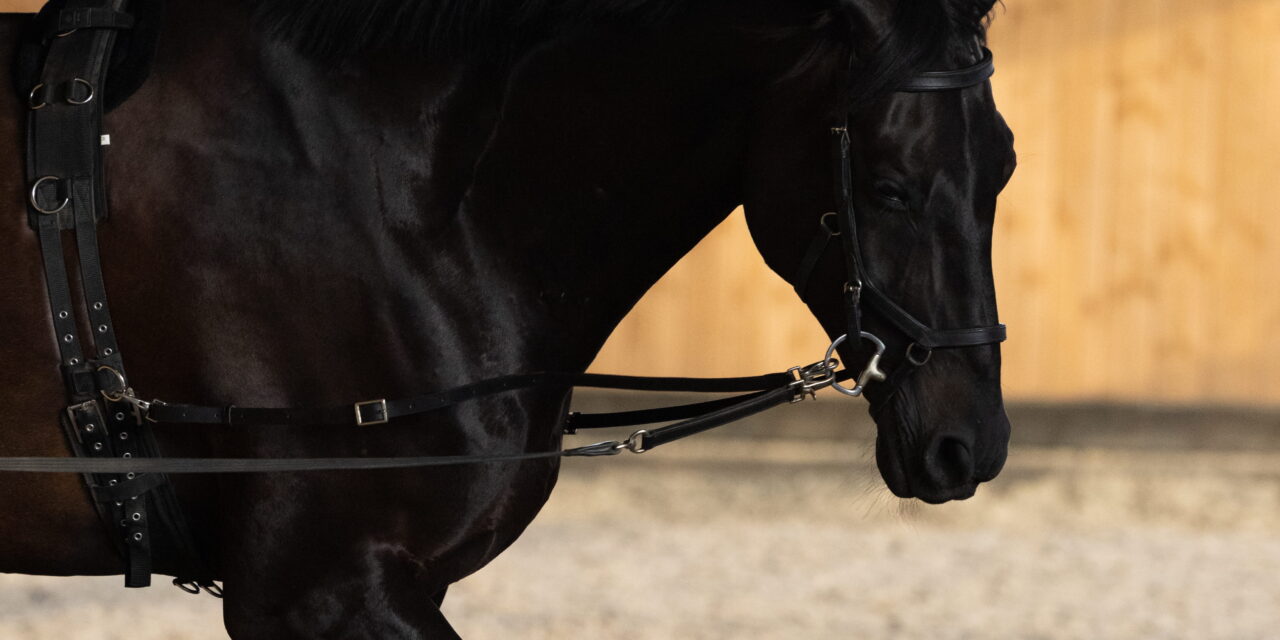
Side reins are fixed straps running from the girth to the bit. They provide lateral guidance but prevent essential forward–downward stretch. Widely used in riding schools and lungeing—often as a permanent solution, which is problematic. Their greatest weakness is lack of adaptability and high risk of being adjusted too short.
Triangle reins and sliding side reins: flexible alternatives
Unlike rigid side reins, these allow stretching. Triangle reins actively invite forward–downward movement; sliding side reins are even more adjustable, ranging from maximal stretch to light elevation. Both work on the principle of pressure and release and are considerably more horse-friendly.
Fixed draw reins: maximum criticism
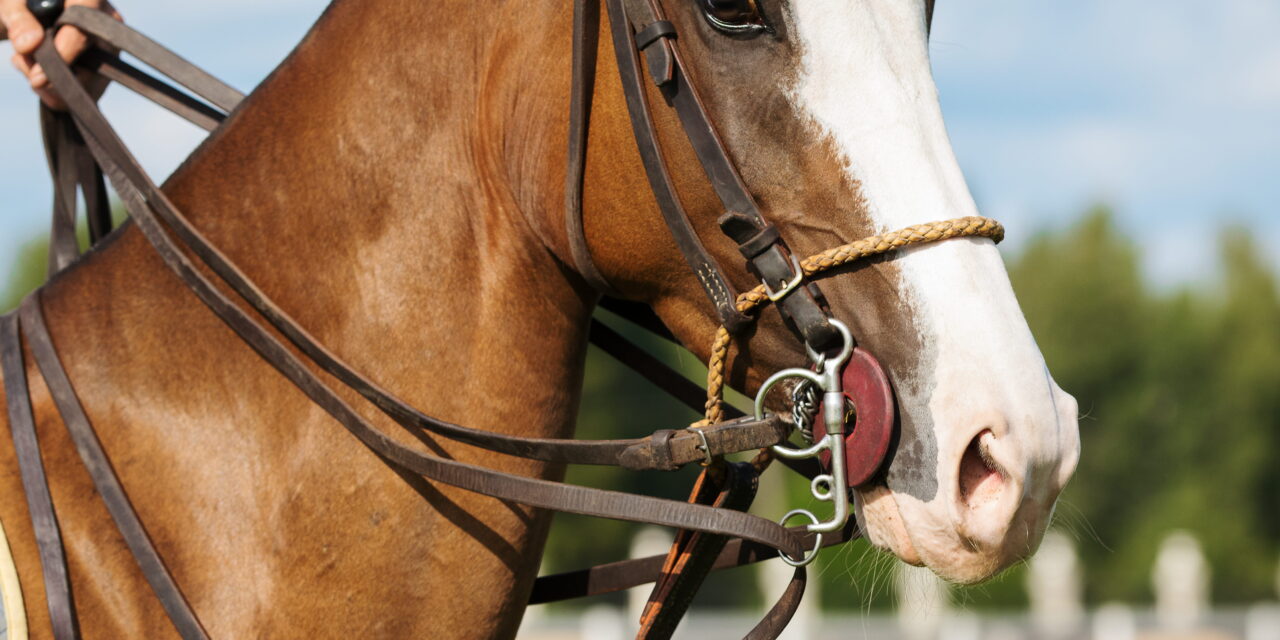
Running between the legs directly to the bit, fixed draw reins aim to prevent head-throwing. In practice, they are among the most problematic auxiliary reins. Rigid upward pressure, lack of lateral guidance, and extreme risk of overbending make them strongly inadvisable.
Chambon and gogue: promoting back activity
These specialized reins act on the bit and poll, encouraging stretch while promoting back use. The chambon is for lungeing only; the gogue exists in fixed and hand-held versions. Both are well-designed but require precise adjustment and solid biomechanical understanding.
Neck stretchers: controversial elastic aids
Elastic straps intended to provide soft contact. In practice, they often cause horses to brace against elastic resistance, curl behind the vertical, and develop incorrect musculature. Widely rejected by classical trainers, their limited transitional usefulness does not justify their widespread misuse.
Running reins: for absolute professionals only
The pulley effect greatly multiplies rein pressure, making running reins extremely severe. Originally intended for short-term professional correction, they are alarmingly often used by inexperienced riders. Riding solely on running reins is abusive and can cause severe injuries, including tongue paralysis.
Thiedemann reins: the compromise
A hybrid between running reins and martingale—milder than running reins, more complex than a martingale. Primarily used in jumping and cross-country. Suitable for advanced riders, too complicated for beginners.
Martingale: the safety aid
The martingale is primarily a safety device designed to prevent uncontrolled head elevation. It is the simplest and least problematic auxiliary rein when correctly adjusted (rings reaching the throatlatch). Particularly useful in jumping and cross-country riding.
Biomechanical and psychological consequences of misuse
When auxiliary reins are misused—and this is the rule rather than the exception—they cause severe problems:
Biomechanically, misuse leads to:
- Curling behind the vertical
- Excessive forehand loading
- A blocked, non-swinging back
- Incorrect muscular development (overdeveloped underneck, weak topline)
- Long-term damage such as kissing spines, arthritis, and chronic tension
Psychologically, misuse can result in:
- Learned helplessness and resignation
- Loss of natural movement joy
- Breakdown of trust in humans
- Stereotypic behaviors and resistance
- The horse becoming a passive object rather than an active partner
These consequences are not theoretical—they affect thousands of horses every day worldwide.
The role of the training scale
The classical training scale—rhythm, relaxation, contact, impulsion, straightness, collection—defines the logical progression of training. Auxiliary reins can, at best, play a very limited supportive role.
In the phase of relaxation, auxiliary reins such as triangle reins or the chambon can theoretically be helpful by inviting the horse to stretch—but only if the horse perceives them as an invitation, not as coercion. When it comes to contact, the situation already becomes more critical: true contact develops from the hindquarters. An auxiliary rein that mechanically restricts head position cannot replace this.
Auxiliary reins are completely unsuitable for impulsion and collection, as these qualities require genuine weight-bearing by the hindquarters, conscious balance, and a high degree of suppleness—all of which cannot be created through external restriction.
The key insight: auxiliary reins may only have a role in the earliest stages—and even then only when used correctly. They can never replace real training.
When—if ever—are auxiliary reins justifiable?
After all this criticism, the question remains: are there situations in which auxiliary reins are actually useful? The honest answer is: yes—but only under very strict conditions.
Auxiliary reins can be useful, if:
- Use is temporary (days or weeks, not months or years)
- The handler has solid knowledge and experience
- Adjustment is correct and generous
- The horse shows no signs of stress or pain
- A clear plan exists for discontinuation
- Alternatives have been considered
In practice, these conditions are rarely met. Most situations would be better resolved through patient training, health checks, or professional guidance.
The better alternative: cavesson and dual lungeing
The best alternative to auxiliary reins is often not to use any at all. The cavesson and dual lungeing are horse-friendly options that allow genuine training without mechanical coercion.
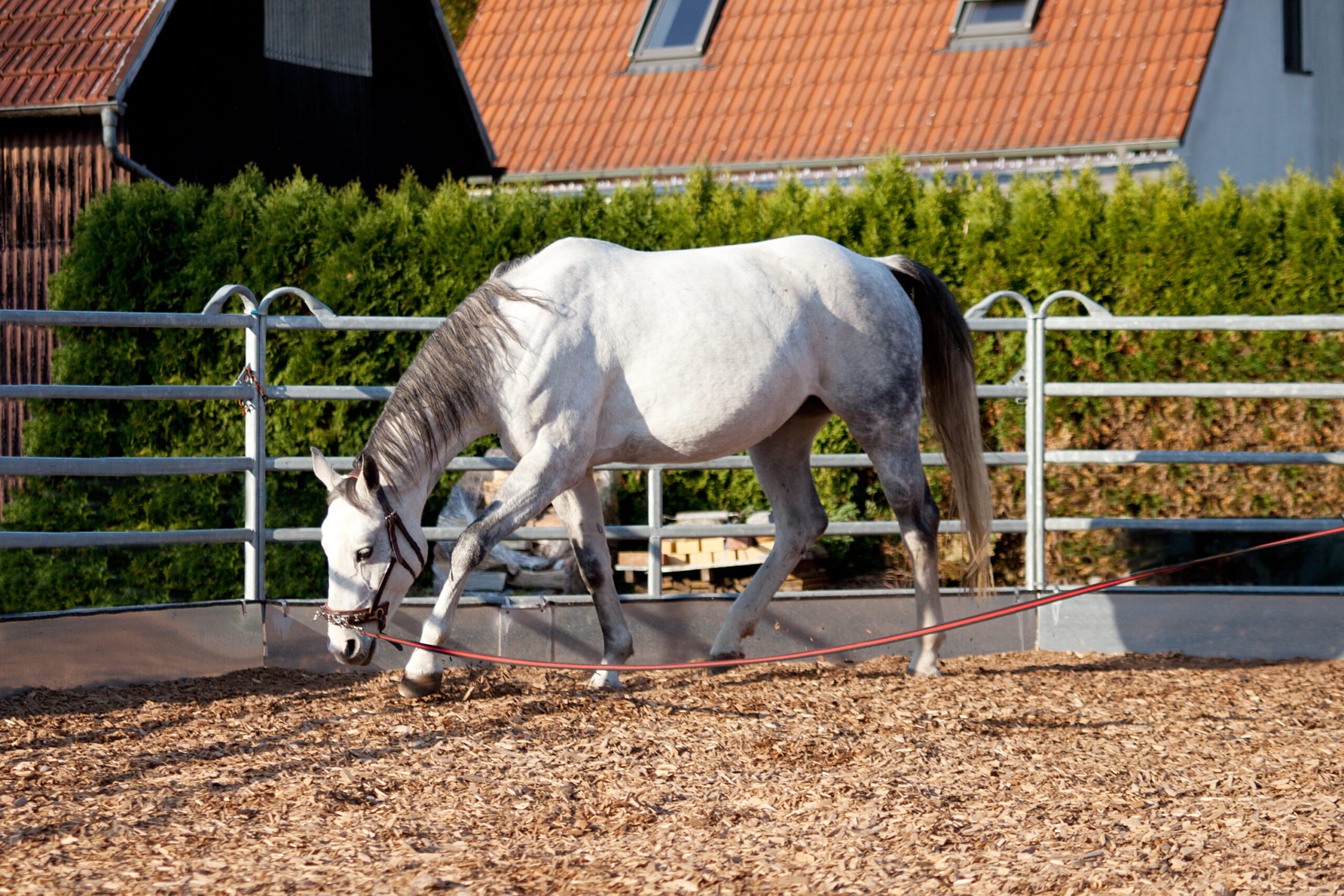
A cavesson is a special type of headcollar with a reinforced noseband to which the lunge line is attached. It acts on the nose rather than the mouth and allows precise influence without a bit. The horse can experiment freely, learns true self-carriage, and does not develop a dependency on mechanical restriction.
© Adobe Stock / anjajuli
Dual lungeing works with two lunge lines that provide lateral guidance without forcing the horse. It simulates later rein aids and prepares the horse optimally for riding. The combination of cavesson and dual lungeing is particularly effective.
Both methods require more skill from the human than simply fastening side reins. But they result in horses with genuine self-carriage, true relaxation, and real understanding. They are more demanding—but better.
The ethical dimension: human responsibility
Beyond all technical discussions about adjustments and effects lies an ethical core question: do we have the right to force horses into positions through mechanical aids that they would not assume of their own accord?
Animal welfare legislation is clear: no one may cause pain, suffering, or harm to an animal without a valid reason. A “valid reason” does not exist when better, more humane alternatives are available—and in most cases, they are.
The ethical responsibility of the rider or lunge handler is to examine honestly: does this auxiliary rein truly serve the horse—or does it serve my own convenience? Does it solve a problem—or merely conceal my shortcomings?
These questions are uncomfortable. But they are necessary. Because in the end, this is not about us or our convenience. It is about sentient, learning beings who are dependent on us and trust us to do what is right for them.
Conclusion: less is more
At the end of this overview lies a simple realization: in most cases, auxiliary reins are not needed. What is needed is time, patience, sound knowledge, and the willingness to invest in one’s own skills rather than in mechanical aids.
The few situations in which an auxiliary rein might actually help are so specific and rare that they do not justify the widespread misuse we see daily in riding schools, private stables, and competition arenas. For almost every one of these situations, better alternatives exist—you simply have to be willing to use them.
Auxiliary reins are not neutral tools. They are powerful interventions in both the biomechanics and the psyche of the horse. In the wrong hands, or when used incorrectly, they cause significant harm. Even in the right hands, they are often unnecessary.
The following in-depth articles in this series examine each auxiliary rein in detail—how it works, where it may be used, and its risks and problems. Their aim is to support informed decision-making. And in many cases, the best decision is this: hands off auxiliary reins, and instead invest in genuine, well-founded training.
Because in the end, what matters is not how quickly we shape a horse into a desired outline. What matters is whether we have a horse that is healthy, relaxed, motivated, and working as an active partner at our side. And that path rarely leads through auxiliary reins—it leads through patience, knowledge, respect, and the willingness to give the horse the time it needs to truly understand and learn.