Key points at a glance:
- Horses promote motor development through balance, coordination, and body awareness
- Interacting with horses strengthens emotional intelligence and empathy
- Children learn responsibility and reliability through caring for a horse
- Confidence grows as children master challenges together with the horse
- Teamwork and patience develop naturally in everyday stable activities
Horses as Developmental Guides on Four Hooves
Many parents observe it again and again: children who spend regular time with horses develop in a remarkably positive way. They become calmer, more focused, and more responsible. But what makes horses such valuable companions in childhood?
The answer lies in the unique combination of physical activity, emotional connection, and practical responsibility. Horses challenge children holistically – and support them on many developmental levels at the same time.
Motor Skills and Body Awareness – Movement With All the Senses
Riding is far more than simply sitting on a horse’s back. Even grooming, leading, and saddling train fine and gross motor skills. Hand–eye coordination improves through precise brushing, and body control is strengthened when mounting and dismounting.
On the horse itself, balance develops continuously. Unlike cycling or swimming, the “ground” moves constantly – in three dimensions and in a rhythmic motion. The child must make countless small adjustments and, in doing so, learns to control their body with sensitivity.
What makes this special: motor development happens playfully and joyfully, not as monotonous exercise.
Learning Empathy – The Horse as a Mirror of Emotions
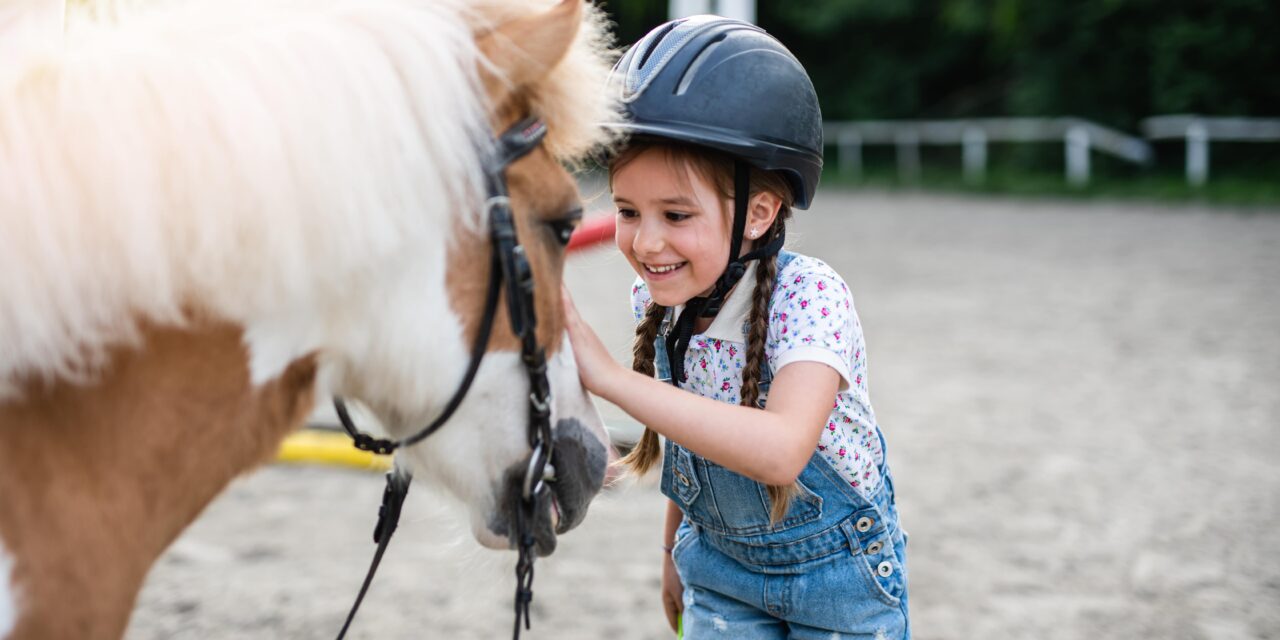
Horses react immediately to a person’s mood and body language. A restless or impatient child will quickly notice the horse becoming tense. Calm, friendly behavior, on the other hand, is rewarded with trust.
This direct feedback teaches children to perceive and regulate their own emotions. They learn to put themselves in another being’s place: What does the horse need right now? Is it relaxed or tense? Maybe even afraid?
This ability to empathize often carries over into human relationships. Children who can “read” a horse also learn to better understand the people around them.
Taking Responsibility
A horse needs daily care. It must be fed, watered, and looked after – regardless of weather or mood. For children, this experience is incredibly valuable.
They learn that their actions (or lack of action) have direct consequences. The horse cannot fill its own water bucket or muck out its stall. It relies on humans. This dependency makes children realize: I am needed. Others can rely on me.
Unlike many other hobbies, there is no “I don’t feel like it today” when it comes to horses. The animal has needs – every day. This reliability leaves a lasting impression.
Building Self-Confidence – Mastering Challenges
Whether sitting on a horse for the first time, cantering for the first time, or confidently leading a large horse – each challenge mastered boosts a child’s self-confidence.
Equally important: the successes are tangible and immediately felt. Children notice physically how they become more secure in the saddle, how the horse responds to their aids, and how they grow calmer and more confident themselves.
They also learn to cope with setbacks. Not every lesson goes perfectly, and not every exercise works right away. The horse teaches patience – and the understanding that true progress takes time.
Teamwork and Patience – Together, Not Against Each Other
In the stable, everyone works together: feeding, mucking out, setting up obstacles. Children experience that some tasks can only be completed as a team. They learn to coordinate, share responsibilities, and be considerate.
The relationship with the horse itself is also teamwork. A horse is not a machine that works at the push of a button, but a partner with its own will. Children learn to negotiate, to ask rather than command – and to accept that things don’t always go their way.
This experience of partnership instead of dominance is especially valuable in our performance-driven world.
More Than a Hobby – A School for Life
Horses offer children a safe and nurturing space in which they can develop essential skills for life. Physical activity, emotional connection, and practical responsibility combine into a unique learning experience.
Of course, working with horses does not replace parenting or other important developmental steps. But horses can accompany children on their journey and help them grow into confident, empathetic, and responsible individuals.
And the best part: for the children, none of this feels like learning – it simply feels like spending time with their beloved horse.