From Apple Pomace to Beet Pulp – What the Ingredient List Reveals About Quality and Value
Key Points at a Glance
- Order matters: Ingredients are listed by their input weight – whatever appears first is present in the largest amount
- Single ingredients beat umbrella terms: “Oats” is better than “grain,” “apple pomace” better than “fruit by-products”
- Spot weight tricks: Heavy ingredients can appear at the front despite low amounts, while lightweight fillers slip to the back
- Identify fillers: Soy hulls, chopped fibre mixes, and beet pulp are often expensive bag fillers with little nutritional value
- Detect hidden sugars: Molasses, beet pulp, and sweet fruits raise sugar content significantly
- Quality costs: High-quality single feed ingredients are more expensive than “by-products
- Transparency signals quality: A detailed list of all components shows commitment to high standards
The Ingredient List is the heart of every feed label where the wheat is separated from the chaff. While marketing claims on the front of a bag often promise more than they deliver, the ingredient list reveals exactly what is really inside. It shows the raw materials that ultimately end up in your horse’s feed trough. But the real skill lies in reading between the lines, because even here there are legal tricks and tactics designed to mislead horse owners.
Understanding the Weight-Based Order
The Basic Principle
All ingredients in horse feed must be listed in descending order based on their input weight. What appears first makes up the largest share; what appears last is present in the smallest amount. This sounds simple, but hides pitfalls that even experienced horse owners often miss.
Input weight refers to the ingredient at the moment of weighing during production. Whether an ingredient was added fresh, dried, or in processed form does not affect its position in the list. This leads to common confusion: 100 g of fresh apples will weigh far less after drying than 100 g of already-dried oats.
The Pitfalls of Weight-Based Listing
A classic example of misleading order: a muesli mix lists “oats” first, followed by “wheat bran,” “apple pomace,” and “soy hulls.” At first glance, oats appear to be the main, high-quality component. But if oats were weighed at 650 g/L, while the three other ingredients together weigh only 200 g/L, even though they make up 80% of the volume, you are essentially paying for a sack filled mostly with airy bulk ingredients.
Problems also arise with ingredients that appear far down the list because they are present in small amounts, but still have a significant impact on the horse’s health – for example brewer’s yeast.
Single Ingredients vs. Umbrella Terms
The Plain-Language Rule
Most manufacturers now use precise names for ingredients, such as oats, wheat bran, sunflower seeds, or soybean meal. This clarity allows horse owners to evaluate ingredient quality and suitability. You know exactly what you are buying and can address intolerances specifically.
Umbrella terms like “grain,” “oilseeds,” or “fruit by-products” leave a lot of room for interpretation. Behind “grain” you might get high-quality oats – or cheap wheat feed meal and processed grain by-products. This vagueness is rarely accidental. It allows the recipe to be changed depending on market prices but often leads to health issues, because you never truly know what you’re feeding.
Common Concentrate Feed Ingredients and How to Assess Them
High-Quality Base Components
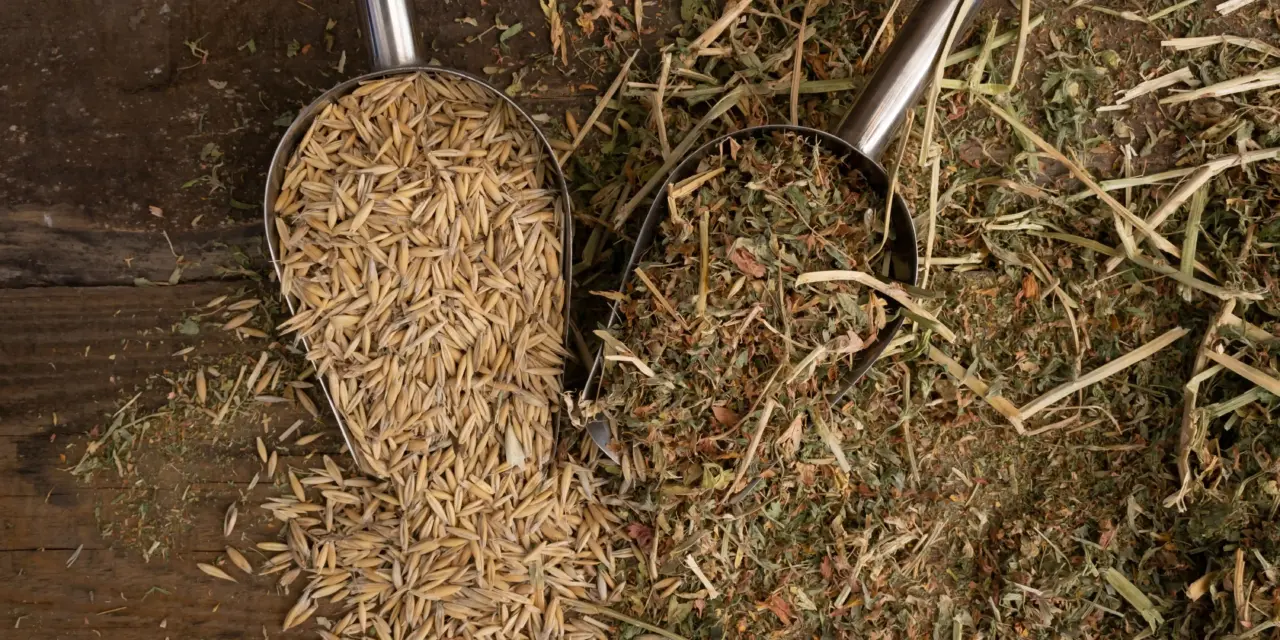
Oats are considered the gold standard of horse grains. They provide high-quality carbohydrates and protein, and most horses digest them well. Whole oats are more valuable than rolled oats, since rolled oats turn rancid quickly (and preservatives below certain limits do not need to be declared).
Barley offers similar nutrients to oats but is digested more slowly and should not be fed in large amounts. Rolled barley is more digestible than whole grains and becomes rancid more slowly than oats.
Corn is very popular in concentrates but contains low-quality protein and extremely hard-to-digest starch, which is why it is usually hydrothermally processed. This improves digestion but unfortunately increases allergy risk.
Wheat, rye, triticale, and similar grains, as well as pseudo-grains, are unsuitable for horses and should be strictly avoided.
Valuable Additives
Linseed (flaxseed) provides beneficial omega-3 fatty acids and mucilage that support digestion. Whole linseed, however, is poorly utilized because it is not chewed thoroughly; ground linseed goes rancid very quickly (again raising the recurring issue of undeclared preservatives).
Sunflower seeds provide high-quality oil, some protein, and vitamin E. Shelled sunflower seeds are more valuable than unshelled ones, as the shell is indigestible bulk that horses often chew poorly in mixed feeds.
Problematic Ingredients
Brewer’s yeast (Saccharomyces cerevisiae) is controversial in horse feeding. In livestock farming, it is used as a fattening feed because pigs and cattle gain weight faster – which is usually not desired in horses. If not fully inactivated, yeast may colonize the horse’s gut and trigger dysbiosis.
Carob contains large amounts of sugar and other easily digestible carbohydrates. While it can absorb some watery manure, it negatively affects blood sugar levels.
Molasses is added as a flavor enhancer and dust binder. It increases sugar content and makes feeds unsuitable for metabolically sensitive horses. Both sugarcane molasses and beet molasses are problematic and should be avoided.
Soy hulls are classic fillers with negligible nutritional value. They fill up the bag and cost money but provide no real benefit. The same applies to sunflower seed hulls, beet fibre, or finely chopped “permanent grassland growth” (= hay).
Wheat bran is a cheap bulk ingredient that horses unfortunately find very tasty. Large amounts become problematic due to its poor calcium-to-phosphorus ratio.
Unmasking Hidden Sugars
The Sweet Trap
Sugar often hides in horse feed under harmless names. Besides obvious molasses, sugar may appear as:
Beet pulp – dried sugar beet pulp still contains considerable sugar, even when marketed as a “structural component.”
Apple pomace – pressed apple residues contain concentrated fruit sugars and significantly raise total sugar content.
Carob – contains roughly 40–50% sugar.
Carrots – dried carrots are also high in sugar and problematic for sensitive horses.
Starch Can Hide Too
Many horse owners are now aware of sugar, but hidden starch is often overlooked. Starch is broken down into sugar in the small intestine and has the same negative effect on blood sugar – especially problematic for easy keepers and horses with insulin resistance or a history of laminitis.
Wheat middlings and wheat bran are by-products of flour production and contain significant residual starch (10–30%).
Rice bran is often marketed as “grain-free,” yet contains 15–30% starch and is frequently heavily loaded with preservatives.
Oat hull bran, another milling by-product, contains 15–25% starch. For comparison: whole oats contain 40–45% starch.
Recognizing “Grain-Free” Alternatives
Manufacturers who deliberately avoid high-grain and high-sugar formulations often use alternative components to fill the bag:
Alfalfa chaff is low in sugar and suggests high-quality protein – unfortunately, it is usually made from the low-protein stems rather than the nutrient-rich leaves and blossoms.
Hay pellets or chopped hay made from various grasses and herbs add bulk with very low nutrient density.
Linseed extraction meal – the defatted, rinsed press cake from flaxseed – is rich in protein and low in sugar, but usually contains preservatives. It creates good analytical values (crude protein, crude fat) without actually being a high-quality feed ingredient.
Recognizing Fillers and Bulking Agents
The Expensive Bag Fillers
Many commercial horse feeds contain a significant proportion of components that mainly add volume but contribute little nutritional value:
Structural chaff made from alfalfa stems, hay, or low-quality plant parts (such as nettle stems) fills the bag but offers poor value for money. Good hay would be far cheaper and far more nutritious. Additionally, these 2–4 cm green stalks cannot be chewed properly and can cause incorrect fermentation (dysbiosis) in the hindgut.
Beet fibres – whether from sugar beet seed shells or from beet pulp residues after sugar extraction – are similarly nutrient-poor. Marketed as “prebiotic dietary fibres,” they are essentially just expensive fillers.
Grape pomace or other fruit pomaces may sound appealing, but they primarily add bulk and residual sugar, while offering little nutritional benefit.
Regional and Seasonal Variations
Understanding Flexible Recipes
Some manufacturers adjust their formulas according to availability and pricing. This is not necessarily bad, but it should be communicated transparently. Phrases like “may contain,” “contains varying proportions,” or “depending on availability” are more honest than rigid lists that are not followed in practice.
Seasonal fluctuations in nutrient content of grains, oilseeds, and herbs are normal. Problems arise only when expensive components are quietly replaced with cheaper ones without adjusting the price. For example, it becomes nearly impossible for customers to detect when valuable nettle leaves are replaced with worthless nettle stems – yet both can legally be declared simply as “nettle.” For manufacturers, however, the cost difference is substantial.
Evaluating Country-of-Origin Information
Some manufacturers voluntarily provide origin information, such as “oats from German cultivation” or “herbs from certified organic farming.” These details are indicators of quality, even if not mandatory. However, anyone labeling a product as “organic” must ensure that every component truly meets organic standards.
In a globalized world, grains and many other feed ingredients are typically traded on international commodity markets. The oats in your feed bag may come from France, the barley from China, and the corn from the USA. The final product gives no clear indication of its origin.
Practical Tips for Evaluation
Analysing the Ingredient List
- Are the ingredients high-quality single feed materials?
- How many umbrella terms are used?
- What (hidden) sources of sugar and starch are included?
- Are there obvious fillers?
- How many “by-products” of the food industry are present?
Ask yourself:
Price–Content Ratio
A feed containing many high-quality single ingredients may justifiably cost more than one full of by-products. Conversely, a feed made largely of fillers should not be priced like a premium product.
The recommended feeding amount also reveals important clues: Large recommended portions indicate low nutrient density. Highly concentrated feeds require smaller servings and may even be more cost-effective in use. Therefore, it is more useful to compare cost per daily ration rather than cost per kilogram.
Recognizing Quality Manufacturers
Warning Signs in the Composition
Excessive umbrella terms suggest flexible recipes that vary based on market conditions. This is not inherently bad but makes quality and exact contents unpredictable. Many types of sweeteners indicate that flavour is achieved through sugar rather than through high-quality ingredients. Long lists containing many tiny quantities can indicate that various cheap components were mixed together instead of relying on a few high-quality ones.
The Truth Lies in the Details
The ingredient list is the most honest part of any feed label. Marketing language cannot be used here: either it lists “oats,” or it doesn’t. Anyone who learns to read between the lines and recognize weight-based tricks can reliably assess feed quality.
The rule is simple: Transparency beats marketing. Single ingredients beat umbrella terms. And less is often more.
A feed with five high-quality components is usually better than one with twenty ingredients of unclear origin. The time you spend studying the ingredient list pays off – through informed purchasing decisions and, ultimately, a healthier horse.