Laminitis in summer on a grazed down, dry field? That can’t be right!
As soon as the first growth has been grazed down, many yard owners turn their metabolically sensitive and laminitis-prone horses out onto the pasture, believing that “there’s nothing left there that could possibly trigger laminitis.”
The thinking behind this is understandable: the first flush of spring grass is highly nutritious and absolutely not recommended for many good doers, especially those with a history of laminitis. What’s often forgotten, however, is that grazed-down pastures are not necessarily any less risky.
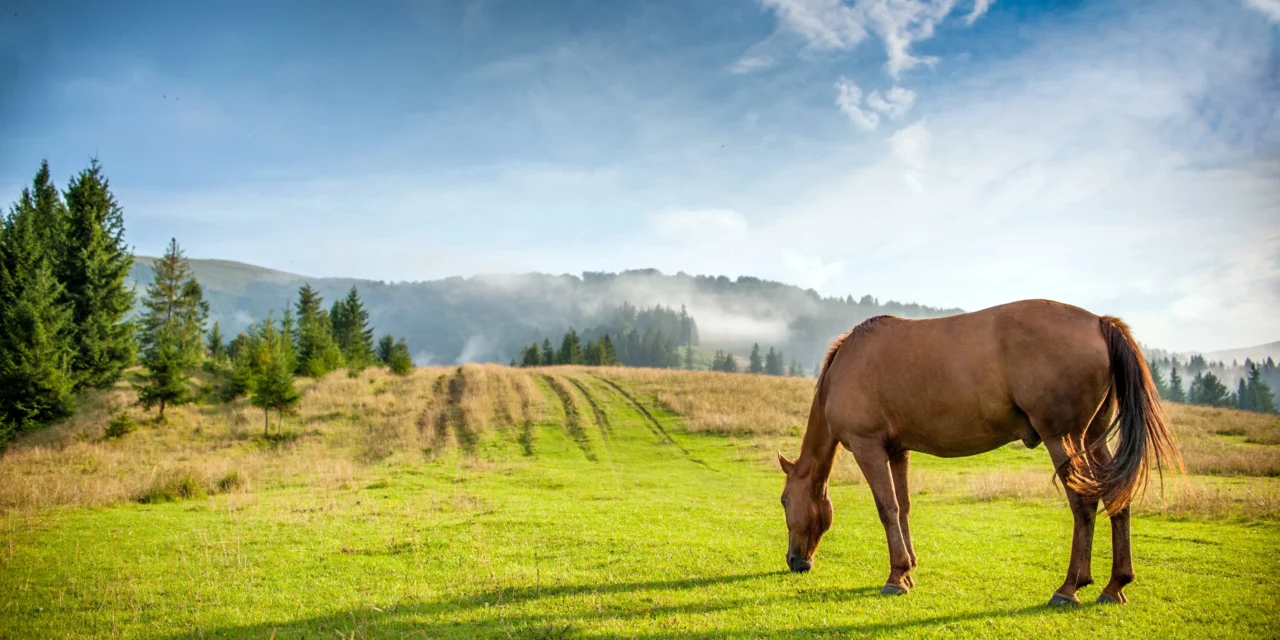
Horses normally graze grass down only to about 10–12 cm above the ground. They leave the rest and move on — but of course, that’s only possible if they can move on and aren’t stopped by a fence.
If horses have no alternative source of forage, they will graze the grass right down until nothing is left — something they would never do under natural conditions. This instinct not to eat grass down to the root is, in fact, a very healthy one.
This is because in the lower 10 cm of grass, the sugar content increases disproportionately. The levels of endophytes — microorganisms living symbiotically within the grasses and toxic to horses — also rise. If the pasture consists mainly of low-nutrient grasses and herbs, this is less of a problem, as the overall amount of sugar and endophytes per plant is comparatively low.
However, the more often you allow your pastures to be grazed right down to the sward, the more you drive out the delicate, less stress-tolerant low-nutrient grasses and herbs — and they won’t return the following year.
What spreads on these areas instead are stress-resistant “performance grasses” — also known as high-sugar grasses. Their seeds are carried in by wind, birds, or wildlife from neighbouring high-yield pastures and then establish themselves there.
And this is precisely where the problem lies: when these grasses are exposed to stress — such as being grazed down to the sward, drought, waterlogging, or trampling by horses on grazed-down areas — their already high levels of sugar, fructan, and endophytes increase dramatically.
At that point, even small amounts of these grasses that the horse nibbles at are enough to throw a compromised metabolism off balance and trigger laminitis.
This is why the rule applies to all horses — and especially to those with sensitive metabolisms: keep them off grazed-down pastures.
You’re doing neither the horse nor the pasture ecosystem any favours by leaving them on overgrazed land. If only small grazing areas are available, it’s better to turn horses out for shorter periods each day — ideally with a grazing muzzle — and rotate them frequently.
And even if it looks to us as though there’s still plenty of grass left, it’s better to move them off a little earlier and give the pasture a chance to recover.
Pasture management and ground care
With proper soil care, regular reseeding with low-nutrient grasses, and occasional rest years — when the land is used for hay or fresh forage production instead of grazing — pastures can be restored to a lower nutrient level and “de-stressed,” making the vegetation more suitable for horses overall.
Of course, turnout is invaluable for a horse’s mental wellbeing, and grass is an excellent source of nutrients. But it’s of little benefit if overgrazed or poorly managed pastures end up making the horses ill.
It’s better to keep horses in the turnout area with hay feeding, ideally adding branches and twigs from non-toxic trees and shrubs for them to nibble on. You can also cut strips of grass from the pasture and offer them in the hay racks as fresh forage — this approach allows you to control intake far more accurately than when horses are grazing freely.
If laminitis has already occurred, a vet should be called immediately, as it is — and remains — a potentially life-threatening condition.
Additional measures in the event of illness
At the same time, you can immediately give OKAPI HoofCool forte , which was specially developed to support acute laminitis. Cooling hooves in the first 48 hours is a quick way to reduce pain, whether with a water hose, placing the horse in a stream or a bucket of ice water.

When cooling with ice or cooling boots, be sure to check the temperature at regular intervals to prevent cold-related damage. Leeches have also proven effective, as they appear to relieve pressure within the hoof capsule and provide local pain relief.
There’s almost certainly an equine therapist in your area who offers leech therapy and keeps a supply of these slippery little helpers on hand — ready to come out quickly in an emergency.
Acupuncture can also provide quick relief and pain reduction, as can acupressure massage or Shiatsu. Please never put overweight laminitis horses on a crash diet to make them lose weight — due to their unique fat metabolism, this can lead to a life-threatening condition called hyperlipidaemia.
Horses with laminitis in an acute episode should — and must — be given an appropriate amount of hay (about 1.5–2 kg per 100 kg of body weight, offered over 24 hours, possibly mixed with straw and/or provided in a hay net), along with a salt lick and fresh water.
To support the stabilisation of newly formed hoof horn, OKAPI Zinc Plus and OKAPI Sulphur Plus (MSM) can be added to the diet. A handful of soaked hay cobs can be used to mix them in. All other feeds should be carefully reviewed.
Diagnostics essential
For horses prone to laminitis, it’s important to carry out diagnostic investigations alongside acute treatment and dietary adjustments to understand why they are so metabolically sensitive and react more quickly than others to even slightly inappropriate feeding. Common underlying causes include:
• an undiagnosed insulin resistance (where diagnostic errors unfortunately occur all too often, leading to false-negative results — meaning the insulin resistance remains “hidden” despite a seemingly normal blood test), which in combination with high sugar levels in the grass (performance grasses / high-sugar grasses, stressed grass) can have serious consequences.
• Dysbiosis (disrupted fermentation) in the hindgut, which, together with high fructan levels (caused by sunny days and cold nights, stressed grass, or performance grasses), can lead to sudden drops in hindgut pH — a trigger for endotoxin-related laminitis.
• Disruptions in the body’s detoxification processes, either due to suboptimal biotransformation in the liver (kryptopyrroluria, KPU) or subclinical kidney insufficiency, which is also often associated with long-standing insulin resistance.
• or a combination of these factors.
It is therefore advisable not only to manage feeding and turnout in a way that prevents laminitis from being triggered (for example, by keeping horses off grazed-down pastures), but also to carry out diagnostic investigations in parallel to identify the underlying causes of the horse’s laminitis tendency — and then address them with targeted therapy.
Once the metabolism is back in balance and the pastures are managed appropriately for horses, even these individuals can often return to grazing — in controlled amounts and, if necessary, with a grazing muzzle — as a valuable form of mental wellbeing.
Comprehensive information on laminitis is available here: Online Seminar on Laminitis